Monday, November 28, 2011

Thanksgiving Dinner at Chamorro Village


So Thanksgiving is over, and the first Sunday of Advent has arrived.  We still haven't finished the leftovers, and we didn't even read all of our Thanksgiving books (okay, the one we didn't read is the one with lots of text that intimidates my early readers, The Pilgrims of Plimouth), but we've put up some Christmas greens and placed the Advent wreath on the table with a new braided palm frond decoration.  We couldn't pack candles so I need to find some candles somewhere.  But even though Advent has begun, here's a rehash of helping out at the Salvation Army's Thanksgiving dinner, courtesy the Guam Pacific Daily News online since I didn't take any photos. The event was held at the Chamorro Village dining area, which wasn't nearly big enough for all the volunteers and participants. People arrived by nine for lunch at 11. Volunteers from the air force base were in charge of carving hams and turkeys donated by the local hotels.  Our family mostly served as runners from the carving stations to the serving stations, although we also helped carry food to the man'amkos, or elderly and  handicapped.  The servers were heaping the plates, and I feared that the food would run out. Even little kids were getting plates loaded with meat, red rice, stuffing, pancit, cranberries, corn, rolls, and other vegetables. And the desserts! But this must have been a case of the multiplying turkeys, because by the end of the day, after everyone had been allowed to go through the line again if they so chose, there was still food on the line, which was taken across the street to the soup kitchen to be made into stew.
Of the various performers, a couple of young brothers on ukulele's
were the most talented. They drew a crowd, including my two
youngest, sitting on the floor down front.


The serving line at Chamorro Village.
One of my kids is in the orange hat in the background


Perhaps not the most talented, but the most entertaining of the performers
was this couple. The husband, whose shoes and back were emblazoned with
"Elvis Loves You," seemed to have bones of cartilage. He danced like
Kermit the frog, only groovier. 
The lieutenant governor serves red rice, while my husband chats
in the background.
The Just Say No hiphop dance group.
A sampling of pies and cakes. Since I wasn't sure what time we'd
be back from serving, I invited people for dessert.
The turkey was so pretty I wished we had company
to enjoy it. Considering we've been eating it for 3 days
now, I figure it was enough to feed at least 24.

Friday, November 25, 2011

On Happiness

While shopping at the exchange book store a couple weeks ago, I came across the print version of The Happiness Project, after the blog by Gretchen Rubin about living out advice for happiness.  It was a cheap paperback, and the print was so small as to look blurry – or are my eyes aging? Reading that book would not make me happy; it would give me a migraine.

Anyway, the existence of this book seems to suggest that you can make yourself happy if you just do X, Y, and Z.  Keep your nails painted a happy color, organize your house, and set fresh flowers on the table - you’ll be happier than if you don’t.  Actually, after looking at the blog, I found that most of the advice is about being polite, smiling when you don't feel like it, and trying to make other people happy, which requires you to be happy yourself.  Start by telling yourself you're happy, and you begin to believe it.

But it seems that something is missing in the idea that happiness is something you can maintain for a length of time.  Isn’t happiness something of a fleeting emotion, not a state of being?  Maybe I’m spinning a different meaning for the word happiness than the author intends. Can you describe yourself as happy if you never are sad? Or if happiness is a case of living well, as Aristotle argues, then simply trying to live the examined life virtuously should be enough to be happy, or rather, content. Reminds me of that article I referenced some time ago about how people who seek their own happiness are sometimes unhappier than those who don't.

I have a problem with too much self-examination.  Am I happy now? Am I happy still? Why am I not happy?  I find myself most unhappy when I start asking myself these kinds of questions.  I can’t count how many times I’ve been asked if we like Guam.  I like Guam just fine when I am not thinking about whether or not I like it. But when queried, I can’t help but think of the things that could be better about it.  Not a lot of wildlife here, lots of rain, lots of potholes, lots of mold.  My husband calls this being pessimistic, especially when I mention it to people who might possibly entertain the notion of spending a few thousand dollars to come visit us, but I prefer the tag realistic.

The thing is, I don’t think about those things on a regular basis, especially when we’re out and about with other people or when they are hanging out at our house. We’ve gradually been adopted into a group of friends. We go to each other’s kids’ sporting events, we ate an early Thanksgiving dinner together, we hang out at the beach sometimes.  Last week we got together at Pizza Hut for a surprise party for one of the guys. It was just cake and pizza and all the kids chasing each other around while the parents talked, but it was fun. It made me happy. 

But I can wake up the next morning and make myself miserable just as easily by thinking about something I'm missing out on, or something I don't have or can't do.  I have to remind myself of that magnet that says, "Happiness consists not in being served but in serving others."

With Advent and the holidays approaching, happiness is much on the mind. How can I make this a happy season for the kids when they are not going to see their grandparents and cousins? They are not going to get all the toys on their lists. 


But we are planning to go to the school band concert and the hanging of the greens at the chapel, and we are semi-joking about wearing elf hats to carol around the neighborhood with these friends and then imbibe wassail and eat cookies together. This will thrill my youngers and make my elders plot ways to escape.

In the back of my mind I seem to remember my mom saying something about how her job wasn’t to make us kids happy. That’s actually a rather liberating feeling – my job isn’t to make my kids’ lives pieces of pie but to teach them to deal with what they are dished out. 

Don’t get me wrong – I don’t deliberately try to make them suffer, unless they’ve done something to deserve a dose of castor oil. And I waste a lot of time wrinkling my forehead trying to decide whether to let them do what they want to do or make them do what I want them to do, if it means a more frenzied schedule.

What I should ask myself before I give them something or give in to something is not whether this thing will make them happy, but whether it will add to, be neutral, or detract from what will help them live out their vocations.  I want them experience wonder and awe and joy on Christmas, but I don’t want those emotions to be tied to the gifts under the tree.  I’m trying to teach them to be loving and generous, to want to praise the greatness of creation and the Creator, to desire and attain eternity.  I want them to value excellence and beauty and truth.  And if that makes them happy, all the better.

Wednesday, November 23, 2011

Tarzan Falls and other things to be thankful for

Last weekend we drove about 4 miles, hiked about 40 minutes and ended up at this beautiful spot: Tarzan Falls.

Wild orchids are still blooming.

The top of the falls. This would have been pretty enough.

The teenagers trying to find a way down.

You can't really see it, but a little eel is stuck in the right arm of the Y-shaped crack.

A lesson in ingenuity and determination from a tree growing out of a rock.

Nature's spa.


Don't walk under the swarming wasps!
These are not the dreaded boonie bees that can sting repeatedly,
but some other large wasp.
Bromeliads along the way up. 


What I'm most thankful for.

Tuesday, November 22, 2011

What Would You Fight For?

Go Fighting Irish!
Their commercials might be better than the football team...


I admit partiality.... Dr. Fallon was one of the professors I studied with -- but that classroom is a lot nicer than the ones we used.

Sunday, November 20, 2011

Happy Feast of Christ the King

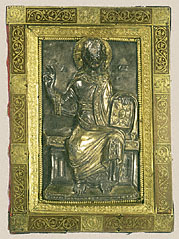
A Sacramentary from the Getty Collection.


I can’t believe it is the week of Thanksgiving.  The sun is shining. We went snorkeling and hiking in shorts this weekend. I have a sunburn.

I know it’s snowing back in the states. But out here, we’re still in perpetual summer. I guess I’ve noticed that the Halloween candy bins are now full of Christmas candy, and in the front of the commissary, there are flats of pumpkin pie filling, canned cherries, canned yams, flour and brown sugar, but the reality of the season hadn’t really sunk in until we were invited to a Thanksgiving dinner last week with friends who are traveling over the holiday. 

And now today was the Feast of Christ the King.  We have twice attended parishes called Christ the King, and the one we belonged to used to put together quite a celebration for the feast day, complete with a group from the symphony playing at Mass. The service today was much simpler, but moving, nonetheless. Our priest gave a stirring homily about serving Christ, in worship and in the poor, and preparing for Advent, but more memorable was the blessing he gave to his Sacramentary. As he closed Mass, he explained how he had been given this book 17 years ago by his parents and had used it every day since then.  He got a little choked up as he prayed over it, retiring it, after its last use this morning. I wonder what he’ll do with it when he switches to the new missal. 

He started incorporating some of the changes several weeks ago, and really the only one that trips me up is the “And with your spirit.”

So now my spirit needs to prepare for the holidays, as does my body. We went to the Exchange this weekend, and the kids picked up the toy catalog. They’ve been crafting wishlists for the past 24 hours, asking for junk that I don’t want in the house. For instance, although we have a great wooden kitchen set I scored at a garage sale years ago, my five year old was getting spun into a tizzy describing how on Christmas morning she was going to wake up and find a new Little Tykes walk-in kitchen. It would be the biggest present in the room, and I would think it was mine, but then her dad would say, no, that’s for her! I quashed her dreams, saying that Santa would not bring things that we already have. Nor would he bring any of those the ugly dolls advertised lately – Monster High and the button eye dolls?   The Exchange stocks the newest and most popular toys – not the finest quality.

But there are not many other places to shop.  One of the nice side-effects of living on a small island is that shopping opportunities are limited. I can’t just run to Target or Walmart for one thing and spend $100 anymore. While a number of wives complain about this, I find it liberating to no longer feel compelled to browse through dollar bins. I'm freed somewhat from buying what I don't want or need because it's on sale. But I'm fearful my kids may turn out like what Thomas Merton describes: 
The modern child may early in his or her existence have natural inclinations toward spirituality. The child may have imagination, originality, a simple and individual response to reality, and even a tendency to moments of thoughtful silence and absorption. All these tendencies, however, are soon destroyed by the dominant culture. The child becomes a yelling, brash, false little monster, brandishing a toy gun or dressed up like some character he has seen on television. His head is filled with inane slogans, songs, noises, explosions, statistics, brand names, menaces, ribaldries, and cliches. Then, when the child gets to school, he learns to verbalize, rationalize, to pace, to make faces like an advertisement, to need a car and in short, to go through life with an empty head conforming to others, like himself, in togetherness."

In order to liberate my children from the gimmes, I trashed the catalog after they went to bed tonight. I would like to liberate them from the idea that Santa will bring them whatever they want, but even though I don’t promote Santa fantasies, I can’t bring myself to disabuse the youngers of their beliefs, and the olders haven’t taken the opportunity to deflate their siblings’ dreams. Perhaps since we're talking about ancient Greece, I'll have them copy this from Socrates: "He who is not contented with what he has, would not be contented with what he would like to have."

Furthermore, I’m going to make them write their lists of what they are grateful for as a handwriting list.  They so quickly forget how much they already have.  Maybe we’ll cut up pictures to make a gratitude poster, or at least try to do some activity that diverts their attention for a short time from what they want to what others need.

Since we don’t have family within a few thousands miles, we’re going to go serve dinner with the Salvation Army this year, something I’ve always wanted to do. I’m even going to dry out our own turkey to consume after our shift at the Salvation Army. We’ve put out an open invitation to some friends and some single junior officers to join us. Maybe nobody will come, but at least I’ll have the motivation to scrub the bathrooms.

It won’t be the same as being with family, but we’ll gather some photos and paste the cousins and grandparents into our poster. At least they’ll be present in thought.

Thursday, November 17, 2011

Unguilty pleasures

I've been indulging again in juvenile fiction...

Firrst Word after Word after Word by Patricia MacLachlan -

Sometimes MacLachlan can be a bit too sweet. But I can't read her picture book All the Places to Love without crying, even when I'm not pre-menstrual. Her new chapter book for young readers was sentimental, but I was drawn into the story, and even better, my 9 yr old, who only wants to read Judy Moody or Harry Potter books, liked it.  Hurrah! Word after Word after Word is Maclachlan's response in novel form to "Why do you write" questions. I felt like I was in the classroom with the students, silent, listening to the mesmerizing voice of Ms. Mirabel.  My throat thickened when the fictional author dumps a bag of prairie dirt on the table and exclaims "This .... is landscape!"

Suddenly, I'm back home. I want to gather all that dirt up in my hands and shove it in my back pocket.  A touch of homesickness. A longing to return. The slightest twinge of regret that we didn't plunk down some theoretical cash for a rectangle of dirt in southern Indiana, and then pack some up in a Ziploc to bring along.

But here we are. And someday we'll miss here, I suppose. I appreciate that yesterday was one of those breezy, sunny days that brought hordes of kids out to the playground in the middle of November.  And I love the way you can just stick a twig in the ground, and it will sprout.  And nothing quite compares to the shock of discovery when you dunk your face underwater in the coral reef, and what looks like a bunch of rocks from the surface becomes a kaleidoscopic fantasyland of living creatures.

But the dirt is red here. If you dumped in out of a plastic baggie, it would thunk, all clumped together. It's clay.  It's resistant to movement.

Maclachlan admits in the author's notes that this book is somewhat autobiographical, and that she really has bags of dirt on her desk and next to her bed and in her pocketbook to remind her "of where I began as a child and the stories I brought with me." I have a friend who has a collection of sand in bottles from all the beaches she's visited.  Ms. Cash, the classroom teacher, has a bottle of ocean water. We've got quite a collection of little shells from past duty stations and vacations. But I wish I had a little bag of dirt to open and sniff every once in a while like a black organic drug, a sedative.

I suppose this emotional response was just what Maclachlan was after when she decided to write about words, "the writer's tool."

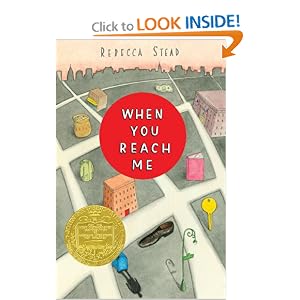
The other book I just consumed was When You Reach Me by Rebecca Stead, which was the Newberry winner a couple years ago, and the subject of a number of favorable reviews.  For a couple chapters, I questioned the reviews - the book is set in a gritty NYC apartment in the 70s, and the main character a sixth grade girl.  Where is this going to go? The way of Francesca Baby, that awful example of Scholastic after-school-special literature we had to read in 7th grade so we'd sympathize with children of alcoholics?

Fortunately, it doesn't go that way. Miranda, the main character, becomes more likable, and although the book starts out feeling like a melodrama, it makes a shift for the better. It's hard to describe without giving away the surprise plot element, which may be why it hasn't been selling like some of the fantasy fiction for preteens, a least that I know of. I wonder if kids who hadn't read A Wrinkle in Time would enjoy it though.

The apparent naturalism of this book did remind me of an reading by Norman Juster in honor of the 50th anniversary of The Phantom Tollboth on NPR last week.  He made the remark that at the time he had finished his book, publishers weren't interested in fantasy. They were afraid it would disorient children.  Now fantasy books take up 85% of the shelf space in the YA section.

And finally an unguilty pleasure that tastes like a guilty one: Chocolate Zucchini cake. A nod to the cuisine of my past. A guaranteed way to make kids like eating zucchini. Made some today in order to appease my twinge of homesickness.  A more appealing evocation of midwestern dirt than dirt.

Chocolate Zucchini Cake with chocolate chips:
1 c. sugar 
1/2 c. butter
2 eggs
1 tsp vanilla
2 1/2 c. flour
1/2 c sour cream (I used vanilla yogurt, since I didn't have sour cream)
1/4 c. cocoa
1 tsp soda
2 c. shredded zuke (I used two grocery sized - a little more than 2 cups)
6 oz. chocolate chips
1 c. nuts if you like them. 
Mix it all together and bake at 350 in a 13x9 pan for 40-45 mins or until done.
Can you see the zucchini?


Tuesday, November 15, 2011

St. Margaret of Scotland

Just because I liked this picture of Margaret, queen and  homeschooling mother of eight, yet never to busy to wash a dirty beggar's feet:

This one by William Hole from her rescue after shipwreck is pretty, too.

I like how she saw through her son's equivocation when he tried to protect her from the news of her husband's and elder son's deaths: "I know how it is."  (from here.)

Friday, November 11, 2011

Learning to read through metafiction

One of the delights of homeschooling has been discovering some new beginning reader books. Lately our favorite library books have been Mo Willems's Elephant and Piggie books.  Despite the antiquated, underfunded status of our library, it does have a section of brand-new books it receives through a grant program. These are loaner books, and my understanding is that after a period of time they will be passed on and a new set will arrive. By then, maybe we'll be tired of reading Elephant and Piggie, but maybe not.


My favorite so far.  Way better than Dr. Seuss. So much clever expression in so little text!


My five year old giggles just like elephant when she reads this.

And I'm happy she's enjoying reading a book about reading.

Tuesday, November 8, 2011

Proof of the Power of Positive Thinking?


There’s a facebook post going around that shows two photos: one of soldiers from WWII, and the other of Occupy Wall Street protestors.  The caption is something about how 20 yr olds in 1944 gave everything while 20 yr olds in 2011 want everything. It stood out to me because I just read a book about a WWII soldier and the nature of survival. I don’t care much about the Occupy Wall Street movement, because I don't understand what they want, and I don't think they do either, but I wonder if the perseverance of the protesters isn’t due so much to their dedication to the cause, as to the euphoria of hanging out together.  There’s a lot you can withstand when someone else is going through it with you.

Hence, I attend book clubs.  I like hanging out.  Usually the talk at the officer spouses’ club book group centers around upcoming events, the pros and cons of different duty stations, comparing lists of who knows whom, etc.  We might talk briefly about the book, especially if there’s a movie version.  But book talk usually expires quickly. Either people don’t read the book, or they share the same opinions of it or are afraid to voice a contrarian position.

Surprisingly, the talk at the first meeting of the book club here really stayed on topic – even despite the fact that there was delicious food to yum over.  Nearly everyone read the book, which also helped.

The book indirectly talks about the importance of camaderie for survival. It was Laura Hillenbrand’s Unbroken: A World War II Story of Survival, Resilience, and Redemption, the story of World War II survivor Louis Zamperini. The Wall Street Journal had run a big review when it was came out, but the review focused on the contrast between the author’s Chronic Fatigue Syndrome and her subject’s indefatiguable spirit.  Louis Zamperini is now an active 94, which is pretty incredible, considering what he withstood as a 20something.

I don’t usually pick up historical biographies, so I don’t know how this book compares to others, but it provides great fodder for conversation.  Is that because of Hillenbrand’s writing or Zamperini’s life? He did lead an incredible life, and he survived horrendous suffering during WWII.  But I’m sure there are other lives just as miraculous – in fact Hillenbrand notes several unpublished memoirs sent to her by other soldiers which she consulted for details about the Japanese prisoner of war camps and about the Army Air Force of which Zamperini was a member, as well as other information about experiences of war. Their stories are probably just as interesting.

Part of what we found interesting in discussion about Zamperini was his change from a rebellious teen to Olympic runner to airplane bombardier to prisoner of war, then alcoholic and, finally, convert.  He went from hopelessness to glory, back to hopelessness and to, hopefully, final glory.  Growing up in depression era Southern California, he stole and fought and ran around like a hooligan. Wait, he was a hooligan. His brother finally talked him into running track, which he did first to attract girls and then because he was good.  His training for the Olympics was amazingly brief, proof of his natural talent. He qualified for the 1936 Olympics in his third 5000m race, even though he was a miler at heart.  A favorite scene for me was when the Notre Dame coach came to Zamperini to wish him good luck. Six(ty) degrees of separation?  

When Pearl Harbor was bombed he joined the air corps, and survived several missions, before the plane he was on went down while on a rescue mission.  Miraculously, he and two other men survived the crash and then lived for 47 days in the life raft, without any stores of food or water. Think Life of Pi, which I thought incredible, until reading this.  One of the men dies, the one who was new to the plane crew, but Zamp and his best friend Phil keep each other alive, even battling sharks and fire from a Japanese plane.

They finally are rescued by the Japanese and taken to a war camp. Although they initially are nursed to semi-health, their POW experience goes from bad to worse.  The pictures in the book add to the drama.  Here are all these handsome young men who died.  The few POWs who survive the torture and deprivation narrowly escape annihilation when the war ends.

So the question debated was how did they survive?  Did Louis Zamperini have special physical and mental gifts that enabled him to overcome the suffering and setbacks he experienced, or did he channel an inherent ability to survive and remain positive that everyone possesses, although many people don’t use it?

One of the wives, who has overcome a snake phobia and taken up triathlons after being a lifelong coach potato was convinced that will power was the answer. And she believes that everyone could do more for themselves just by making up their minds to do it.

It’s an interesting question.  I wanted to agree with her. And I do, sort of.  People DON’t exercise their wills – or their bodies – nearly as much as they should or can.  I definitely agree that most people give up much too easily, not on life per se, but on exercise programs, reading, name your self-improvement program. I know I’m guilty of making resolution after resolution that I don’t follow through on just because I’m lazy and selfish. (Heck, I felt like I was going to expire from endless waiting at the DMV the other day. Torture!)

But I’ve also seen that it’s possible to decide to do something and do it, even though you think you may not be able to. Running a marathon for instance, or even just running a 5K.  Running a mile for some people. A person of average health should be able to will themselves to run a mile.

There are a lot of things that sound overwhelming, but can be accomplished simply by doing and not overthinking.  Learning a language. Moving is another one. Traveling with kids.  Cooking dinner.  Fixing a toilet flusher.  Waiting in line.

The lady who had the irrational phobia of snakes wasn't even able to go outside in snake season, from the time she was little. When she found out she was coming to Guam, she had to make herself look at snakes so that she wouldn’t be afraid to go outside. She went to see a therapist, but he wanted to talk about dreams, so she made up her own program to gradually get used to looking at snakes, including watching a snake show on tv, which she wasn’t able to do before, and buying a toy snake.

I tend to be skeptic about therapists.  Could people who are depressed cure themselves by getting outside and doing some hard labor, so they stop thinking about how bad life is?  Someone mentioned that the new thing is to tell returning soldiers that they shouldn’t accept a diagnosis of PTSD as a label because then they will allow themselves to use it as a crutch or an excuse to avoid change and responsibility. Could the same be said of some people who are diagnosed with depression, or, as Laura Hillenbrand was, with chronic fatigue symptom, or other disorders that are difficult to pinpoint physically?

Even though I agree to an extent with the lady who thought people hold the power of change in their mind, I tend to think that that there are people who are just wired differently.  The guy who dies in the boat when Zamp and Phil survive may have been one of them. Maybe he let himself die because he felt guilty about eating the one chocolate bar they possessed, or because he didn’t share the connection that the other two had. Maybe his will was weak, but maybe he just didn’t have a temperament that allowed him to stay focused on living.

Of course, men of all types of personalities survived the POW camps, despite sickness, beatings and deprivation.  Did Louis have an even stronger constitution to withstand the extra beatings he receives because he was an Olympic runner, or did he simply will himself to stay alive?

Can someone train themselves to be more positive? Can someone change their temperament through will and practice? 

The example that came up was the Navy wife who never is happy where she is stationed, versus those who make the best of it, who make friends and explore. In a way this is a question of survival.  If you don’t have a choice to pick up and move across the country or across the world, you do have a choice whether to enjoy it, or to be miserable thinking that everything is better somewhere else.

I like to pride myself on my endurance and tolerance for pain.  I can run and run and run. I can drag children across the world.  I can push six kids through a tiny hole into the world without pain killers and drag them in and out of ER’s and temper tantrums.  But could I survive the privations that Louis undergoes? Could I beat back sharks and catch and kill an albatross and eat it raw?  Could I stand up under repeating beatings and punishments while suffering from dysentery and starvation?  Then overcome alcoholism and flashbacks in a single conversion moment? Is that a miracle? Was Louis Zamperini given extra gifts from God, or was he just good at using the gifts God gave him?

Sunday, November 6, 2011

Adventures with Tofu

As I showed my ID to the checker at the commissary last week, she announced, “Cases of tofu for $1.”  Behind her on a flat were about two dozen cases of tofu. 

I had passed by and was headed to the produce section before what she said registered.

Cases for $1.

I don’t have any love for tofu. Does anyone? I knew what my husband would say when he saw 12 packages of tofu in the refrigerator. But $1!?!

No one else was picking them up, so in an effort to be a good steward and help the commissary dispose of their overstock, I added a case to my cart.

It has been well worth $1 to experiment with this gelatinous soybean product.  The first package went into a traditional stir-fry: frozen mixed vegetables, soy sauce, sesame oil, chunks of tofu. Everyone complained, but they ate it, albeit reluctantly.

The second box went into a smoothie: frozen mixed fruit, milk, OJ, tofu, a couple packs of stevia.  My teenagers and their friend sucked them down. I didn’t tell them until later what was in them.  At first my 14 yr old berated me for hoodwinking them, but I tried to remind him that tofu is good for building muscles.

Another box got mixed into a batch of chili. I thought the tofu would take on the color of the tomato sauce, but it stayed whitish. So I told the kids those white chunks were like pieces of cheese.  The 5 and 7 yr olds were deceived, and the older kids kept the silence because they were hungry and the tofu was in small enough chunks not to be noticed.

Box 4 went into chocolate mousse.  I loosely followed a recipe my vegetarian friend gave me after I gave her 5 boxes of tofu.  And actually, this mousse is pretty tasty and a nice texture. And easy! Melt chocolate chips and then add melted chocolate, the tofu, a couple tablespoons of cocoa to the blender with a sweetener and blend until smooth and fluffy. Then chill a couple hours before devouring. The recipe calls for maple syrup, but I didn’t have any. I thought it would be ruining the integrity of the tofu to use corn syrup, so I used my last teaspoon of honey, a little molasses and some stevia packets. Unfortunately, the molasses taste is noticeable, but not enough to slow anyone down from eating this fluffy stuff. I can barely call it dessert. It’s nutritious!

So now I’m down to my last couple packets of tofu.  At least one will go into another smoothie tomorrow afternoon.  Suggestions for the last box?

Thursday, November 3, 2011

Stepping back in time

My son stood over my shoulder while I was typing this, and asked what I was writing. "Is that a book report?" he asked. Of a sort, I replied. 
"You're writing a book report because you want to?!" He spoke with disbelief.
Dear son, maybe someday you'll read books you want to talk about, too. 
*******
The library on base is a step back in time – not just because it shelves histories, but in the use of the card catalog, the date stamp, the way they manually check out books by signing your name on a card.
It also has a nice collection of classics in heavy duty binding left over from the 1960s – and before.  The materialistic bibliophile in me loves the heavy paper stock that is imprinted by the type, the musty smells, the indestructible covers, the black and white illustrations.  Gotta love the substance in these books too. Just finished two – one that I read in high school: Goodbye, Mr. Chips by James Hilton, and one I just saw mention of somewhere: Mrs. Mike by Benedict and Nancy Freedman.
Both of these books would send someone who deplores the reek of sentimentality running. Goodbye, Mr. Chips makes a lot of lists of classics, but I hadn’t heard of Mrs. Mike, and maybe I dreamed about reading a review of it because I can't find it now. (It is here!) But sometimes sentimental is what you’re in the mood for: a good story about good people told cheerfully. No Oprah Book Club melodrama. Just happy tales that both happen to hit on a similar theme: that suffering is not something to be avoided, but something that makes you who you are.
I won’t rehash Mr. Chips, since the story is familiar. When I initially read it, it fueled my desire to experience British boarding school – the kind of desire that I suppose is now initiated by Harry Potter books.  But I remembered little about Mr. Chips the man, and what a good sort he was, despite being a bit mundane.  He recognizes that the kind of greatness he can achieve, a minimal kind but something nonetheless, requires faithfulness in the little things: having students over for tea, eating with the faculty, doing your job as well as possible, even if not in a flashy way.
All with a good sense of humor.
Although his life is quiet, Mr. Chips is not without his tragedy: the loss of his wife and child.  Perhaps if Mrs. Chipping had lived, Mr. C might have been an even better man. But even in the brief time she shared with Mr. C and the academy, she changed him, and some of the other faculty.  Her death could have derailed him. The death of all his students in the wars could have demoralized him.  The attempt of a young headmaster to fire him could have doused his spirit. But he perseveres in being the kind of man he is, nothing more, nothing less.  And he is loved for it.  (Which is similar theme #2: people have more effect on your life than you realize even if you only meet them briefly.)
While many people apparently believed the imagined Mr. Chipping was a real person, Mrs. Mike, Katherine Mary Flannigan, actually was a real girl, even though I initially thought she was pure fiction.  I googled the book to see where I came across the reference (and didn’t find it), but I found a few testimonies about how beloved this book was by women of a certain age. Apparently, it has had a resurgence of interest with the advent of internet recommendations, and has had a reprinting.
Maybe the book isn’t first class literature, but I will add my name to its list of fans.  The story is episodic, like a Little House book for grownups, or a teenaged Caddie Woodlawn set in Canada. But the effect is that all the episodes add up to make you feel like you’ve been in northern Canada yourself. I think I could begin to understand Cree.  I had to sit in the car an extra fifteen minutes after soccer practice yesterday to finish it. And then I wanted to go back and reread the best parts. 
Initially, I thought that Mrs. Mike – Kathy - was too obvious and too chipper.  She’s a spunky Irish lass sent to her uncle in Canada to recover from pleurisy. She meets a handsome Mountie named Mike Flannigan, and falls in love with him while pretending to disdain his flirtations.  Within weeks they are married, surprisingly quickly considering she’s only sixteen. And right after their wedding they head up to the uncivilized north to Mike’s station.  It happens so fast, you almost forget to think how unlikely that should be.


But as impetuous as her decision to marry and follow Mike Flannigan is, Kathy is steadfast in her love.  If initially, she is all cheer and good humor at the beauty she sees all around, she begins to notice the ugliness: mad women sent away, dead men in the snow, Indian women called “klooches”  beaten and berated.  Her husband Mike is a realist, and where she sees injustice, he sees why the women stay around.  He intuits honesty and dishonesty in the people who come to him to arbitrate their disputes.  He doesn’t fear doing his duty, whether it be pulling a tooth, fighting a fire, or sawing off a leg.

As Kathy grows into adulthood, her innocent idealism fades away, and she becomes more interesting. The struggles she experiences and witnesses become more poignant, and Kathy becomes more dimensional.  She meets another white woman whose children keep dying.  Kathy calls her “a mother of sorrows.” But the woman remains unbroken.  

Kathy also realizes that the Native women are not all abused.  She takes in a young girl from the mission orphanage, and promises the nuns that she will keep the girl safe from a young halfbreed, Jonathan, who is in love with her.  The young man is the son of a rebellious father, and he has run-ins with the law. But as Kathy and Mike learn about his background and his character, they realize he values honor and dignity, especially after he takes the blame for a murder that a mad woman committed, rather than put her in trouble and defend himself.  Eventually, Kathy understands why her young friend, Mamanowatum, or “Oh-Be-Joyful,” is in love with the young man, and she allows them the freedom of belonging to each other.

Kathy suffers her own tragedies, and even at one point leaves Mike.  So although the book starts out with the two of them so happily married and so perfectly suited to each other, and it seems that it will simply recount their adventures, it does take a dark turn.  Sorrow drives the two of them apart, and Kathy goes back to her mother.  But she realizes she doesn’t fit in city life anymore.  The insignificance of some of the arguments she witnesses between her mother’s boarders amaze her. Their pettiness seems pale beside the disease and destruction she has experiences. She realizes she has grown to love the north, and has become a different person, one who can’t run away from her sorrows, and so she returns.

The book ends on a hopeful note, of course. Jonathan reappears at the end of the book, bringing the sorrowful news that Mamanowatum has died.  He brings their baby to Kathy and Mike to raise. The mother had named the baby Kathy, after her “almost-sister,” even though they hadn’t seen each other for 8 years.  Kathy welcomes the baby, but mourns her friend, especially since her other friend has also just died.  She contemplates how their lives have intersected, even when they weren’t in communication. “You could see that events were like the people they happened to. Oh-Be-Joyful’s life had always had that intense emotion and pathetic grasping after happiness that my mother said was characteristic of those ‘who are not long for this world.’ Perhaps on another day I would laugh at this and consider it superstition, but this day, watching Oh-Be-Joyful’s baby in Mike’s arms, I saw the pattern too. . . . Oh-Be-Joyful had cared for and loved my children, and now it was I who was to care for and lover hers. Mike was right: the pattern of a life isn’t a straight line; it crosses and recrosses, drawing in and tying together other lives, as I do when I gather in the ends of my thread to make a knot.”    

Kathy realizes that even though she has suffered much, she has also had great joy, even if just for a little while. And the remembering of those pleasures, especially of her lost children, brings more pleasure than pain.

To be honest, maybe the reason I loved this book is that it is so easy to identify with Kathy: marry young and idealistic, take off on an adventure, meet with hardship, but recognize the heavier suffering that so many others have, meet people you grow to love, lose them, feel like throwing in the towel, but finally realize that all these experiences are fitting into a pattern that is more amazing than can be predicted, even if the book is predictable like the happy ending we all hope for.
Reading is one form of escape. Running for your life is another.
-Lemony Snicket