Wednesday, February 19, 2014

Following along with The Immediate Book Meme

Linking up with the Darwins on a reading meme. Can't resist these...


1. What book are you reading now?

A Room with a View - E. M. Forster
Thy Will Be Done: Letters to People in the World - St. Francis de Sales
Five Little Peppers and How They Grew - Margaret Sidney

2. What book did you just finish?

Morrissey autobiography (not worthy of Penguin Classic status!)
Mansfield Park - Jane Austen
Charlotte's Web - E. B. White
The Lost Boy - David Pelzer

3. What do you plan to read next?

Need suggestions! Something holy for Lent and something fun to get through last weeks of pregnancy

4. What book do you keep meaning to finish?

Woman - Edith Stein

5.What book do you keep meaning to start?

Story of a Soul - St. Therese Lisieux
Boswell's Life of Johnson
Bleak House - Dickens

6. What is your current reading trend?

A little bit of something spiritual (stashed in the bathroom) for morning/evening reflection,
classic novel alternating with contemporary fiction/memoir, and
something with the kids

Tuesday, February 18, 2014

Prescription: Jane Austen

Perhaps all the world needs to be a brighter place is an injunction to read Jane Austen once a year or so.  Ah, pastoral escapism at its finest!  I just finished  Mansfield Park, and life feels much lighter and more satisfactory.  I spent several days ignoring the news and current events and everyone else's crises, and now feel refreshed and certain that despite the conniving of shallow people, sometimes the right people end up together.

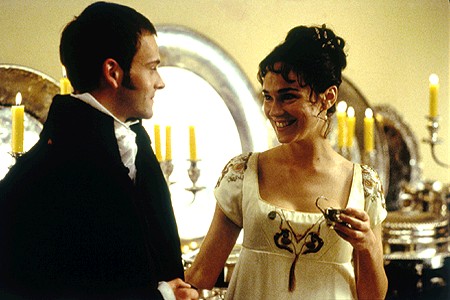
To be honest, I don't think I've ever read the whole of this novel before, although I thought at first I was rereading. I remember reading part of it years ago - high school, college? - and not finishing.  Then I watched the movie that came out in 1999 directed by Patricia Rozema. Mistake. This movie is takes egregious liberties with the original work, and gave me a mistaken impression. I should have known the film was derivative, but in my mind I had this feeling that Mansfield Park was the "dark" Jane Austen.  The characters may not be as engaging as the Bennets and the Dashwoods, and the plot a little thinner, but I'm glad I finally read it instead of thinking I knew the story from the film.  It pays to read first, watch second. I kept waiting for the dark secrets suggested in the movie to come to light in the book. Of course, they never appeared.

So why do filmmakers feel it necessary to add drama and darkness to a book that is enjoyable enough without the suggestion of perversity?  Would modern audiences really be bored with the story the way Austen tells it?

Surely the scriptwriters are mistaken that audiences want darkness. Judging by what I've read in response to some of the events on Downton Abbey, viewers would be happier if the scandals and surprises were toned down. The acting, dialogue, and cinematography are gripping enough without the writers needing to go to great lengths to keep the viewers in emotional turmoil. In fact, I haven't been watching because I read some spoilers and didn't want to be strung along for weeks waiting for resolutions.  I'd be a bigger fan of Downton if the writers DIDN'T sensationalize the script.

Likewise, Austen's book needs very little drama to be intensely readable.  Her characters and dialogue are interesting enough without excessive plotting.  There's drama in reading about Fanny Price's emotional maturing.  The suspense of wondering whether Edmund Bertram will have his eyes opened or whether Henry Crawford truly has turned a corner keeps you page turning.  Austen adds more suspense by developing her characters enough to keep you wondering whether Fanny's judgment regarding Mary Crawford's shallowness and Henry's flirtatious nature is just.  Their character flaws are masked by attractive characteristics: they're entertaining, they show compassion, they seem to do the right thing most of the time, they bring a spark of life to the party - all the things that make them easy to love, especially when countered with the sometimes dull life of the estate. It's just that every once in a while they reveal a shallowness and selfishness that will probably grow over time instead of lessen. Austen had me wondering if Fanny's goodness could make Henry into a good person, even though I knew the end of the story - would he really give up his careless flirtations if he were wed to just the right person?

Meanwhile in the movie, the characters experience little interior change.  Drama is provided by Sir Thomas' involvement in the slave trade and the suggestion that he behaved criminally to his chattel.  Where Austen suggests immoral behavior on the part of Maria Bertram and Henry, the movie shows it.  Fanny is more independent and energetic in the film than in the book. (Perhaps one change that I don't disagree with - Fanny in the book is extremely shy and unhealthy in the beginning. Does she not translate to the screen well as a heroine because she is too good?)  And the filmmakers exaggerate all the flaws of the Bertram women to make them less likable - which highlights Fanny's attractiveness. Lady Bertram appears as a drug addict. The sisters are hateful to Fanny. Tom, the older brother, is a gambler and spendthrift. And you can see Maria and Henry plotting. It's almost too obvious what will happen.  But I have to admit, the movie is easy to watch - great acting, beautiful scenery and costumes, good chemistry. It's just not Jane Austen's book.

Wednesday, February 12, 2014

Pregnancy journal - third trimester

My due date is just 7 weeks away. Far enough in the future that labor doesn't feel imminent, but close enough to feel like it's time to start getting ready. Or at least to think about getting ready. I'm tired of maternity clothes but determined not to buy any more after I just bought a formal dress for the military ball in three weeks. (Great deal on clearance at Ross!) I should probably start washing baby clothes - I have a decent sized bag of hand-me-downs waiting to be organized and there are some itty-bitty onesies and sleepers mixed in with the girls' doll clothes that I need to rescue and wash. The car seat returned by my sister-in-law also could use a wash down - and a good inspection to make sure it hasn't been compromised by spending a few years in a garage.

What else needs to be done? Set up the crib some friends gave us and wash the sheets, of which I still have a couple. Start a shopping list to which to add waterproof mattress covers and changing pads (and possibly a new carseat).  Decide about diapers: I'm tempted to try cloth again. We used cloth with the first 3 boys, but when our third was about 6 months old, we moved and lived in temporary housing for about 6 months. The convenience of disposables won me over. Plus, I had begun to feel that the abundance of laundry - not just the diapers themselves, but the leaky clothes and the wet sheets - was creating a drain on resources. I know cloth diapers are much more absorbent and convenient to use now, but our water bill is our largest utility cost here in California, so I haven't yet decided which diaper form to use.

To add to my indecision, I looked up cloth diapers online and was overwhelmed by the choices. So many brands! So many designs! What works best for the least amount of money? If I knew another child would be using these, I would be more willing to invest. On the other hand, I notice that a week's supply of disposables is about $35 now.  This baby will spend a lot of time on the go with her multiple siblings' activities - do I want to pack wet nappies in plastic bags with us? Any recommendations?

Another quandary: we still haven't decided on a name. We are still getting suggestions: "Nola" and "Adelaide" are the two newest. We know three new baby girls: a couple from church just had a Francesca, another had Vivian Louise, and the third new baby in our circle of friends is Christine Elizabeth.

Who does this baby look like?
32 weeks. Going to need braces for that overbite?

This is my most recent ultrasound image by the perinatalogist, who lectured me about having too much amniotic fluid, an indication that my gestational diabetes is not as firmly under control as I thought.  "The baby will come out crying 'Where the hell is my sugar!'" he warned if I don't watch my intake.  And this weekend brought two brunches and two large dinners with company, so my eating habits were compromised. I'm craving chocolate right now, as a matter of fact.

The baby is normal sized but extremely active. I'm sure she's busier than the other kids were in utero. So I've been having anxieties that she has some kind of neurological disorder, and she'll never sleep.  Maybe it's my sugar levels?

Other that her extreme activity and my extreme tiredness by about 7 pm, we both are healthy. Although I fall asleep on the couch every night, I still feel relatively normal during the day. I have already gained 30 pounds and am starting to develop varicose veins, so I'm also nervous about blood clots and my ability to stay active for the next couple of months. After our busy weekend, I bribed my kids to rub my feet and ankles with the promise that whoever rubs my feet the most gets to hold the baby first.  Another perk of being pregnant while having older kids. Their attention to my roiling stomach gets a bit annoying at times (please stop poking my belly!), but for the most part I am touched - bad pun - by their attentiveness and excitement about meeting their baby sister.  I'm excited, too, - the next couple of months will be a test of slow time.
This is how I feel at the end of the day: like a resting harbor seal we saw on a recent boat outing.

Monday, February 10, 2014

Pessimism/Optimism

My husband came home with news the other day that a friend from college was in a rehab center for alcoholism and anorexia.  Wait a minute. I thought I got a happy-looking Christmas card from that family with photos of their four cute kids...

Turns out our friend's husband has been managing for a few weeks with the help of a babysitter and family members to work and run the house.  I don't know how long she'll be in rehab or how long after that her real recovery will take.

And what I really don't know is whether or not I write to her. "Hey I heard this about you. Just wanted to let you know you're in my thoughts and prayers!" Would it be a comfort or proof that the gossip network spreads far and wide?

I can't say I'm surprised that this friend suffers from anorexia.  All of my college friends had weird eating habits. We were high achieving college student-athletes.  The alcoholism part is a bit of a surprise, but I could certainly understand how anyone in a similar situation could drawn into a substance abuse problem. There are a number of our friends/acquaintances who probably also need to cold turkey quit some substance or another. I tend to think most people have secret vices they barely have under control.  So it doesn't surprise me that much to hear about abuse, infidelity, addiction, etc.

My husband and I have an ongoing discussion about whether this makes me a pessimist. I like to think I'm a realist - Sin exists and everyone sins.  War, poverty, disease and criminal behaviors are never going to disappear.  We're at the age when marriages start falling apart.  Not as much fun as the post-college "Everyone's Getting Married" stage, or, a few years later, "Everyone's Having Babies" stage.  Now it's the "Who's Next in the Line for the Counselor" stage.  Unfaithful spouses, substance abuse, children getting into trouble with the law, parents getting sick and dying.  The next decade is when we earn our wrinkles and gray hair. The future sometimes look bleak.

While it doesn't surprise me to hear about people having problems, usually of their own making, I'm not sure this makes me a pessimist. I also have this sort of expectation that people are usually more fascinating - more intelligent, more talented, more together - than they usually are. Easy to assume about people in the internet world: everyone presents their best side to the camera.  But I also assume it about the people we meet. And sometimes it's true - we've met some people with really great stories and experiences.

Nonetheless, usually people are a lot more normal than I anticipate. Their houses aren't always perfectly clean. They forget things, they lose their cool with their kids, they may have had a homebirth but they feed their kids McDonald's. And sometimes they are alcoholics or embezzlers or unfaithful.  No matter how often I witness or experience failure, I still don't think I expect it as a pessimist would. It's not surprising that most of our efforts fall short of our goals or that sometimes we fall into deep pits of despair and disappointment and disillusionment, but rather than throw up our hands and quit trying, we dust ourselves off, try to crawl out of the pit, and try again to live a faithful life. Even better is when we try to help each other up.

Besides, there would be no stories without conflict or suspense or impending disgrace, without a potential redemption in sight.  That is the end of the story, right? That's why it's not pessimistic, but Christian, to expect failure and shortcomings and disappointments, as long as you equally expect people to survive, to endure, to be broken and then healed.  I do believe my friend and her husband will endure this difficult time.  Maybe it will take years. They won't be the same people. Their children will suffer, too, but they will, hopefully, learn about forgiveness and mercy and the need for grace.

The need for grace is why we get married after all - not because we believe in fairy tales of happily ever after, but because we believe life is a struggle and we need a companion who holds our soul's sanctification dear, someone who will be Christ to us, someone who will forgive us over and over and over. I admit, I was perhaps more optimistic about marriage as a newlywed, but I also knew that marriage was not just about the pretty pictures - plenty of people warned us about the "work" of marriage.

Here's Pope Francis from last October's pilgrimage of families:
And that is what marriage is!  Setting out and walking together, hand in hand, putting yourselves in the Lord’s powerful hands.  Hand in hand, always and for the rest of your lives. And do not pay attention to this makeshift culture, which can shatter our lives.


With trust in God’s faithfulness, everything can be faced responsibly and without fear.  Christian spouses are not naïve; they know life’s problems and temptations.  But they are not afraid to be responsible before God and before society.  They do not run away, they do not hide, they do not shirk the mission of forming a family and bringing children into the world.  But today, Father, it is difficult…  Of course it is difficult!  That is why we need the grace, the grace that comes from the sacrament!  The sacraments are not decorations in life – what a beautiful marriage, what a beautiful ceremony, what a beautiful banquet…But that is not the sacrament of marriage. That is a decoration! Grace is not given to decorate life but rather to make us strong in life, giving us courage to go forwards! And without isolating oneself but always staying together. Christians celebrate the sacrament of marriage because they know they need it!  They need it to stay together and to carry out their mission as parents.  “In joy and in sadness, in sickness and in health”.  This is what the spouses say to one another during the celebration of the sacrament and in their marriage they pray with one another and with the community.  Why?  Because it is helpful to do so?  No!  They do so because they need to, for the long journey they are making together: it is a long journey, not for a brief spell but for an entire life! And they need Jesus’ help to walk beside one another in trust, to accept one another each day, and daily to forgive one another.  And this is important!  To know how to forgive one another in families because we all make mistakes, all of us! Sometimes we do things which are not good and which harm others. It is important to have the courage to ask for forgiveness when we are at fault in the family. Some weeks ago, in this very square, I said that in order to have a healthy family, three words need to be used. And I want to repeat these three words: please, thank you, sorry. Three essential words! We say please so as not to be forceful in family life: “May I please do this? Would you be happy if I did this?”.  We do this with a language that seeks agreement. We say thank you, thank you for love! But be honest with me, how many times do you say thank you to your wife, and you to your husband?  How many days go by without uttering this word, thanks! And the last word: sorry. We all make mistakes and on occasion someone gets offended in the marriage, in the family, and sometimes - I say - plates are smashed, harsh words are spoken but please listen to my advice: don’t ever let the sun set without reconciling. Peace is made each day in the family: “Please forgive me”, and then you start over. Please, thank you, sorry!  Shall we say them together? [They reply “yes”] Please, thank you and sorry.  Let us say these words in our families! To forgive one another each day!

Please, thank you, and sorry.  Again and again. To each other and to God.

I also started reading Evangelii Gaudium, finally.  Pope Francis begins by acknowledging the darkness in the world:

 2. The great danger in today’s world, pervaded as it is by consumerism, is the desolation and anguish born of a complacent yet covetous heart, the feverish pursuit of frivolous pleasures, and a blunted conscience. Whenever our interior life becomes caught up in its own interests and concerns, there is no longer room for others, no place for the poor. God’s voice is no longer heard, the quiet joy of his love is no longer felt, and the desire to do good fades. This is a very real danger for believers too. Many fall prey to it, and end up resentful, angry and listless. That is no way to live a dignified and fulfilled life; it is not God’s will for us, nor is it the life in the Spirit which has its source in the heart of the risen Christ.


3. I invite all Christians, everywhere, at this very moment, to a renewed personal encounter with Jesus Christ, or at least an openness to letting him encounter them; I ask all of you to do this unfailingly each day. No one should think that this invitation is not meant for him or her, since “no one is excluded from the joy brought by the Lord”.[1] The Lord does not disappoint those who take this risk; whenever we take a step towards Jesus, we come to realize that he is already there, waiting for us with open arms. Now is the time to say to Jesus: “Lord, I have let myself be deceived; in a thousand ways I have shunned your love, yet here I am once more, to renew my covenant with you. I need you. Save me once again, Lord, take me once more into your redeeming embrace”. How good it feels to come back to him whenever we are lost! Let me say this once more: God never tires of forgiving us; we are the ones who tire of seeking his mercy. Christ, who told us to forgive one another “seventy times seven” (Mt 18:22) has given us his example: he has forgiven us seventy times seven. Time and time again he bears us on his shoulders. No one can strip us of the dignity bestowed upon us by this boundless and unfailing love. With a tenderness which never disappoints, but is always capable of restoring our joy, he makes it possible for us to lift up our heads and to start anew. Let us not flee from the resurrection of Jesus, let us never give up, come what will. May nothing inspire more than his life, which impels us onwards!

Without Christ, I would be a pessimist. But although my faith waivers often because I am so frequently caught up with my own "interior life" that crowds others out, including God, I know I have witnessed healing and redemption, and the reality of these "resurrections" confirms my belief in the goodness and grace of God.

I don't know if I'll write to my troubled friend or not. Perhaps I lack courage, though I tell myself I don't want to embarrass her. But I have thought and prayed for her. And I'm optimistic about her recovery.

Tuesday, February 4, 2014

More Kinnell

It's been a busy week. I've started a post or two, but since I haven't had time to finish them, here for your reading delight are a couple more poems by Galway Kinnell from the Academy of American Poets website. The first is in honor of having finished reading Charlotte's Web with the youngers last night.

Saint Francis and the Sow
The bud
stands for all things,
even for those things that don't flower,
for everything flowers, from within, of self-blessing;
though sometimes it is necessary
to reteach a thing its loveliness,
to put a hand on its brow
of the flower
and retell it in words and in touch
it is lovely
until it flowers again from within, of self-blessing;
as Saint Francis
put his hand on the creased forehead
of the sow, and told her in words and in touch
blessings of earth on the sow, and the sow
began remembering all down her thick length,
from the earthen snout all the way
through the fodder and slops to the spiritual curl of the tail,
from the hard spininess spiked out from the spine
down through the great broken heart
to the sheer blue milken dreaminess spurting and shuddering
from the fourteen teats into the fourteen mouths sucking and blowing beneath them:
the long, perfect loveliness of sow.
- See more at: http://www.poets.org/viewmedia.php/prmMID/19852#sthash.xXLJPlql.dpuf

Why Regret?
Didn't you like the way the ants help
the peony globes open by eating the glue off?
Weren't you cheered to see the ironworkers
sitting on an I-beam dangling from a cable,
in a row, like starlings, eating lunch, maybe
baloney on white with fluorescent mustard?
Wasn't it a revelation to waggle
from the estuary all the way up the river,
the kill, the pirle, the run, the rent, the beck,
the sike barely trickling, to the shock of a spring?
Didn't you almost shiver, hearing book lice
clicking their sexual dissonance inside an old
Webster's New International, perhaps having just
eaten out of it izle, xyster, and thalassacon?
What did you imagine lies in wait anyway
at the end of a world whose sub-substance
is glaim, gleet, birdlime, slime, mucus, muck?
Forget about becoming emaciated. Think of the wren
and how little flesh is needed to make a song.
Didn't it seem somehow familiar when the nymph
split open and the mayfly struggled free
and flew and perched and then its own back
broke open and the imago, the true adult,
somersaulted out and took flight, seeking
the swarm, mouth-parts vestigial,
alimentary canal come to a stop,
a day or hour left to find the desired one?
Or when Casanova took up the platter
of linguine in squid's ink and slid the stuff
out the window, telling his startled companion,
"The perfected lover does not eat."
As a child, didn't you find it calming to imagine
pinworms as some kind of tiny batons
giving cadence to the squeezes and releases
around the downward march of debris?
Didn't you glimpse in the monarchs
what seemed your own inner blazonry
flapping and gliding, in desire, in the middle air?
Weren't you reassured to think these flimsy
hinged beings, and then their offspring,
and then their offspring's offspring, could
navigate, working in shifts, all the way to Mexico,
to the exact plot, perhaps the very tree,
by tracing the flair of the bodies of ancestors
who fell in this same migration a year ago?
Doesn't it outdo the pleasures of the brilliant concert
to wake in the night and find ourselves
holding hands in our sleep?

- See more at: http://www.poets.org/viewmedia.php/prmMID/19553#sthash.XbCGZ1kr.dpuf

Monday, January 27, 2014

Marriage and Poetry

I know the rest of the country is suffering in the Polar Vortex, and California is suffering from the worst drought in a century, and the Middle East is still entangled in violence and political upheaval, and the goodwill of the Olympics is threatened by bombs, and the moral fabric of America is crumbling, and all over the world suffering and travail seem to suggest the world's end will come soon, but right now here at our house, there has been relative peace. I've entered that nice, cozy, nesty stage of pregnancy. My round belly makes a suitable shelf for a cup of tea. I don't feel guilty about walking away from supper dishes to sit in a comfy chair because my ankles feel the tiniest bit swollen and need to be put up. I ask for things and the kids bring them to me. They, and I, like to poke at my belly and watch the resulting waves of movement as their sister squirms away. They've been pulling out photo albums of their own baby days to try to predict the baby's appearance (each one so similar, so different) and resurrecting memories that seem both far distant and like yesterday. And I like to think that my husband has been happy that I've rebounded from the sloughs of anxiety, and we're now on one of those pleasant plateaus of affectionate marriage that happen every so often, even when the future seems bleak and the rest of the world cries out with lamentation to the Lord.

Not that everything around here is perfectly blissful, of course, and my husband may question whether I really am less anxious than usual or not, and maybe it's just the combination of hormones that last trimester pregnancy generates to facilitate labor which result in a sense of well-being, or maybe it's just time. On a walk the other evening, my husband and I were reminiscing about our naivete during our engagement when people would tell us how much work marriage was, and we'd just laugh. We perhaps put off the work of marriage for a few years of newlywed bliss, but certainly these middle years of marriage have required a far amount of exertion to plough through the rough spots. If we were still doing marriage prep, we'd have more experience of both the work of marriage and its reward, these periods of peaceable companionship.  Saints talk about the consolations of faith; these moments are what sustain and strengthen faith and love in marriage and faith.

On the Image blog the other day there was a query about television and film writers depicting healthy marriages. The writer was particularly interested in film imagery - I couldn't think of anything offhand except "Cheaper by the Dozen," but I think the author, Brad Winters, had more serious dramas in mind. My daughter and I just watched "Little Women" from the 1970's after she finished the book. Lots of happy marriages there. And if book adaptations count, there are the films of Jane Austen's books, but she also has some unusual matches. The book I just finished shows happily married Mormons. Because a good drama involves conflict, troubled relationships make better movies. But healthy marriages are the ones that endure conflict and distress even with very few consolations.

Melanie posted a poem by Joseph Mills, "The Good Nights," that describes a simple moment of consolation - a late-night glass of wine: "this evidence/ even after all these years/ of the unquenchable desire/ for each other's company."

It reminded me of this poem of Galway Kinnell's making - - this is what good marriages are like; this is what makes marriages good.

After Making Love We Hear Footsteps

For I can snore like a bullhorn
or play loud music
or sit up talking with any reasonably sober Irishman
and Fergus will only sink deeper
into his dreamless sleep, which goes by all in one flash,
but let there be that heavy breathing
or a stifled come-cry anywhere in the house
and he will wrench himself awake
and make for it on the run—as now, we lie together,
after making love, quiet, touching along the length of our bodies,
familiar touch of the long-married,
and he appears—in his baseball pajamas, it happens,
the neck opening so small he has to screw them on—
and flops down between us and hugs us and snuggles himself to sleep,
his face gleaming with satisfaction at being this very child.

In the half darkness we look at each other
and smile
and touch arms across this little, startlingly muscled body—
this one whom habit of memory propels to the ground of his making,
sleeper only the mortal sounds can sing awake,
this blessing love gives again into our arms.

- See more at: http://www.poets.org/viewmedia.php/prmMID/15927#sthash.JXK7764N.dpuf


Friday, January 24, 2014

Getting out there

Sometimes doing something when you really don't want to turns out to be exactly the right thing to do.

Not always, but take yesterday morning. Our church has a moms' group that meets in eight week sessions. I went to the fall session to meet people and get connected to the parish community, but it's organized in such a way that doesn't really leave time for real socializing. There's a talk by a speaker, a brief q and a session, a talk on a virtue or saint, and then a craft. You're supposed to catch up and visit with the people at your table during craft time, but I usually have something or other that prevents me from staying very long to scrapbook or make cards.  My inclination was to stay home and do ... something.

Plus, I don't really want to do crafts. My kids bring home enough paper and foam creations.

I don't mean to disparage this ministry. It's well attended because it does provide a way to connect with both your faith and people who share it. I have met some people with whom I'm now on the "hi how are you?" level with when we see each other at Mass or wherever.  But no friendships have blossomed - yet.

There's a nominal fee (for crafts and coffee), so attendance requires making a decision.  Since I didn't have any other commitments on the calendar yesterday, I went ahead decided to sacrifice the two hours I could have spent on the internet or something.

And of course, it ended up being a wonderful two hours. The speaker, who is the youth minister at the church, said some things that rang clear and true about the burdens of melancholy, even though I'm sure she didn't have "unexpected pregnancy" in mind when she was talking about crosses. She's done wonderful things for the youth ministry here - it's active, well-attended, and solid, from what I can tell. For instance, some of the high school girls are starting a "One Piece Revolution." And my boys want to go to Bible Study and confirmation class. Maybe because all their friends are there, but that's valid enough. The youth minister has achieved something by making the kids want to gather with her rather than at the mall or wherever.

Now I can't even recall her exact words, but her message was about not running from our wounds, but accepting that love hurts.  It struck me that part of the melancholy I struggle with lately is rooted in a desire to not feel any disappointment or discouragement.  We, as Christians, shouldn't want our lives to look just like everyone else's. This isn't novel, of course, but it - a mix of envy and vanity? - is perhaps one of my biggest demons. It's not so much that I compare our life to other people's or to some worldly standard, but rather to some imaginary image of my own making of what it SHOULD be or what I COULD be doing - and then feeling crippled by inertia or a sense of impossibility. But letting go of that sense of being stuck, of failing at life, requires humility and acceptance - and gratitude for what is.

How many times do I need to be reminded of this? over and over and over.

Another moment of light: One of the "mentor moms," an older lady at our church who always says nice things about our family, gave me a couple statues of Mary for my girls. She said the statues were prizes she had won when she was in grade school and sodality.  They were prettier than I expected (not garishly painted resin made in China), but even prettier was her action; maybe the gift began with a desire to clean a closet, but that she thought of my girls was immensely touching to me.


On top of that act of kindness, another lady, the only other person I know in town who has seven kids, gave me a Christmas card.  Our paths don't cross much because her kids go to different schools, but she has been friendly and supportive when we see each other at Mass or this moms' group.  I'm sure she gave out a lot of Christmas cards, but again, it's touching to be remembered. And it's nice to know we're not alone in this large family business.

So was the good feeling I left with yesterday morning an act of providence or receptivity? Either way, my heart was warmed by the interaction with these other women.  It's a mixed group - some homeschooling, home birthing, Latin Mass types, some public schooling, trying to keep the kids Catholic types, some with kids at private school, wanting to live the faith and live in the world, some new moms with babies and pre-schoolers, some experienced mothers with grown children, some with school aged kids. "Diverse" might not be the most accurate word to describe the group (although now that I think of it, there is a good mix of Hispanic, black, Asian, Middle Eastern, and white women) but certainly it is more diverse that some of the mom groups I've belonged to, which perhaps is why having a more structured style is appropriate.

If I hadn't attended, I might have spent the morning feeling sorry for myself for not having a job or ambition to find one, or perhaps berating myself that I haven't gotten involved in some sort of do-good work like volunteering for St. Vincent de Paul or Meals on Wheels or Foodshare. I probably wouldn't have used the time productively to clean house, to create something beautiful, or to file taxes.  I would've wasted time on the internet. Before the enlightening morning, I took an energetic walk with my sister-in-law and a couple of her new friends, and afterwards, I went home, finished The World's Strongest Librarian while eating lunch, started some laundry, and then started writing this. So it was a good day, a contrast to the night before when I was fighting off that sense of stagnation and self-pity that plagues me when I stay up too late at night.

Even reading that book emphasized the message of the day - getting out there, connecting with someone in however minimal a way, a card, a wave, a walk - makes a difference. Hanagarne's story was a good read -- he's a good storyteller; his struggle with Tourette's is fascinating and his perseverance inspiring; his struggle with faith is honest in a way that doesn't discourage believers but makes real is difficulty; his relationship with his family is strong - unlike many memoirs, this isn't a story of how he overcame familial dysfunction and moved on. He remains close to his parents and depicts them in a way that makes you love them, too. And on top of all that, his descriptions of a librarian's life are all at once amusing, bittersweet, and affirmative of the importance of books and reading and libraries.  The public libraries may be full of homeless people, schizophrenics, bored teens, loud pre-schoolers, and retirees, but he defends their role as  "a potential step forward for a community. If hate and fear have ignorance at their core, maybe the library can curb their effects, if only by offering ideas and neutrality. It's a safe place to explore, to meet with other minds, to touch other centuries, religions, races, and learn what you truly think about the world."

Another good quote: "Many librarians -- I've done this myself -- lament the idea that we might simply be competitors for Netflix or iTunes. I'm past caring about that. I want people walking through the doors. I don't care what their reasons are. That kind of makes me feel like a carnival barker -- that my job might just be to get people in a building -- but I still think it's worth it. Once they're here, we'll work on why they return. Once they're here they've entered an institution dedicated to fighting ignorance and providing a space without ideology. Is it too lofty to hope that a library could curb the poison of racism. That it could create a reality usually expressed by treacly expressions like "a sense of community"? Even if someone believes that the library's primary function is as an expensive homeless shelter or as a place to rent free movies, even if they believe it's a waste of taxpayers' money, even if they think that all the goofy stories I'm telling in this book are the norm .... well... what patrons use the library for doesn't change what it offers. Anyone could enrich their life by spending some time here, if only they were willing to look around.

Nothing rivals this library for its sheer variety of humanity."

I wouldn't have picked up this book if it weren't for the fact that long ago the townspeople agreed to give the library a prominent corner on Main Street close to where I was running errands, and I had some few minutes to spare before picking up the kids from school.  A young tattooed guy with a skateboard was going inside just as I was entering. He made some offhand but awkwardly chivalrous remark about holding the door for the pregnant lady. Another small connection with humanity.
Reading is one form of escape. Running for your life is another.
-Lemony Snicket