I've come across some interesting links lately that have stirred cogitation. I'd like to come back to some of these topics again, but needless to say, rarely do I actually come back to links I've copied and pasted. Rather than keep all of these interesting reads to myself, here they are, briefly annotated:
- This is an article my college son had to read for his theology class. It summarizes a study about adolescents and faith. The study categorizes the type of belief that teens of various doctrinal backgrounds seem to profess under the title "Moralistic therapeutic deism." In other words, most teenagers believe in a creator God that helps them feel good about themselves and inspires them to do good deeds. I don't know that this kind of faith is limited to adolescents. People want to be happy and content, they want life to be fair, and people to be nice to each other. It's easy to "sell" a faith that is all about good feelings. The authors don't speak about what they consider a "mature" faith, but certainly at some point, the parts of life that are ugly around the edges have to be accounted for - and responded to with mercy. I know that I have much maturing to do in my own faith life, but motherhood, marriage and aging have helped me see how it is possible to love unconditionally, and to forgive unaccountably, and to embrace smallness and humility. But still these could be called types of actions and aren't inextricably tied to faith, although they may be inspired by it, and strengthened by the graces of sacraments and Words. I have always found action easier than contemplation. Where my faith is weak is in that very thing that distinguishes faith from morality: loving and worshiping God. I know God's presence in the world and the hope of the world to come are real things, but rarely do I stop to think or listen. In many ways, it is easier to love the sinner, who wears skin. My soul moves sluggishly toward God, unless inspired by some reflection of His beauty. I still struggle to comprehend grace in action. So I remind myself to be thankful for those trials that reduce, that humble, that detach.
- I meant to come back to this one from Humanum - a commencement speech to an all girls' school by Elizabeth Kantor about love being the most important vocation. I thought about emailing it to my older kids, boys and girl.
- Another article from the New York Times captures what I had been wrestling with when debating whether to renew some print magazine subscriptions. This one claims that not only are ebooks and online articles changing the way we read, but they also are changing the way kids learn to read. Long ago I read something about how "print rich" homes produce better readers. We have plenty of books in our house, but in between frequent changes of address, a tight budget, and plenty to read elsewhere, we get few magazines. Now another study shows that even if parents read a lot, if they aren't leaving material around for their kids to read, the kids are going to gravitate toward social media and games. My own experience emphatically confirms this: If my parents didn't leave copies of the Couple to Couple League newsletter around, I never would have understood Natural Family Planning. Cricket inspired my siblings' and my imaginations. If my grandfather didn't keep stacks of Crisis, the National Review, First Things, and Heritage Foundation newsletters around (along with National Geographic, Smithsonian magazine, and the ever entertaining Reader's Digest), my understanding of faith, culture, and politics (and trivia) would have been much hazier. I worry that I may have deprived my own children by rarely subscribing to print journalism. We have intermittently received the Wall Street Journal, the National Catholic Register, Magnificat, National Geographic, Cricket and long ago got First Things, but I was more open to spending money on subscriptions when we were homeschooling and internet usage was limited by a dial up connection. And I would frequently get frustrated with myself for spending time reading magazines instead of getting things done around the house - or homeschooling. But now I am frustrated with myself for spending so much time online!
So in response, I ordered
Image magazine (to support my dear sister), and I am waiting for a sale on
WSJ to renew. I like the trivia the kids pick up about the world from
National Geographic, and I think I might get one other subscription to a periodical that nourishes our faith life - not sure which one -
Magnificat, First Things, or something else.
- And I enjoyed the article that Preventing Grace linked to about the differences in American and British children's fiction. (The American being moralistic and the British being fantastical.) That article is not the point of her post, which is about how easy it is to imagine God as an engineer and to read the Bible as an instructional manual on achieving salvation, as opposed to seeing God as an artist who creates out of love -- a post that neatly circles back to my ruminations at the beginning of this post. How we long for an orderly checklist of what to do! But how blessed are the moments of pure pleasure of being with another, a someone or a Someone.
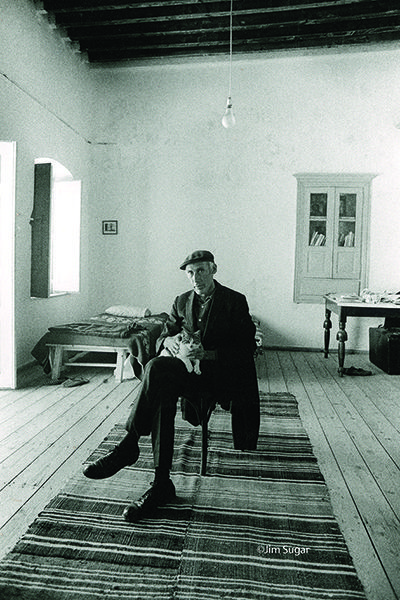
- And so my last link is to this: an article from Notre Dame magazine (one of our few print journals which actually usually has a number of thoughtful articles) about the poet Robert Lax, a friend of Thomas Merton, and a poet of little renown, but great faith. The article itself is brief, but has inspired me to look up more Robert Lax. And the picture that accompanies it looks like the portrait of a true contemplative.
For [Lax}, artistic expression is spiritual expression, and the hands that grope for God are stained with ink and oil. In these days when it’s difficult to pass on values in a traditional way, we must encode them in literature and art.


1 comment:
I vote for Magnificat. It really does help "worship" to begin with the Word, rather than words about the Word.
I've never regretted that subscription, even though it's expensive, year after year.
Post a Comment