Wednesday, January 23, 2013

Second guessing


I talked to my mother-in-law the other day, and she commented on what unusually nice weather they were having – sunny and in the 60s.  Before I spoke, I caught myself thinking, Wow, that’s really cool for the summer. Oops, I mean warm for winter. What season is it? I’m going to miss Guam.

We still have just over 4 months left. Plenty of time to enjoy island life. But the calendar is filling up.  I’ve been researching schools in California and printing applications. It’s giving me technostress.

I’m considering putting all the kids back in school this move. The boys all wanted to go to school here once they made friends, although, ironically, it seems like several new home schooling families have moved in to the area lately. Nonetheless, even though the past few weeks with just the girls home have gone well, I’ve appreciated the ability of the older kids to take advantage of things like free music lessons, Spanish class, drama class, etc.  The older boys in particular seem to work harder for other teachers than myself, motivated partially by competition, which is perhaps not the best motivation to do well in math, but viable. And the younger boys are being assigned more work and taking more responsibility for it than they did with me. School has been especially good for my youngest son, who needed the routine and structure, as well as the encouragement he receives from his teacher, who is absolutely wonderful.  It’s been a good semester.

Of course, as soon as I feel sort of at home with this decision to send all the kids to school in California, I read something like Jennifer Fulwiler’s post on the dangers of being too detached from your kids, so that they identify more with their peers. Maybe I should reconsider.  Especially since we’re moving to Southern California.  Are my kids going to be pressured by their peers to give up their faith, to smoke pot, to bleach their hair? AHHHH! Peer Culture!

Not only did I start to second guess my inclination to put them in school, but I began to wonder whether my working at the community college and leaving them at home for an hour or so before their dad gets home is abandoning them. I fear we have not given them roots. I fear we should have read them to sleep more often. I should not have let the older ones get ipods.  I began to think of all the compromises I’ve made in my parenting. I let them eat hydrogenated oils and corn syrup. I found out our water has unacceptable levels of trihalomethanes, and we're all going to get cancer because we haven't been drinking filtered water.  I’ve been parenting all wrong.

Fortunately, before this fear crippled me, we received a note in the mail yesterday from a young couple newly arrived on island. My kids have taken a liking to them, and we had them over to dinner last week. They are like a young aunt or uncle or an older set of cousins. Anyway, in the midst of my parenting crisis, we got their thank you note that said “Being in your home, so full of life and love, was a heartening and inspiring experience.” “Full of life” may be a euphemism for “loud and rowdy,” but I was still consoled by this little note. Maybe we’re not doing it all wrong.

Deep breath. Perhaps it's me who needs to detach from peer culture and focus more on what's around me, so that I can see the kids are ok.  This move is going to be another challenge, but also another opportunity to find strength in and from each other. It's one more way our family will grow in our identity as a family. Having lived on an island will give my kids a sense of their uniqueness.  And the last two years have provided multiple opportunities for our family to bond, even though I'm not home schooling everyone. Trust. 

And at least my older boys haven’t caved to peer pressure yet to get a tattoo like 75% of their classmates.

Monday, January 14, 2013

Wondering about Sophie Wilder


You know you’ve read a book that captures your imagination when you find yourself starting to pray for the characters in Mass.

I caught myself doing just that Sunday morning. I spent a good part of the prayers for the faithful thinking about Sophie Wilder and Charlie Blakeman, the main characters in Christopher Beha’s What Happened to Sophie Wilder.

Don’t read this post if you think you might read this book, because I want to talk about the ending. Sister, I’m sending you the book, so click away now because I want to hear your opinion of it without prior information, which is how I read it, other than the mention of it in a blog post by D. G. Myers, which is what inspired me to buy it.

Here is what Myers says on his blog (talking about Paul Elie's NY Times article about the paucity of novels in which religious belief figures chiefly in the dramatic action): 
"There is no possible stipulation, however, which can explain Elie’s neglect of Christopher R. Beha’s extraordinary What Happened to Sophie Wilder. I’ve called the novel a modern saint’s life. It has everything Elie is looking for—the living language of religious faith, a distinct and conclusive personal transformation under the influence of the Holy Spirit, the acceptance of religion’s explanatory power, a commitment to the established Church instead of the Do-It-Yourself religiosity that so many Americans seem to prefer, an ethical quandary that is directly caused by Christian faith, an emphatic and unembarrassed Roman Catholic character, and best of all, it is entirely contemporary in its setting—but its author is young and not yet famous (he will be), his publisher is a small house (not like Elie’s own Farrar, Straus & Giroux), and it does nothing whatever to confirm the trend away from novelistic belief which Elie is at such pains to illustrate. Even worse, Beha’s novel may be part of a countervailing trend toward anew Catholic fiction, which rejects the literary Catholicism of Flannery O’Connor for predecessors like Graham Greene and Evelyn Waugh instead."

In his Commentary article, Myers suggests Beha, who is an editor for Harper's Magazine, may not want to be known as a Catholic writer, even though Myers posits Sophie may be a saint (not sure I'm buying this). He writes this (talking also about the main character in William Giraldi's Busy Monsters): 
"Despite this difference, Charles and Sophie have something profound in common. They are what James calls sick souls. They are, in Othello’s language, “Unreconcil’d as yet to Heaven, and Grace.” They are intimates of evil and the failure of love. They are afflicted by man’s fallen nature — their own sin and other people’s — and find no peace in the knowledge that man, created in the image of God, reflects his glory. As Charles puts it, “Our species swam laps in a cesspool,” which leaves him with “the pressing need to get monastic, take a vow, wear a robe.” His language is comic, but his need is not. Both he and Sophie are in need of redemption, and both Busy Monsters and What Happened to Sophie Wilder are odysseys of a soul in search of redemption."

Want to read it, too? Then come back and tell me what you think. . . 

After that introduction, I was superexcited when the book arrived, and since I hadn’t read anything captivating since before Christmas, I dove in right away.  At first I was a little disappointed – the characters seemed shallow, typically disenchanted, hip artistic types, and the story not as literary as Myer’s recommendation made it seem. But as I read on, I found myself becoming attached to Sophie and Charlie (not Giraldi's Charles), especially after they left school. Charlie has been holding a candle for Sophie for years, and when she reappears, he gets a chance to step away from his dissatisfying life and to make some something out of her story of conversion and loss.

Initially, I was a little unconvinced by Sophie’s conversion – it seemed too much like Merton’s. Was it brought on by the beauty of the books she had been reading at Aunt Beth’s, an aesthetic conversion, as Charlie thinks at first?  By the time she became involved with Tom’s father, I was persuaded that her conversion was true and deep, perhaps partly because she can see holiness in others, whereas before her conversion, other people were all potential storylines: “She had come to find in these short morning ceremonies something more practical in place of the sublime, just as she had come to see the holiness in Father Seneviratne, even though he admitted that his path to the priesthood had been directed by earthly concerns.” 

Or is this because she is using her imagination now to create a new version of her story? In the beginning, Charlie and Sophie are drawn to each other through writing – they create dramatic story lines for the people they see walking about the town – and they create their own version of each other.  Beha's book has Charlie telling Sophie’s story based on what she had told him on a few long walks. How much does he contribute to the story of what happened in the last days of Bill Crane, Sophie's father-n-law?

I’m still not sure what I think about this book, partly because I think some of the story needs more development, but mainly because of what happens in the end.

Is Beha another Graham Greene? Is Sophie a bit like Henry Scobie in The Heart of the Matter? She despairs because she doesn’t repent of her sin?

Is the conversation with Charlie about beauty a clue? Sophie tells Charlie she gave up writing because she came to agree with Augustine that “Beauty comes from the fair and fit.”  She claims that she no longer cares for the “self-contained work of art”: “A work whose purpose is to be beautiful gets trapped in circularity. It can’t ever succeed in that goal.” Has she tried to hard to make her life a work of art?

When Charlie counters that beauty is a real need, she responds with this line from Kant: “Two things fill the mind with ever new and increasing wonder and awe: The starry heavens above me and the moral law within me.”

She says this when the two of them are at her parents’ home in the country. Earlier she had told Charlie about a time during a blackout in New York City when she was surprised to see the stars. They renewed her faith in something bigger than herself. Her invitation to Charlie to come to the house ended with “you can see the stars here.”

So she has the starry heavens.

A few lines later she tells Charlie she can’t marry him because in the eyes of the Church she is still married to Tom. Thus, she seems to be acknowledging the moral law within her.  “God couldn’t possibly want you to suffer for the rest of your life when you didn’t do anything wrong,” Charlie says. Sophie responds, “You may be right about that, too. I can’t know what God wants. I only know what I promised.”

But when you find out what has happened and what will happen, you wonder what she means here and even more when she quotes Eliot, saying, “I’m not going to change my mind. . . . because I do not hope to turn again.”

She had wanted to save Bill Crane as he lay on his deathbed, but in the end she believes Bill brought “her into the fire with him.” Ironic that Crane is so bitter – a devil figure? - considering he may have sacrificed his entire life to protect his son’s innocence.

So what to make of the ending? Is Sophie’s faith real; she just couldn’t forgive herself? Or she despairs because couldn’t accept relativity in the moral law? Is Charlie’s version of her choice the real version? If Charlie’s version is wishful thinking, does it suggest that faith is impossible? Or the exact opposite: and that he is the one that has been saved by Sophie’s sacrifice, because he recognizes that “she couldn’t know until the very last page if she had been redeemed.” Metaphorically speaking or not?

Are we supposed to question both endings because both are written by storytellers? Art lets us choose our own ending?  Is Charlie given a new start by Sophie's reappearance - and the telling of Sophie's story is partly his redemption, even if it is only a redemption from the murky life he had been living?

Here is the catch when reading a book that deals with faith, (and I think Myers is right about why we don’t have a Flannery O’Connor or Greene, or Percy, or Murdoch, or Waugh, etc., for this generation): it’s hard to not to judge the characters on the basis of how well they live their faith.  I feel a little like the book club members O’Connor complains about: I want a book that makes me feel good about faith and life, almost more than I want a book that is true.  And really, Charlie's accidental stop at Regina Laudis makes you think that's what the ending is going to be: sweet and comfortable. But it's not. This book leaves so many unanswered questions – questions that can only be answered by letting the imagination roam.

It’s a thought-provoker, to be sure. Wondering what others think…

(Looking for the links, I found other good remarks: background on the genesis of the book from the NYT, Sam Sacks' honest review that notes some flaws, Gregory Wolfe At the Wall Street Journal, Beha on writing, and another, not so glowing, but good review here  and some good questions and comments on symbols.)

Saturday, January 12, 2013

2012 Reading Review

I just finished my first book of 2013, What Happened to Sophie Wilder by Christopher Beha and want to talk about it with someone, but in the meantime finishing a book inspired me to look back over my reading in 2012.

Here’s a summary:
Books read:  60. More than usual, but out of those 20 were kids’ chapter books, so really about average.

Favorites: My daughter loved the Mother-Daughter Book Club books, but I preferred Emily of Deep Valley and The Invention of Hugo Cabret. Dare I admit how much I try to hide my laughter over the Diary of a Wimpy Kids books?

I sometimes wish I kept a list of picture books checked out from the library that we loved so that I could remember them later. A few standouts I still recall: a picture book biography of  J. R. R. Tolkein, the biography of Martha Graham, a photo essay on the Fibonacci sequence, an old book about a little girl living in Thailand.

14 or so books I read were non-fiction, essays or poetry.  Favorites: Sally Thomas’ book of poetry, Brief Light.   I also really liked de Boton’s The Art of Travel and Murakami’s What I Talk About When I Talk About Running.

I’m not sure where to include V.S. Naipaul’s A Way in the World, but it was fascinating.

As far as spiritual reading goes, I really like Madeleine L’Engle’s Walking on Water. It’s the kind of book you dip in and out of and every time find something to chew on.  Call to Holiness was also good, but light.

From the classics:
Shakespeare: The Tempest and A Midsummer Night’s Dream (should I continue to teach this or switch to Othello?)
Dickens: Great Expectations: LOVED
Bronte: Wuthering Heights: Somewhat disenchanted. Lovely writing, but honestly, I got fed up with Cathy and Heathcliff. So selfish, and eventually tiresome
Sophocles: Oedipus Rex
Also pulled out some Thoreau when my son was writing on Civil Disobedience.
FINALLY finished The Wind in the Willows, which I have started many a time and can never seem to truly love, although I love the setting and the idea.  It was a read aloud with the kids, but they frequently wandered away from my reading in boredom. Did I just put it down too much to get drawn in? Or does it jump from episode to episode to quickly to feel attached?

The rest were novels. I meant to post about my very favorite, Willa Cather’s One of Ours when I finished it, but I never had time. Every time I read a Cather book, I love her more. Is she underappreciated? I’m not sure of her contemporary reputation in academic circles, but every time I read one of her books I am surprised by the depth and eloquence of her writing. 

One of Ours is the story of Claude Wheeler, who chafes under the business acumen of his father and the religious fervor of his mother. He yearns to live a life devoted to seeking something noble and good – and his friendship with the Erhlichs in his college town, Lincoln, give him some insight about what this life looks like, but he always feels like an outsider during their intellectual, lively comversations. His father calls him home to manage the farm, and he ends up in an ill-suited marriage, mainly because the girl who would share his vision seems to be dating his mercenary older brother. It is not until he joins the Army to fight in World War I that he feels a part of something bigger than himself. In France he discovers true brotherhood, nobility, and a purpose for living. But of course, it is a war…

Some favorite quotes: One night while reading Paradise Lost aloud with his mother, he comments on how Milton needed the wicked. His mother questions him, and Claude points out how if all the sinners were taken out of the Bible, it wouldn’t be very interesting. “Except Christ” says his mother.  “I only mean that even in the Bible, the people who were merely free from blame didn’t amount to much.”   Mrs. Wheeler replies “As I get older, I leave a good deal more to God. I believe He wants to save whatever is noble in this world, and that He knows more ways of doing it than I . . . . I believe He is sometimes where we would least expect to find him, - even in proud, rebellious hearts.”

In the midst of a blizzard, Claude looks out the upstairs window “There was a solemnity about a storm of such magnitude; it gave one a feeling of infinity. The myriads of white particles that crossed the rays of lamplight seemed to have a quiet purpose, to be hurrying toward a definite end. A fain purity, like a fragrance almost too fine for human senses, exhaled from them as they clustered about his head and shoulders.” His mother looks out into the night and quotes “Ever thicker, thicker, thicker,/ Froze the ice on lake and river; Ever deeper, deeper, deeper, /Fell the snow o’er all the landscape.” Mrs. W feels the poetry in the moment, even if she isn’t as witty and lively as Mrs. Erhlich, (Claude’s first love?)

Feeling ever more discouraged with farm life when his brother Ralph comes home at Christmas throwing money around, Claude reflects on what prosperity has done with the community. Preceding Wendell Berry by sometime, he remarks that for the wheat, corn and pigs, things with intrinsic value, that a farmer takes to market he gets manufactured gods with poor quality and big machinery that is goes to pieces, 3-1, outlived by the horses. Even the neighborhood has changed: “Claude felt sure that when he was a little boy and all the neighbors were poor, their houses and farms had more individuality. The farmers took time then to plant fine cottonwood groves on their places, and to set osage orange hedges along the borders of their fields. Now these trees were all being cut down and grubbed up. Joust why nobody knew…. with prosperity came a kind of callousness; everybody wanted to destroy the old things they used to take pride in. .. . It was less trouble to run into town in an automobile and buy fruit than it was to raise it.” 
But Claude sees little chance of escape from this life.  He is a farmer with little love for the job. He often suffers failures. He has security, but “Sometimes he thought this security was what was the matter with everybody; that only perfect safety was required to kill all the best qualities in people and develop the mean ones. . . . but if you went to bed defeated every night, and dreaded to wake in the morning, then clearly it was too good a life for you. To be assured, at his age, of three meals a day and plenty of sleep, was like being assured of a decent burial.  Safety, security; if you followed that reasoning out, then the unborn, those who would never be born, were the safest of all; nothing could happen to them."
But Claude does not despair completely: “Claude was aware that his energy, instead of accomplishing something, was spent in resisting unalterable conditions, and in unavailing efforts to subdue his own nature. When he thought he had at last got himself in hand, a moment would undo the work of days; in a flash he would be transformed from a wooden post into a living boy. He would spring to his feet, turn over quickly in bed, or stop short in his walk, because the old belief flashed up in him with an intense kind of hope, an intense kind of pain, -- the conviction that there was something splendid about life, if he could but find it!” 


Well worth reading for the characterizations, the writing, the history, the effect…
  

I also really liked Oscar Hijuelos’ Mr. Ives’ Christmas, although it leaves something to be desired as an uplifting Christmas book since it is about how Mr. Ives marks time after his son’s murder a couple days before Christmas.  He doesn’t mark it well for a number of years. He and his wife had been artistic idealists, living in a rough part of New York as a sign of their open-mindedness. But Mr. Ives had settled into life as an art director in advertizing, and his wife became an art teacher; their son shares their idealism, but had wanted to become a priest. After he is shot by a Puerto Rican, Mr. Ives must confront some latent racism in himself, as well as feelings of betrayal. He and his wife drift apart, but manage to stay together. Eventually, a generation later, Mr. Ives finally meets the man who shot his son.  Hijuelos’ writing is matter of fact, without many embellishments, but he creates a complex portrait of a man who deals with disappointment and survives.

Other favorites: The River Ki, A Tree Grows in Brooklyn, and Mr. Pip.

Worst book of the year: A Confederacy of Dunces. Yuck. Pass. And I like New Orleans and odd characters, but I regret wasting time on this, despite Walker Percy’s intro.

Friday, January 11, 2013

Christmas vacation review


I know, it's practically the middle of January. Time to move on from Christmas vacation to a new topic, but I'm still trying to organize photos from the last month, which reminds me of some things that we did that I want to remember. Maybe one of my resolutions should be to have a better memory, especially since I took the time to read that Joshua Froer book on memory champions.  I have thought of a number of other things I’d like to write about lately, but the inspiration expires as other events crowd our time.  The happy side of this busyness is that we’ve had some quality family time the past couple of weeks.  

So in the interest of aiding memory, here is a list of some of our recent memory-making moments:

1. My second son put in a lot of time organizing a giving tree project for his Eagle Scout project.  He was inspired to do something for foster care children by our friends who are foster parents here, but his initial idea, sponsoring a 5K fundraiser run, was too complex. He tried out a couple of other ideas, before settling on the giving tree idea. He contacted the shelter run by Catholic Social Services and the Sisters of Mercy here, who gave him a list of gifts for the kids. He invited a group of kids from the chapel and some of the scouts to make tags and decorate a tree with them. Then he gave a nice little speech at each of the Masses and the Protestant service about his project. The response was generous. For broader outreach, he went to the mall one Saturday with some other scouts to collect gifts and hand out flyers. They raised donations there, but the biggest gift came from the Navy spouses’ organization, which donated $1000 to the shelter from their craft bazaar the weekend before, after the president heard my son’s speech at church. That was nice.

It was also nice to play Santa. On the Saturday before Christmas, we gathered up some cookies and snacks and stuff to make s’mores and delivered the gifts to the shelter. The sister in charge had thought it would be nice to have the scouts demonstrate making a fire and tying knots, but the kids were a little too young for knot tying, and several had special needs. The oldest was an 8 year old girl who seemed self-conscious at first, but one of the scouts brought his ukulele and got to playing Christmas songs, which ended up being the best entertainment of the afternoon. He had everyone singing. And a big reward for my son was a nice hug from one of the little girls with special needs – a great confirmation for all the work he did getting out of his comfort zone calling people and asking for help.

I left the party feeling a little depressed. A sweet chubby baby boy was one of the new arrivals at the shelter. The sister said she couldn’t believe he was neglected because he was so fat.  I have toyed often with the idea of signing up to be a respite care provider for foster parents, but thus far have not because it requires going to the court and to the police station for background checks and we only have 5 months left.  But here are these children with no home to go to, and a shelter that is partly boarded up. The water pump had gone out that week – the $1000 was just in time for repairs. 

2. I wonder if we should be doing more than just helping at outreach events. For instance, we also helped at the Christmas dinner for foster families at the Baptist church, with our foster parent friends. There were so many volunteers there that I had little to do, except hold a foster baby for one of the parents who wanted to help her own daughter with a craft.  I had come earlier in the week to help organize some of the donated clothes and toys, and again felt blessed with the abundance that our family has.  I wanted to take that foster baby home.

3. Meeting the new family with six adopted kids who just moved in down the street seems to be another sign. After seeing them drive up, my 10 year daughter asked if our next car could be a big white van. I don’t think that is on my husband’s wish list. My younger kids love playing with them - they've had lots of play-in-the-street time lately with their new ripsticks from Santa. And now they also want a baby sister from Africa.

4. We have met another family with adopted kids in the neighborhood who home school. She set up a field trip to the National Park on the north end of the island to see some caves with pictoglyphs.  We signed up for a guided tour by an anthropology student at the university, who actually is studying languages of one of the other islands, but she was knowledgeable about the caves and the drawings, perhaps since her grandmother’s family had hidden in a cave during World War II, trying to escape capture by the Japanese.


Swarming butterflies


Blue banded king crow butterflies swarming. Hypolinas bolina?

House figures

turtles
Three fingered hand - thought to be that of a thief?

A Fish

5. Christmas Eve arrived sunny and warm, as usual here.  My husband wanted to go diving in the morning, so that we could get some good underwater photos, but our camera malfunctioned. Fortunately, we ran into a friend who took some for us. The boys saw a shark. The fish saw a photo op.

6. On Christmas Eve, I found myself making one more futile trip to the Exchange, although it was at the goading of my oldest who wanted to buy gifts for his siblings, and because I lost a bag of books I had purchased for gifts.  Of course, they turned up under a pile in my closet (they were supposed to be under a pile in my husband’s closet) – in time for Epiphany.  We went to Midnight Mass at the cathedral again, at the kids’ request. The music is beautiful, and the pageantry of the celebration is unparalleled on the island. The bishop sang “O Holy Night” at the Mass’s close, and then everyone adjourned to the lanai for bunelos dagu. While we were licking syrup off our fingers, the bishop came up to our family and greeted us. I think I flubbed the moment: “Thanks, Bishop, for a lovely Mass. We love it here.” I felt stupid all the way back to the car, but my husband assured me that the Bishop is very laid back here. Or he thinks the haoles are awkward.


7. The elves were busy VERY late Christmas Eve.  Presents still had to be partially wrapped and sorted, and a dollhouse needed finishing touches.  At a certain point, sleep seemed irrelevant. Fortunately, the kids were tired and slept all the way until 7. The teens would have slept longer, but everyone woke up in good spirits.  After last year’s bonanza – I overdid, because we weren’t going home to see family – this Christmas spread was more modest, but everyone seemed satisfied, except perhaps the oldest, who coveted his brother’s dive knife and machete, even though he has his own and his tent was more expensive. I liked that the older boys asked for “instant gratification” gifts (meaning a toy), so I let more Legos into the house despite declaring a moratorium on Legos some time ago. The girls at first seemed under-impressed with the dollhouse, but it quickly has become the most played with toy in the house – even the boys enjoy it.

8. After sipping coffee and enjoying the morning, we moved into get ready for company mode. A couple families joined us for Christmas dinner, although I’m afraid in our sleep-deprived state we messed up a couple dishes: undercooked the butternut squash risotto and overcooked the cherry pudding. The kids were happy to play with friends and new toys, and we shifted the focus from food by playing “Things” with the grown- ups. Always fun.

9. The day after Christmas was more relaxing. We caught up on sleep, caught up on Christmas cards, caught up with family via Skype.  We took a short hike down the Spanish Steps to one of the best snorkeling areas on the island and were rewarded with a view of an octopus. 

10. The next few days are sort of a blur. I know we went to a dinner and dessert party at the neighbor’s that was a lot of fun.  We watched a few Christmas movies, including Christmas Story and The Sound of Music, as we seem to do every year. The older boys went to see Lincoln, and on Friday they and their dad went camping with the scouts as a part of the “Order of the Arrow Ordeal.”  Meanwhile, I invited the daughter of one of the leaders to stay with us, since her parents were involved in the campout. The little girl down the street ended up inviting herself to stay, too. We had planned to watch “Anne of Green Gables,” which my 10 year old received from her grandparents, but the younger girls lost interest. It is a long movie, but I felt sorry for my older daughter, even though I was also partly angry with her, when she went to bed in tears because of the interruptions. I’m afraid part of her dramatic response is an early sign of puberty. Yikes.


How many horizon shots can I take? Looking at the northernmost tip of Guam.

10. For the feast of the Holy Family, we had a big dinner and played family games, which makes the kids happy even though they frequently leave the table angry or crying.  We continued the celebration New Year's Eve day, beginning with a long hike leading to a cove known as “Double Reef” because a second reef is located a couple hundred feet off beyond the close one. The hike was beautiful, although treacherous over mossy limestone rocks, and the cove was pretty, too. But lately there have been numerous weather advisories about high surf and bad riptides. I was very anxious about the boys swimming out to the reef with my husband, while I stayed back with the youngers.  I couldn’t relax, and the youngers picked up on my anxiety, although after a while they left me standing scanning the horizon for snorkels, counting them after each swell. I tried to wave them back, but they were busy watching dolphins and moray eels. I thought about a young Navy sailor who just died jumping from a cliff into the water – not a suicide, but killed by the waves bashing him into the cliffside. I thought of Irish fishermen’s wives living with the constant fear that they’ll be widowed by the sea.  I understood why most of the locals don’t swim in the ocean.  Come back, come back, come back! And come back they finally did, triumphantly full of reports about coral beauties.  My husband assured me they would have turned back if he thought the currents were too strong, but I still muttered prayers of thanksgiving on the hike back.

I think this is a Japanese morning glory.


Moss covered limestone.

Fresh water sinkhole where radioman George Tweed, who hid from the Japanese around here in WWII, got his drinking water.


Horizon with vines. The wave line is the second reef. We think.

We had promised the kids a trip to Yogurtland, the frozen yogurt place where you serve yourself and choose your toppings at a topping bar and pay by the weight.  Not a cheap place to eat for our family.  Then we popped into the Japanese food mart for rice balls that the kids learned to love in Japan, which are a cheap eat for our family.  The shop was lively, with a table set up at the entry for a little new year’s lucky game played with red balls and a dancing dragon robot doll.  We didn’t play the game, but it seemed festive, even though it is not the Japanese New Year.

We ended up eating out twice because our friends invited us to their church’s praise and worship concert for New Year’s Eve. We didn’t have time to cook after the vigil Mass, so we went to the ramen noodle restaurant for more Japanese food.  The kids were not thrilled about going to a church function for New Year’s Eve, and I was fighting a cough, so we didn’t stay until midnight. I played the party pooper and went to bed, but the kids stayed out in the street with the neighbors and their dad until midnight to welcome in 2013.

11. Since the week had the feel of a staycation, we accepted an invite to the waterpark New Year's Day. Great fun was had by all.


Tuesday, January 8, 2013

Welcoming babies and resolutions

Well, posting those videos sure didn't help the Irish in that game yesterday. Notre Dame didn't win, but my sister now has a sweet baby girl, and she looks like a real winner -  very huggable with chubby cheeks! And I'm so happy I get to be her godmother!

So Happy Birthday to the newest Duffy!

And happy many other feast days that have passed lately: Happy belated Feast of Mary the Mother of God.  Happy belated Feast of the Holy Family, one of my favorites.  Happy belated Epiphany! Happy birthday to all the babies born this first part of 2013! 

I started this a few days ago, but since I'm late with everything else, I might as well post it.

The Christmas season is coming to an end. I've taken down some of the decorations. All the cookies are gone. I finally sent out Christmas letters. Time to look forward to 2013.

At the Solemnity vigil on the 31st, the priest brought up making New Year’s resolutions that include making Christ a part of our every day life. Great. Since I hadn’t even given a thought to a resolution, I was glad to take his suggestion. I know a lot of people think New Year's resolutions are pointless, as in Mark Twain's quip, "New Year's Day: Now is the accepted time to make you regular annual good resolutions. Next week you can begin paving hell with them as usual." But I still like the idea of setting some goals, even if they remain unrealized aspirations. I've definitely got room for improvement.

I’m trying to remember what my New Year’s resolutions were last year.  I have trouble remembering what I resolved to do yesterday… That's why blog labels are helpful: link to past resolutions.

Progress on last year's goals: I did not get around to Story of a Soul or Edith Stein, but I just bought Edith Stein's book on The Woman at the Cathedral bookshop when we were shopping for Epiphany gifts (slim pickin's this year). I did drink more water and run more. I didn't progress much in the way of saintliness, maybe even did some backsliding. As far as a community service project: we started teaching CCD, which is a challenge because my own son defies me weekly in class and declares he hates our boring class, and we participated in a number of short term events: beach clean up, soup kitchen drive, serving dinner at the USO and water at the parade. And we've done more with foster care. Not exactly regular involvement, but not a total wash. Could I count that as about 50% actualization?

On to 2013. So besides making Christ a part of everyday life, which is pretty much a given, here are some thoughts I came up with:

1. Academic resolution: actually read the Edith Stein book and the other book I bought for myself, on Gerard Manley Hopkins (chalking that one up to professional development expenses).  Re-write my class notes so that I have more concrete goals for each class meeting, and add in more evaluations earlier in the semester, so that I can tailor the semester to the students' needs. Write some goals for the girl's next semester of home schooling, so that by the time May rolls around with our move to California, I'll be able to say "Ok, we're done with school," even if the schools are still in session. (The one success with home schooling this year is that my 5th grader discovered "Anne of Green Gables" and is working through the 4th book of the series now.  She received the movies for Christmas, but what's with the 3rd film? It totally deviates from the series and even from Anne's character. All of these crazy adventures in New York and World War I - how does Anne stay so fresh and clean while wandering the front searching her husband? And then the involvement with Jack Garrison? No, no, no! I was dismayed as we watched it.)  And read aloud more with the younger kids.

2. Physical resolution: Continue to drink more water and run more. I'm 95% committed to running a marathon in April, so I'm also adding "get plenty of rest" to my health resolutions. This means taking a day off each week from running and/or strenuous exertion, something I don't always do. And I want to use the long runs coming up as reflection/prayer time, a time to be thankful for the gift of health and the beauty of my surroundings. (when actually I'll be thinking about how miserably hot and sweaty and I am, how much I have to do that I should be doing instead, how much I hate laundry, whatever.)

3. Spiritual resolution: To comply with the request from our pastor, I want to get back in the morning meditation habit. Not just a quick reading of the day's gospel with the girls, but real reflection. And remember to see the face of Christ in everyone I meet.

Since the Year of Faith is well underway, I'd also like to comply with the Pope's suggestion to revisit some Vatican II document. I went to a catechetical conference back in September where one of the speakers who teaches at the seminary here gave a great summary of the four big documents. I've been meaning to type up his notes, but never got around to it, and now I've forgotten some of what he said, but I did look at my notes again.  He first summarized Lumen Gentium as being about living in communion with each other through Christ just as the Trinity is a communion of persons; then Dei Verbum, which he summed up as about the Word as God's personal self communication: God's revelation is a person, not content, so we should be in communion with the Person of Christ. Next he brought up Sacrocanctum Concilium  which addresses the encounter with Christ in the sacraments: even though we are limited in our capacity for faith, Christ reveals his fullness completely in the sacraments. And finally, he wrapped in Gaudium et Spes, pointing out that the role of the Church in the world is to be full of joy and hope because we are full of Christ when we are in communion with each other, and that joy should radiate to others. Then he drew a nice little symbol for each book that became the chi rho symbol, showing how each document addresses how to live in communion with Christ and the Church, or how to be transformed through faith into an 'alter Christus.'

4. Perhaps I should also have a resolution having to do with community life to pull in the whole human integration thing, but I think that will be just to continue with what we are doing, but to do it better. And then this summer when we move again, we'll reevaluate how we want to serve the community and to try to make good choices about where and how we live.

Now to get on with the rest of the day and living out these resolutions!

Monday, January 7, 2013

Play Like a Champion Today!

Here's what we're watching tonight - getting excited for the big game tomorrow!

We're even pulling our kids out of school to watch Notre Dame beat Alabama. (It's on at lunchtime in Guam.)


I really am this kind of football fan:

Here come the Irish (stage dress could be better, don't you think?):

It really is magical:

Trumpets under the dome: 


Why, yes, I do want my kids to go to Notre Dame: 

The Irish Guard do the Victory Clog:


Regis conducts the Victory March at Carnegie:


And finally, the glee club sings the alma mater in Williamsburg:


Thursday, January 3, 2013

Yet another Hobbit review for Tolkien's birthday

I have been reading The Hobbit with my 8 year old for over a month now (with interruptions), and will have to read an extra chapter tonight in honor of the Professor.

So I know almost everyone has seen the movie version of The Hobbit by now. But since in the Western Hemisphere it is still J. R. R. Tolkien's birthday, I thought I'd post this review I wrote and never finished.

I took the older boys to see The Hobbit with their “Catholic Youth Group” friends. They’ve figured out that if they say the youth group is doing something then I’ll say yes much easier than if they say they are want to go to the movies with “friends.” I had promised we’d go to see the midnight premier, and they were planning to go in costume. One of the boys was Gandalf the White a couple years ago for Halloween and the hat and sheet are still around. Another was going to take his bow and be Legolas. And the youngest was going to glue fur to his feet and be a hobbit. BUT the premiere here was a Thursday night, and I couldn’t reconcile myself to staying up until 2 am and then getting them up for school at 6, so we went Friday night. Since it turns out that GIRLS were going with the group – in our car, even - only the 12 year old ended up wearing hobbit fur. He relishes being the object of hilarity and had a great time playing annoying little brother in the back seat.

The kids loved the film, and I enjoyed it, but I have to admit I was a little disappointed in it.  I didn’t know it was going to be 3 parts until the week before, which I feel is blatant money grubbing, not an attempt to make a faithful interpretation of the book. Since I’ve been reading the book, I was fresh up on the text, and I have to say that Peter Jackson takes a number of liberties, so fidelity to the text is not the motivating factor for making a trilogy. 

In order to make the movie long enough, a lot of battle scenes and background storylines were added. My oldest seemed to think it was great that some of the background mythology was included, but I wondered how much of it is true to Tolkien's vision. First, all these orcs are running around riding the wargs and hunting the dwarves from the beginning. I guess they are supposed to add suspense and special effects wonderment.

Then there’s the addition of the Pale Orc story.  I had just read the one mention of the Pale Orc in The Hobbit, but I wondered if maybe the legend came from one of the background texts. Mr. Darwin points out the source on his post, so it is quite elaborated by the filmmakers. A problem I see with it, is that is seems to humanize the orc by giving him a motive for revenge. Then again, he is seemingly indestructible.

Another addition: Radagast, the brown wizard very briefly mentioned by Gandalf in the book, and his cute animal friends. I believe he must have been added to charm the young ladies who come to the movie and need something lovable to oh and ah over.  His rabbit sled bordered on ridiculous, but my daughter loved that part.

The scene with Gandalf and Galadriel seems a needless moment  - the quote about "small acts of kindness of love" being the only thing that can defeat great evil  makes Gandalf seem like the author of one of those little gift books you get for graduation.

And finally, the worst offense is the addition of the scene where Bilbo rescues Thorin from the orcs after they’ve escaped the goblins and are stuck in the pine tree.  Giving Bilbo this heroic moment in order to win Thorin’s admiration seems totally out of character.  Bilbo survives by being clever, not dashing. With the addition of some syrupy platitudes along the way, I was starting to get annoyed with the whole thing. It was exciting, but I nearly got a headache from all the twists and turns, although the dizziness of the movie may also be due to its high definition filming.   I was ready to go at the end, not reluctant to leave my seat.

The 8 year old didn’t get to go, because he hasn’t finished the book, so his dad will take him when we're done reading, but I’m wondering if the movie won’t be too intense. It almost seems more threatening than The Lord of the Rings – yet another change from the book. The Hobbit has a more humorous tone - Tolkien often prevents suspense by telling that Bilbo DID rescue the dwarves before he actually does, as in the scene when they are all imprisoned by the wood elves.  The movie is breathtaking and gripping, but the narrative voice of the book has a warmth that's missing in the movie.

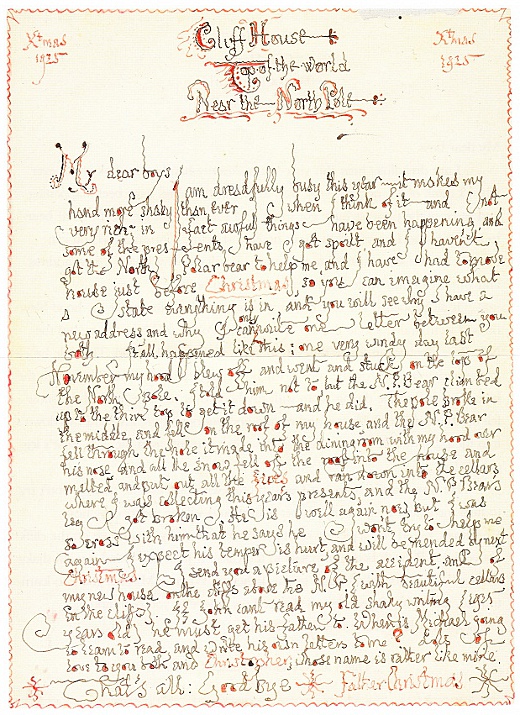
It is present, however, in this letter from Fr. Christmas, reprinted at Letters of Note:


Wednesday, January 2, 2013

Awkward family photos

Outtakes from the 2012 Christmas family photo shoot at Dadi beach.


Reading is one form of escape. Running for your life is another.
-Lemony Snicket