Thursday, May 30, 2019

Memoirs and memory

May was a pretty good month for reading for me. Not that I read copious amounts, but what I read was really good. I finished two very different books - Educated by Tara Westover, the bestseller about the girl who went from apparently no education to a Harvard Ph.D., and The River Why by David James Duncan, an odd book about fishing, philosophizing, and finding faith that I had seen recommended on lists of books for my nature writing class but had never encountered. - Saving that for another post...

I was on the library's wait list for Westover's memoir for several months. After finishing it in a few days, I'm not surprised that it is on the bestseller list.  Westover tells a good story and tells it well.  It's thoughtful and heartfelt and fascinating - I kept wanting to find out what crazy thing would happen next in her family.  (I also read Wired for Story this month, which posits that the most important part of writing is tantalizing your audience with the prospect of what's on the next page.)

Westover has a fascinating background, which is familiar to readers of book reviews: her parents are Mormon survivalists who live on a farm in Idaho and run a scrapyard and now an essential oils business. The story begins with an account of her mother becoming a midwife, so she can help other mothers give birth at home. The parents are skeptical of the government, the medical establishment, the educational system. The younger four of the seven children don't have birth certificates and never go to school. The father regularly puts the children in danger by employing them in the scrapyard, where several are injured, including a son who is severely burned, and himself. His recovery from severe burns is the catalyst that enables the family to make millions from essential oils. He doesn't go to the doctor, but instead is healed by the used of salves and balms that his wife makes and administers to him.  She was severely injured herself in one of two bad car accidents caused by the father falling asleep at the wheel while driving at night.

These are the incidents that keep the reader turning pages. There is also the minor drama of Tara's coming of age - she has a beautiful voice and is allowed to take dance and music lessons and participate in musical theater, even though she doesn't go to school. The father suffers a couple mental breakdowns, and she later realizes he suffers from psychiatric disorders. And then there is the major drama of the older brother beating and berating his sisters.  Fear and frustration over these interactions are part of what eventually propel Tara to apply to college and leave home.

Despite the family's suspicion of the government and other public institutions, they don't forbid Tara from going to school. They have a computer and internet, which she uses for finding out about BYU. Her older brother who has also gone to college helps her study for the ACT. None of this causes a large rift in the family. And while Tara attends BYU, she comes home regularly, even as she begins to question the way she was raised.

I would warn about spoilers ahead, but I think all the press about the book has revealed the end of the story.  Tara goes on to do extremely well at Brigham Young University and gets a fellowship to study at Cambridge for a year. A don there encourages her to continue her studies of history, and she eventually attends Harvard as a visiting scholar and earns a Ph.D. from Cambridge.  Although she claims not to have received much if any education at home (and suggests she didn't know what the Holocaust was when she first attended a lecture on it at BYU), she apparently can write and read and think well enough to earn degrees from prestigious universities. She is a prodigy, as are two of her brothers, who also have Ph.D.'s.

While she is away at school, her family has phenomenal success selling essential oils and profiting from her mother's energy healing business. The family home is expanded and help is hired, so people are in and out of the house all the time. For many years, Tara stays connected with her family, but after she accuses her brother of abuse and tries to get his wife and her sister to speak up about the way they were abused by him, too, she is cut off from the family.  Her father, sister, and two brothers no longer talk to her, and her mother won't see her until she reconciles with her father. This causes her great pain, even though she struggled to move away and sees harm in the way she was raised.

After I finished the book, I was curious about the rest of the story, so I went to the trusty internet to find out the name of the family essential oil company and what happened after this book that reveals so many intimate secrets and complex relationships was published.  The family business wasn't familiar to me, although that's not surprising. I found many glowing reviews and interviews with Tara about her story.  Obama and Oprah praised it.

There is also a statement on Goodreads by one of the brothers who Tara appealed to for help writing the book. He claims that the story is Tara's and that her memories don't entirely match his own.  He notes several events he remembers differently, including his brother's burns and his other brother's traumatic accident at a building site.  And Westover does note these discrepancies in the book. She includes not just footnotes but also paragraphs about how certain events - like her brother's burns - are remembered differently by everyone who was there.

There is also a letter from the family's lawyer that claims that Westover exaggerates her lack of schooling. It points out how three of the kids have advanced degrees, and how the other children are successful at what they do, and it connects this success with the family's home school.  It claims she has exaggerated the arguments with her brother. The letter doesn't accuse Westover of libel, and there is no lawsuit, but it does claim that her memory is faulty.

These postscripts add another layer of meaning to the story. On the one hand, the book is fascinating because the characters are unusual and extreme.  Crazy things happen to them. And yet this girl -  and her brothers - manage to have incredible success.  And for a number of years, she wants to come home. She loves the mountain she grew up on and she craves attention and love from her parents.  As I read, I was surprised she would spend any time alone with her abusive brother, and yet she does. She wants her father's love and attention, even as she acknowledges he is mentally ill. She shows up from overseas for family events.  She doesn't want to be alienated from her family, even though she isn't willing to swear she is possessed by demons.

As I read, I also wondered how she managed to do so well in college. Almost no details are given about her mother teaching the children, but some of them are able to read and write well.  This discrepancy either makes Westover's achievements nearly miraculous, or it causes the reader to question whether she is telling the whole story about her education.

But memory is another fascinating theme. In our own family, the kids either don't remember things or remember them quite differently.  They say things about the past that are a conglomeration of different stories or that leave out great big details. Their stories shift as time goes by. My husband remembers me saying things that I swear I never said - perhaps he interpreted something I said as meaning something different from what I intended.  My own siblings and I have different perspectives on things that happened when we were growing up.  Sometimes I wonder if we were at the same place at the same time.

Memory is unreliable.  It seems as if memory has a great deal to do with personality and perspective.  Does the truth of history belong to the person who tells it first and tells it best?  Or is the best option to consult different sources and knit together some relatively reliable account of events based on probabilities and similarities between stories? 

The difficulty of knowing what is actually true vs. what is true for Tara Westover's story is impossible to determine. And perhaps unnecessary, especially if her story is taken just to be an interesting read and a meditation on the way education occurs and its effects on individuals.

Monday, May 27, 2019

Revisiting the school question again

We've had a wonderful Memorial Day - began the day by attending the Memorial Day service at memorial park in town.  A couple World War II veterans live in our neighborhood, and they laid wreaths at the base of a Veterans' Memorial here in honor of their fallen companions.  A few Gold Star mothers and wives and representatives from a variety of military service member support organizations also honored fallen service members from over the decades. Since this community has such a large proportion of active duty and retired service members, it's a moving event.

But the rest of the day, I have been tangling with the question of what to do for school for the youngest child next year. She is of the age to go to kindergarten, and at one point, I really thought I would stick with conventional school for her. But now that the time has come to register for next year, I am torn about sending her. The unconventional part of me thinks I should home school her. So do my older kids. Their opinion is meaningful to me since they have been schooled in a variety of schools. I'm touched they value their home school experience - except the youngest two who are the most social and are not as quick to admit they were home schooled. Their experience was briefer and just different from the older ones.

My quandary is that I don't want to quit my little teaching job, and I'm not quite sure how I can manage teaching college and teaching kindergarten at home. I almost feel like it will be harder to home school one child than several, because I am her only entertainment. I have a friend who has offered to help out, but I really need something consistent.  I put out an advertisement for a babysitter/tutor on the local home school group newsletter, but heard nothing. I also have looked into a few charter schools that cater to home schoolers, but the timing is not quite right for me. Their kindergarten classes are either on the wrong day, or the wrong time, or just not quite long enough for me to get from my school to their location, and none are willing to allow her into the first grade group. 

One part of me thinks I am being selfish for wanting to keep my job and put her into traditional kindergarten. Perhaps I should quit my job and stay home with her. My other local options are not as attractive. Our parish school apparently has a good kindergarten teacher, but she is having a baby in the spring, and the class last year had 30 kids (the class does have an aide).  Many people love the local public school kindergarten, but it, too, has large classes, and the new state curriculum is not impressive. I would love to postpone the peer pressure of public school as long as possible, as well as continue the more literature rich education we've been doing at home.  And I like home schooling people. 

The other part of me thinks that I could use the time she would spend at school to get more house and school work done, so that I am more available to the other kids after school. The youngest is very social and may be lonely at home. I tend to start projects like home schooling with ambitious plans and finish them with less enthusiasm.  She might learn more at school. The parish school does have wonderful feast day celebrations for All Saints Day, Our Lady of Guadalupe, Holy Week, and May Crowning. The other kids have done well in school, like school, and do not want to return to home schooling, even as they recommend it for elementary school.  I have friends whose kids are in the parish school, too. 

I'm probably overthinking the options. Is it a question of doing either what is best for her or easiest for me, or am I not framing the question in the right way? That question is one fraught with guilt.  I tell myself that I could start one and change course if it isn't working. But nothing quite seems like the perfect solution. I keep praying I will find either someone willing to watch her for 3 hours twice a week while I go to school or a charter school where she could go a couple days a week.  Other moms from the parish school say that they pull their kids out of school all the time. Maybe I could sign her up for the parish school and then keep her home a day or two a week to do field trips and art and reading. Maybe, maybe. The perpetual war between heart and mind continues. 

Friday, May 24, 2019

Notes on a Commencement

Despite the busyness of the spring season, I love the month of May -- partly because of Mother's Day, which is a good excuse to celebrate motherhood and babies, and partly because my birthday is today (I am sitting at Starbucks with my free birthday bonus venti double latte), and partly because all of the programs end, and partly because the flowers are so, so beautiful, and partly because the weather is so, so nice, and partly because there is something to celebrate every weekend.

This past weekend we celebrated our oldest son's first graduation from college. He finished his mechanical engineering degree and was able to walk in the graduation ceremony with his classmates, even though he will be returning to campus in the fall to finish a second bachelor's degree in theology.  It was a beautiful spring weekend in the Midwest that did my heart good, even though it left me longing to stay. Our youngest came with us - she is a great little traveler and she wanted to stay at the rental house longer - her only tears of the weekend fell when it was time to leave.  I felt a little the same, although I was a bit worried about the kids we left home with the 21 year old - he was probably the one we had to worry about the most.  (The neighbors confirmed that there were no wild parties, there were no beer bottles in the recycling, and the house was clean and everyone was alive when we returned home.)

This graduation was a time of mixed emotions - As always, I was happy to be on campus. I loved going to this school almost 25 years ago, I still love going to school, and this campus holds special memories. And our oldest was in good spirits, happy to introduce us to his friends and professors, so the time with him was precious. He is staying in Indiana to work an internship this summer, and next summer he will probably be going to a full time career job. He may never live at home again, a bittersweet realization.  My parents came, and sharing these events with them was wonderful, as were the evening conversations and the midday breaks for coffee. The flowers around campus were in full bloom, so the air was sweet with the fragrance of lilacs and lily-of-the-valley. But the skies were grey and misty most of Saturday and Sunday morning.  In fact, the graduation was moved into the basketball arena from the football field, an unpopular but necessary decision.

Highlights of the weekend: Saturday morning breakfast at our rental house with our son, his girlfriend, and her parents. Because we didn't decide to go to this event until after our trip to Italy, we didn't have many choices of places to stay. Hotels in town were booked or out of our price range, so I found a house on VRBO about 40 mins from campus on a little lake. I didn't think it was going to be so far away but the price was excellent, and it had plenty of room for us, my parents, and two kids. In fact, I think it slept 11. It smelled a little musty and looked like it had last been updated in 1985, but the kitchen was well stocked and the space and view of the lake made staying at a home much more comfortable than staying at a hotel.  And we could make breakfast for friends! The only catch was that our phones kept changing the time - they couldn't decide if we were on Chicago or Indiana time, so every morning we either woke up late or early. (Fortunately, we woke up early the morning we had to drive back to Chicago to catch our flight.) We should have brought an analog alarm clock instead of relying on phone alarms.

Other highlights: Walking around campus with the boys and my parents. We had most of Saturday to help the boys move out of their dorms - our third son had stayed on campus for the week, also. My husband wasn't as happy to drive the boys' junk to their friend's house to store for the summer, but the rest of us got coffee and then walked dreamily around the lakes enjoying the flowers and stopping to pray at the Grotto. The baccalaureate Mass that evening was beautiful. Notre Dame does liturgies well, even liturgies in basketball arenas.  Afterwards, we went to a dinner that some of our son's friends had put together at a parish hall, so all their families could meet and eat in a relaxed atmosphere.  The girls who planned it both came from big families and were thoughtful about planning a nice but not expensive dinner for their families. It was catered by the local Indian restaurant, so the food was delicious. We stayed several hours, but left as the college kids were hitting the dance floor - it was almost like wedding reception.

Because the graduation ceremony was moved inside Sunday morning, not as many guests could come, so we left my mom, middle son, and youngest daughter at home, while my husband, dad and I went to the graduation. Peggy Noonan was the commencement speaker, so we thought my dad would enjoy the ceremony the most. However, I have to say, I thought the valedictorian's speech was surprisingly good, and Noonan's was a little disappointing. Expectations have a lot to do with that assessment. I didn't expect the valedictorian's to be as good as it was - even though she had an impressive introduction of social work and academic achievement.  She actually talked quite a bit about living a life of faith and saying yes to service like Mary. Noonan's speech was quite funny at the beginning, but she spent most of her speech talking about how the conservative movement has lost its vision and what is needed to correct it. She never quite redirected her commentary to the graduates in particular.  After the initial jokes with a local connection and remarks about Reagan's commencement speech at Notre Dame in the 80's (which she may have written, although she didn't claim it), she spoke about the necessity for the conservative movement to regain its principles - it sounded more like a column for the WSJ than a commencement address.

Nonetheless, we left encouraged by the accomplishments and optimism of these young people. Following the university-wide commencement ceremony, each college had a diploma ceremony, where the graduates crossed the stage and awards were presented.  Looking around at the smiling faces and meeting some really wonderful young adults and the families gave me a real boost of hopefulness. We had time for another walk across campus and coffee break before heading to one of our son's friend's homes for a post- graduation dinner.  This is a home schooling family of 9 kids, of which 3 have graduated from Notre Dame and one other is attending and another is heading there in the fall. The parents are both grads, and the father works at the university as a research engineer, so that explains some of the trend, but they all seemed to be bright, outgoing young people with lots of talent - musicians and artists and entrepreneurs.  They would be intimidating if they weren't such welcoming hosts.

Although we could have enjoyed sitting around talking longer, we did have to leave before dawn to catch our flight.  It was hard to say goodbye - even the youngest didn't want to leave because the other younger siblings at the party were such good playmates to her, even though they were mostly 10 and 12 year olds. And she was confused and sad that her older brother wasn't coming with us. 

As a consolation, because we woke up an extra hour early the next morning we were able to have a leisurely breakfast with my parents before hitting the road, and we didn't stress about traffic.

Although our son has not officially finished school, he is planning to be mostly financially independent next year. He is renting a room from a friend who will be working on campus in the investment office - and has invested in real estate. He bought his own car, got his own car insurance, and has a decent job for the summer.  In many ways, our responsibility for him as parents is growing smaller and smaller.  That hasn't quite sunk in yet. I want to keep being his parent, but I'm also excited for him and a little nervous.  How will he handle the difficult moments yet to come? Have we given him the right advice and resources? Will he continue to have faith in God and others?  What moral and spiritual inheritance have we given him?  I don't feel too sentimental because I know we have many memories to make still ahead, but why didn't I believe those old ladies at the grocery stores who told me how fast the time would pass?

Some images of the weekend in no order:

Outside her big brother's dorm
Outside the basilica
I had to put on comfy shoes.
Receiving his diploma
With the grandparents
No announcements yet.
Peggy Noonan addresses the graduates.
Found our graduate in the crowd!
Spring at the Grotto
The sun came out to warm the lilacs before we left.
Enjoying the party
 

Tuesday, May 14, 2019

Favorite Movie of All Time?

We made it! This weekend marked the end of the plowing season for us - the drag is over, the yoke is removed, we can lift our heads and look about. Although another month or so of the school remains for the middle kids, the summer season is almost upon us, when we can just soak up the sun and rain and grow for a while.

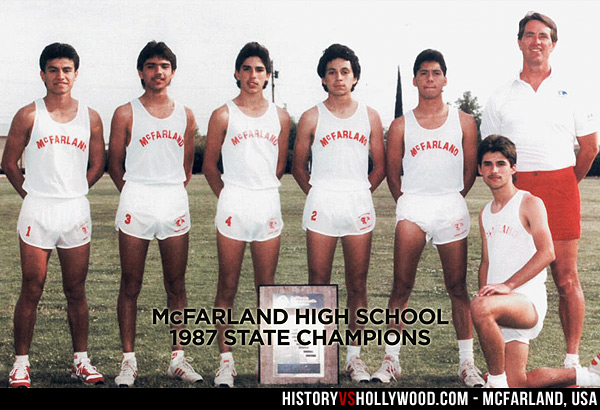
To celebrate turning in grades for me and finishing AP tests for my high schooler, we didn't do anything too fancy, since Dad was out of town, but we did take a break to sit on the couch and watch movies - actually the same movie two times. It's rare for me to watch a movie over again, but McFarland, USA, is just that good.  In fact, it may rank among my favorite movies of all time. We first watched it a few years ago not long after it came out on DVD (2015), but I don't see that I wrote about it. It follows the typical Cinderella sports formula - underdog surprises everyone - but knowing the plot doesn't take away from the emotional resonance of the film.  Perhaps I'm biased towards running movies, but this one presents not just a story of unexpected victory, but also of the importance of family and community bonds, of the value of hard work, of the universality of human dignity, and of the reality of sacrifice and redemption.

Based on the true story of Jim White, a high schooler biology teacher and football coach excellently portrayed by Kevin Costner, who has been fired from multiple schools for losing his temper with his students or players, McFarland, USA, recreates his first year at McFarland High School. Located in the California Central Valley, McFarland is home to California's almond orchards and other agricultural industries. It is not a wealthy or beautiful place, and White only moves his wife and two daughters there because he can't find any other jobs.

He begins the school year teaching life science and PE and coaching football, but conflict with the head football coach ends with White being removed from the coaching roster. As PE coach, he watches his students, mostly Hispanic kids who work on the farms before and after school, run and realizes they are gifted with endurance and speed. After reading in the news about the addition of Cross Country to the list of sports sponsored by the state's sports federation, he asks the principal if he can start a cross country team and apply for funds from the state to underwrite uniforms and coaching. He has to work hard to recruit a team of seven runners - the team leader he saves from suspension for fighting by getting him assigned to the cross country team and a set of three brothers are only allowed to run after he shows up to help them harvest cabbages and share a meal with their family. He reschedules the practice times around their picking schedule to please their tough love mother and foreman father.

Rated PG and produced by Disney, McFarland presents the challenges faced by the working poor Hispanic community and the racial tension between people of different colors in a way that is humanizing and empathetic. You don't have to love running or the sport of Cross Country to enjoy this movie and be touched by the relationships that grow and develop. It's a story about poverty and race, but the real heart of the story is the story of how the runners begin to believe in themselves after they have a little tiny success. Inspired, they put in more time and effort to their training, only to be victorious in their efforts.

Critics of this movie might point out that the ending is predictable, so I don't know that I have to announce spoilers, and viewers don't get a lot of insight into the minds of the runners - Costner's character is the focal point, although he is mostly defined by the way he interacts with others. Neither are the characters completely flat or predictable - for instance, one runner writes poetry that warms an English teacher's heart.  It might not show the really difficult side of being a farm worker, but it does open up the eyes of kids who will never have to work picking cabbages at age 10 to some of the difficulties of being a farm laborer.  It is made for a family audience after all, and other than a scene of suggested violence, it is suitable for the whole family. I admit I let the five-year-old watch it, even though it was probably thematically too mature for her. She's watched a few cross country races herself.

So if you do love Cross Country, this may become your most favorite movie ever, especially if you have watched your kids compete on the same courses, or if you have run across rocky fields from Mile 1 to get a glimpse of your team at mile 2 and then charged across a hile to see them run mile three, and then rushed to the finish line to watch them collapse in exhaustion. If you have watched or been a part of a team of good - but not necessarily great - runners who band together as a team and win competitions to advance to the state finals, even if the individual runners themselves would never win a race, you will love this movie.  Cross Country is a team sport, and even the anchor runner is an important asset, as Danny learns.  It's hard not to cheer at the end of the show.

Related image
https://disneynerds.com/2015/02/18/mcfarland-usa/mcfarland-3/

Read more about the true story of the McFarland HS team and the tragedy of two girl runners who were killed while practicing here: https://johnhartephoto.wordpress.com/2015/02/11/a-glimpse-at-the-real-mcfarland-usa-kids-and-coach-jim-white/

A Hollywood vs. History link about the differences between the true story and the movie: http://www.historyvshollywood.com/reelfaces/mcfarland-usa/

Some of my favorite cross country runners:
Image may contain: 11 people, outdoor and nature


Tuesday, May 7, 2019

The final slog

I can't believe it is early May already. Flowers and trees are profusely blooming. We are still celebrating Easter. But lately it is hard to get out of bed, hard to focus on what people are saying, hard to start or finish things on the to do list, and hard to respond to the needs of the people I love.

Part of my difficulty with these tasks and others is just plain exhaustion. I've been burning the proverbial candle at both ends for too many weeks - late nights, early mornings, long, busy days. And then when I snap at the kids or forget an appointment or realize I have not communicated clearly enough to students, I taunt myself with a wavering vision of what should have been, a dream version of life that serves only to drive home a sense of failure in the immediate, disappointing reality.

And the other night I committed the folly of self-sabotage by staying up late to finish a novel. Because it was good and because I haven't read a novel in too many weeks and because reading is my painkiller of choice. It was Leif Enger's Virgil Wander, which was absorbing, although not a "you've got to read this" type of book (even though I wasn't able to put it down for three hours last night). It's the story of a man who accidentally drives into a lake in frozen Minnesota - an inland lake or Lake Superior? - and survives. The book starts with him leaving the hospital. He has minor brain damage which causes him to forget adjectives and experience other short-term memory lapses. The accident also causes him to rethink the way he lives. A shortcoming of the book might be that the reader never really has a clear grasp of what Virgil was like before the crash, just that he is different in some slight way. He owns a small, independent village movie theater in a down and out former mining town, in addition to working as a town clerk. The novel follows his recovery and his interactions with his neighbors and some newcomers, including the Swedish father of an old friend who disappeared in a flying accident. The book begins slowly, but picks up steam as you begin to care about the characters and their relationships develop. Enger is a good writer, and the characters are mostly appealing, except for the antagonist, a slimy guy who may or may not be the source of the town's bad luck. All is not woe, however; many relationships are begun or strengthened over the course of the year as Virgil gains new perspective on life. A few characters might be just a bit unbelievable in their eccentricities (the sheriff and his fat cat, for instance, which can lower car windows) but most are likable and find themselves climbing out of difficulty rather than into it. So although the town is covered by a dark storm cloud for much of the action, the novel ends on a light note.  What I liked most about it was the way the characters love their home - a sense of community that often seems missing, even though my feelings of exile and homesickness are primarily self-imposed because I refuse to love this place. Or does it refuse to be loved?  In fact, in many ways, the "village" where we live (as it calls itself) is the inverse of Virgil's hometown. We have a small, thriving movie theater, a well-paid, under-worked police force, and perpetual sunshine that hides a dark side.

Reading Enger's book was a bit of bibliotherapy - but also contributed to the problem of avoiding work that needs to be done. It is easy to diagnose errors. I am doing too much and therefore doing nothing well. I have no patience with my middle school track team, whose members have been bonkers lately. They don't want to RUN.  This is TRACK.  Their parents are basically paying for glorified babysitting. I don't know if they expect their children to be better runners by the end of the season - in two blessed weeks - but it is not going to happen. Last year was a better year because we had some older students who actually were motivated to improve and win some races and, more importantly, set a good example of following directions without whining. And we do still have a couple of naturally good runners, but they do other sports and show up to practice only occasionally. It has been a challenge, for sure.

I am also somewhat disappointed with the final essays turned in my college students and am feeling disillusioned. Here I have a difficult time diagnosing whether the failure is mine or theirs. Some of the papers I have been grading are so badly written that I feel no culpability because these reveal a need for remedial writing help.  But other papers are so vague and general in their analysis of an essay, poem, or book not assigned in class that I wonder if I have failed to equip students with the vocabulary they need to talk about nature writing. Do I blather on so much in class that they don't know how to read closely and look for details that support ideas?  On the bright side, many students were gracious and thankful when they turned in their final exams. Maybe they just haven't had enough practice in literary analysis, and my expectations are too high. I have to remind myself this is a general education course, and most of the students are not literature majors. On the bright side, the students who chose to do a creative project instead of analyzing an unassigned text turned in creative, introspective poems and essays that showed thoughtfulness and insight. They had to write an explication of their own work, if they chose to write a creative piece, and these short essays often showed a deeper understanding of the genre. They also were more honest and engaged with ideas and the places described.

As I finish grading, I am rethinking course design for the fall term. I won't completely start from scratch, but I've ordered a new text from Library of America, instead of using the Norton Anthology of Nature Writing, which I liked, but it is expensive, and it is available online, so students always had their laptops up with the excuse of looking at their texts, but I suspect this isn't often the case. I read a lot of essays full of cliches like "This author thinks we need to be one with nature" or generalizations like "This author thinks we should have a relationship with nature." I think I need to spend a class period practicing marking up a text, so that we practice in class finding a passage that answers a question, instead of asking questions and hoping for someone to respond without really teaching them to go to the text for the answer. I also need to be more systematic in the way we discuss what these authors convey about nature and place and focus on whys and hows.

Writing this down has helped me think more hopefully.  Or maybe taking a break to read a book was just what I needed to refocus.  The end of the busy season is nearly here, and soon we will be welcoming the college kids home. Spring may be a little late arriving in my heart, but I feel a little less frozen.

Reading is one form of escape. Running for your life is another.
-Lemony Snicket