Showing posts with label stuff. Show all posts

Tuesday, September 26, 2017

Stuffed

Our garage is looking a little overstuffed.  Boxes line the walls, full of unshelved, unread books, old certificates and artwork, mementos packed in tissues, binders from past jobs, and clothes that don't fit anyone. Bikes hang from the ceiling and lie across the floor, entangled with scooters, roller blades, and ripsticks. Wetsuits drip-dry from a line suspended from hooks hanging down from the ceiling. Suitcases are stacked haphazardly on top of placeless dining chairs. Three old coffee makers await the ewaste pickup day, missed three times.  A "rescued" road sign one of the college kids picked up one night gives me grief because it has no place, and I don't know how to get rid of it and the teen who picked it up is off at college and can't toss it in a dumpster himself.

Six tennis rackets, a box of model trains, dive gear, bike repair tools, a shelf full of offsize cleats, a bin of balls and wooden swords, three sets of golf clubs, 8 folding camp chairs, 2 bins of camping supplies, an overflowing box of sleeping bags. Old blankets, a pack n play, a stroller, a car seat. An old desk, an unused rocking chair, a cupboard full of VHS tapes and CDs. And then a workbench cluttered with tools and hardware and paint and oil and broken things to be fixed. Bags of t-shirts to make into a t-shirt quilt for a graduation present for the kid who graduated three years ago, or throw away.  Three coolers and a water jug. Unnecessary lamps. Bins full of decor for Easter, Halloween and Christmas times four.

The catalog could continue, but you get the idea.  We have a lot of stuff that is used rarely, if ever.  Every so often, once every couple of years usually, we go through things and shred some papers, cull some belongings for the giveaway truck in an attempt to half our belongings, so we don't go over the weight limit when we move. Since we already have more beds, mattresses, chairs, and dressers than the average family because we have a larger than average family, I always feel somewhat concerned about our worldly possessions adding up to more poundage than the average family is allowed.

Since we didn't move this summer (my husband just started a new job for the Navy in an office across the bay and a few miles down the road), I feel out of sorts.  The St. Vincent de Paul truck came to church last weekend, so we loaded up the Suburban with some unused shelves, several bags of cargo shorts and other unstylish clothes, the old crib, extra tennis rackets, and a kid-sized rolling suitcase (because we still have three others), and I meant to throw in an extra scooter no one rides. I even gave away some books.

I would like to keep shedding, to go through boxes of documents and mementos, to get rid of stuff and move on to a new place, despite the glorious weather, pristine gardens, and friendly neighbors at our current location. I would like to move someplace where the rent is less, the yard is more, and the local Catholic school is Catholic and affordable, where the church has an active youth group for teenagers, where we meet with some people who are less concerned about temporal things and more concerned with eternity. I would like to someday be able to paint the walls the color I like and plant a tree that I will see fruit.  I would also like to quit some volunteer duties gracefully - by moving.

But the Navy still has the upper hand for a few more years, and here we stay for at least two of those.

In my mind and heart, I know that we are lucky to get to stay. A lot of people would be thrilled to stay put for a few more years, especially with a senior in high school.

But I feel the weight of the stuff. It accumulates with time, and fear keeps it around - a fear of needing it the next time around, of getting rid of it and then wishing we had it. Or maybe it is a fear of forgetting, of not having a history without it.  The longer something stays around, even if it is something silly like an old paper, the harder it is to part with it.

All the natural disasters the past few weeks are a reminder of how quickly stuff can be lost. And of how unnecessary it is to survival.  Carrying the weight of having to stay in a place long enough to get tired of the responsibilities, the duties, the frustrations with schools, the disappointment with the okay youth program, the potential for what could be good, but just doesn't quite measure up,  the burdens of friendship and not-friendships, of fees and uniforms, and teams is tiring. This is my lament for the week.  Tomorrow I'll feel grateful again, and I'll move on to the next thing, and try not to think about everything in the garage basement for a few more months.

Instead of quitting it all, finding a dumpster, and moving away, I will stay put and keep at it, or say I'm sorry, I can't, or find someone else.  I will be grateful for the chance to stay with something for a change. At least I know a few someones now.

Monday, September 16, 2013

Foolishness

Just returned home from shopping with my sister-in-law. We hit a couple of estate sales and a thrift store, on the hunt for chairs and bookshelves.  This area is famous for its recycling of stuff. It probably has the highest thrift store per person ratio in the world.

But so much is worthless. At least to me. At the first sale, we waded through tables of porcelain animals, glass perfume bottles, and old books.  Some little old woman (her housecoats and slippers all for sale in her handicapped accessible bathroom) had lived here and accumulated a lifetime of memorabilia.  All of these little things must of had value to this lady at some point.  Maybe a granddaughter gave her the unicorn. Maybe she collected bottles from trips.  She also had lots of original artwork by the same two amateur artists - perhaps her friends, because her own set of paints and unused sketchbooks were for sale. My sister-in-law bought an oil painting. I lingered over a watercolor of a tree, but passed on it because we have two boxes of pictures in frames that we don't have room for.

Didn't find any chairs but I did buy two things that also have little or no intrinsic worth: a little bookshelf with doors (inconvenient! But cute!) and an old copy of Dante's Inferno illustrated by Gustave Dore. I don't need this! Why did I cave to the acquistive urge?

Easy answers: 1. Shopping with someone else always  leads me to buy more. 2. I imagined that I would regret not buying them when I got home if I didn't buy them.  3. Neither was very expensive - in fact, they were bargains. Maybe I can think of it as a donation to the fund to pay off this little old lady's debts.

Instead I feel a little guilty carrying them into the house.  We're supposed to be shedding belongings because our space is limited. Down with clutter!

The truth is I bought these things to fit some image of what I wish life was like. I wish I had a spot for a collection of antique books, maybe an office where these could be on display. But the reality is that I don't. The shelf may end up going in the girls' room to hold doll things. The book will be stashed in a corner somewhere with other books that won't be looked at.

At least this foolish indulgence will cure me of acquisitiveness for a period.

And my most recent read has cured me of any desire to go on a cruise, not that I ever have desired that.

Katherine Anne Porter's Ship of Fools focuses on the foibles and faults of a group of transatlantic passengers. The book has been in my possession since my husband went to graduate school  - a  discarded library book - so for about 8 years I have been shipping it around. Now I finally read it, and I should pass it on, because while I appreciated Porter's witty observations of human nature and her artful prose, I don't anticipate ever reading it again, or encouraging any of my offspring to read it.

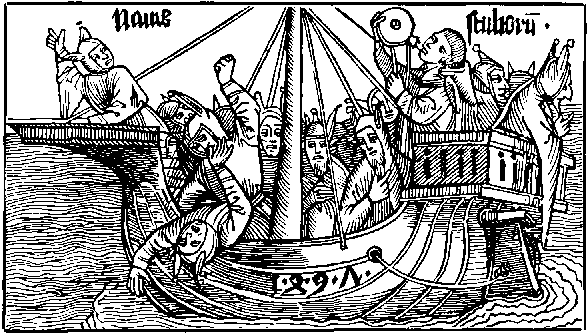
I was in the mood for something more uplifting, so my opinion may be colored by my mood. This book is a downer, as the title suggests and the frontispiece confirms - a reproduction of an early Renaissance woodcut that illustrated a German version of the allegorical "ship of fools," the travelers on the journey of life to eternity. The book is divided into three parts: "Embarkation," "High Sea," and "The Harbors."   The plot follows a group of travelers aboard a second class German cruise ship, the symbolically named Vera, leaving Veracruz, Mexico, heading to Bremerhaven, Germany.  Most of the first class passengers are German, except for 4 Americans, 8 Spanish dancers, a zarzuela company, the Spanish version of Gypsies, a Spanish countess being deported for traitorous crimes, a Cuban bride and groom, who are never named, a young Mexican mother married to a diplomat, traveling with her Indian (meaning native) nurse,  a couple of Mexican priests, a Swiss family, and a Swedish man. In steerage are nearly 900 Spanish field workers being deported because of the sugar cane crash in Mexico. The ship's company provides the rest of the cast, notably the doctor, the only authentically religious character above deck, and the captain, an authoritarian German.

It is an immense cast, but not terribly hard to keep track of, because the characters are almost all stereotypes. Their flaws are noted with biting attention, like exaggerated caricatures, and only occasionally are they given a human softness (perhaps in keeping with the allegorical tone).  None of them is particularly an admirable character, although the bride and groom and the Spanish mother are perhaps the ideals. They have only bit parts to play - perhaps as contrasts of true love and motherhood in contrast to the rest of the dysfunctional characters. I had a little sympathy for the German doctor, who is a pious Catholic, but who nonetheless falls in love, inexplicably, with the Condessa, who is sickly and addicted to drugs. To avoid her attractions, he drugs her more, only to repent of his actions when she is finally let off the ship to live out her exile on a Spanish island. He "tormented her with his guilty love and yet had refused her -- and himself -- any human joy in it." But his suffering does give him compassion for his fellow sufferers.

The vivacious young American painter, Jenny, is apparently loosely based on Porter's younger self.  She's been in Mexico protesting inequality, she lives a Bohemian life, but misses her family (her softness), she is repulsed by the anti-Semitism of the Germans but can't bring herself to feel much sympathy for the one Jew on the ship, or to see the passengers in steerage as individuals. She can't seem to love her boyfriend or get rid of him.  But she does seem to mean well and to pursue beauty and goodness in her own flawed way. She seems to be able to overlook the meanness of others out of a kind of simpleness, for instance on her family: "She had spent years of strategic warfare trying to beat those people out of her life; then more years trying to ignore them; to forget them; to hate them; and in the end she loved them as she knew well she was meant in simple nature to do, and acknowledge it; it brought her no peace, and yet it put a certain solid ground under her feet."

The crossing is taking place in 1931, which was just as the Nazi party was beginning to gain momentum and Spain and Mexico were politically tumultuous and America was suffering a depression. An interesting time frame, but since the action takes place on the ship, history figures in only through the characters' personalities and expressions and their reactions to their fellow travelers. The wealthy Germans seem particularly distasteful for their prejudices.

Since the title comes from an allegory one might think that the book would have a message or lesson, but few of the characters are changed by their proximity to people they might otherwise never come across.  A few scenes read strongly as symbolic: for instance, when one of the peasants in steerage dies while trying to rescue a beloved bulldog. The dog lives and is pampered, while the man is drowned and given a burial at sea. A fight breaks out between the believers and the atheists in the steerage as his body is dumped into the sea. Meanwhile, the owners of the dog can't even remember the name of the man who rescued their pet and resolve that they need do nothing to show their gratitude.

If there is any, the message seems to be an observation about the capacity people have to be small and ugly to one another and unsympathetic to their fellows, especially if their own comfort is challenged.  Even if they are forced to confront their weaknesses and faults, the characters don't make amends or seem to have any motivation to be better than what they are. They seek stimulation or numbness through sex and alcohol. They either fear public opinion or flaunt it, but don't seem to seek authenticity, except maybe the Spanish dancers who don't hide their sins of thieving and prostitution because they recognize that none of the other passengers has enough courage to challenge them. The dancers hold a huge fiesta their last night on the ship, and while the other passengers scorn the idea, they nevertheless come to the party, or linger on its edges observing while the event turns bacchanalian.

After this last debauchery, the passengers are subdued, perhaps chastened, perhaps ill. Some of the potential romances are squelched as the true natures of the lovers come out in the alcohol soaked lack of inhibitions.  And as the ship nears harbor, the characters naturally withdraw from the quickly formed and somewhat forced friendships they have begun.  They become strangers again, but they are cordial as they depart the ship. Even the American lovers are reconciled, although aware that their romance may not last. The final image is of one of the ship's musicians, a young boy, looking at the harbor, whispering, "'Gruss Gott, Gruss Gott,' as if the town were a human being, a good and dear trusted friend who had come a long way to welcome him." Perhaps the vision of the homeland, the final destination, is the only consolation.

Porter was not apparently religious and lived a morally questionable life herself, according to a review of her bibliography. But supposedly she did twice flirt with Catholicism, at least according to Wikipedia. Her view of human nature seems to encompass more of the proclivity to sin than the desire for salvation, but it sounds like she spent her life in a desperate search for love that couldn't be found in other people without being able to make her way to God.  Nonetheless, she can have the doctor think, "Let science do what it might, there was a mystery in the destiny of man beyond fathoming except in the light of divine revelation; at the very bottom of life there is an unanswerable riddle, and it is just there, . . .  where man leaves off and God begins." And perhaps that is what gives him, and the author, compassion for her foolish characters.

Wednesday, July 14, 2010

Home again, home again, jiggety jog

After 5092 miles, the last 200 or so along the gulf coast without a/c, we returned from our six week vacation. We got home with just enough time before bed to unload the vehicle, have a supper snack of baked spaghetti I put in the freezer sometime back in May, scout out 5 dead palmetto bugs and a rhinoceros beetle downstairs and a pale, blind baby gecko in the bathtub upstairs. The toilets were spotted with rust and mold, but otherwise everything seemed pretty much the same as we left it, including the laundry in the dryer, which, thanks be, had dried thoroughly.

Returning to temps in triple digits and humidity about that high made me wish I might have stayed a couple more weeks up north, but the kids were thrilled to see their toys again. My older daughter unpacked her birthday gifts, rearranged her doll tableau, and had her clothes put away before the boys were done getting in and out of the shower. Of course, they had wasted a bit of time making sure all their legos still existed. And they unpacked their bags, too. To them, this means dumping the contents of the suitcase on the floor and putting the suitcase over by the storage closet. My oldest has told me he is just going to wear the clothes on the floor until the pile is gone. I suppose I should be glad he’s not getting new clothes out.

Meanwhile, I’m feeling the way I often do after a long vacation: overwhelmed by stuff. If I can live for 6 weeks from a suitcase – and not even wear half of what I brought – why do I have so many clothes? (and the kids so many toys?) I fully intended to reduce drastically my skirt and t-shirt supply today, but when push came to shove, I couldn’t decide what I liked least. I like all my skirts. You’d think since I’d paid so little for them, I’d have an easier time parting with them. The problem with shopping at thrift stores is that, while you can buy a new outfit for $5, you’re always a little afraid that that outfit is the last cute thing you’ll ever find in your size. I need someone (Betty?) to come and tell me what to throw out. (Freedom in obedience!) It’s easier for me to sort through other people’s stuff: my mom’s, or the boys’, and pick out their week’s worth of clothes to keep. Plus, each kid only gets two drawers, so if they have more than what fits, the extra becomes hand-me-downs, but I have six drawers and a large closet, which isn’t entirely stuffed. After being inspired by the Franciscan way of life in The Right to Be Merry, I thought I’d have an easier time with cleaning stuff out.

I’ve had the same problem with the kids’ schoolwork, which was dropped in the office as we headed out the door back in May. Each kid now has a pile of artwork and papers. I’ve recycled all the worksheets and coloring pages, but I’m trying to pick out the few items that best express each kid’s personality to keep in a file folder until they grow up and decide what to do with it. I’m also trying to keep the piles even, so that someday in the future, some kid won’t question me about why so and so’s pile is bigger – did I think he was more talented? Did I love him more? But the kindergartener used reams of paper to illustrate his superhero saga and to design cruise ships a la Richard Scarry, while the seventh grader only has a few book reports that reveal something of his personality after I’ve thrown out the tests and quizzes.

Time to get rid of more paper before the mail arrives tomorrow.
Reading is one form of escape. Running for your life is another.
-Lemony Snicket