Just returned home from shopping with my sister-in-law. We hit a couple of estate sales and a thrift store, on the hunt for chairs and bookshelves. This area is famous for its recycling of stuff. It probably has the highest thrift store per person ratio in the world.
But so much is worthless. At least to me. At the first sale, we waded through tables of porcelain animals, glass perfume bottles, and old books. Some little old woman (her housecoats and slippers all for sale in her handicapped accessible bathroom) had lived here and accumulated a lifetime of memorabilia. All of these little things must of had value to this lady at some point. Maybe a granddaughter gave her the unicorn. Maybe she collected bottles from trips. She also had lots of original artwork by the same two amateur artists - perhaps her friends, because her own set of paints and unused sketchbooks were for sale. My sister-in-law bought an oil painting. I lingered over a watercolor of a tree, but passed on it because we have two boxes of pictures in frames that we don't have room for.
Didn't find any chairs but I did buy two things that also have little or no intrinsic worth: a little bookshelf with doors (inconvenient! But cute!) and an old copy of Dante's
Inferno illustrated by Gustave Dore. I don't need this! Why did I cave to the acquistive urge?
Easy answers: 1. Shopping with someone else always leads me to buy more. 2. I imagined that I would regret not buying them when I got home if I didn't buy them. 3. Neither was very expensive - in fact, they were bargains. Maybe I can think of it as a donation to the fund to pay off this little old lady's debts.
Instead I feel a little guilty carrying them into the house. We're supposed to be shedding belongings because our space is limited. Down with clutter!
The truth is I bought these things to fit some image of what I wish life was like. I wish I had a spot for a collection of antique books, maybe an office where these could be on display. But the reality is that I don't. The shelf may end up going in the girls' room to hold doll things. The book will be stashed in a corner somewhere with other books that won't be looked at.
At least this foolish indulgence will cure me of acquisitiveness for a period.
And my most recent read has cured me of any desire to go on a cruise, not that I ever have desired that.
Katherine Anne Porter's
Ship of Fools focuses on the foibles and faults of a group of transatlantic passengers. The book has been in my possession since my husband went to graduate school - a discarded library book - so for about 8 years I have been shipping it around. Now I finally read it, and I should pass it on, because while I appreciated Porter's witty observations of human nature and her artful prose, I don't anticipate ever reading it again, or encouraging any of my offspring to read it.
I was in the mood for something more uplifting, so my opinion may be colored by my mood. This book is a downer, as the title suggests and the frontispiece confirms - a reproduction of an early Renaissance woodcut that illustrated a German version of the allegorical "ship of fools," the travelers on the journey of life to eternity. The book is divided into three parts: "Embarkation," "High Sea," and "The Harbors." The plot follows a group of travelers aboard a second class German cruise ship, the symbolically named
Vera, leaving Veracruz, Mexico, heading to Bremerhaven, Germany. Most of the first class passengers are German, except for 4 Americans, 8 Spanish dancers, a
zarzuela company, the Spanish version of Gypsies, a Spanish countess being deported for traitorous crimes, a Cuban bride and groom, who are never named, a young Mexican mother married to a diplomat, traveling with her Indian (meaning native) nurse, a couple of Mexican priests, a Swiss family, and a Swedish man. In steerage are nearly 900 Spanish field workers being deported because of the sugar cane crash in Mexico. The ship's company provides the rest of the cast, notably the doctor, the only authentically religious character above deck, and the captain, an authoritarian German.
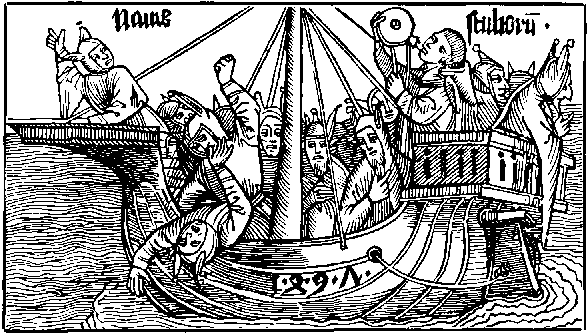
It is an immense cast, but not terribly hard to keep track of, because the characters are almost all stereotypes. Their flaws are noted with biting attention, like exaggerated caricatures, and only occasionally are they given a human softness (perhaps in keeping with the allegorical tone). None of them is particularly an admirable character, although the bride and groom and the Spanish mother are perhaps the ideals. They have only bit parts to play - perhaps as contrasts of true love and motherhood in contrast to the rest of the dysfunctional characters. I had a little sympathy for the German doctor, who is a pious Catholic, but who nonetheless falls in love, inexplicably, with the Condessa, who is sickly and addicted to drugs. To avoid her attractions, he drugs her more, only to repent of his actions when she is finally let off the ship to live out her exile on a Spanish island. He "tormented her with his guilty love and yet had refused her -- and himself -- any human joy in it." But his suffering does give him compassion for his fellow sufferers.
The vivacious young American painter, Jenny, is apparently loosely based on Porter's younger self. She's been in Mexico protesting inequality, she lives a Bohemian life, but misses her family (her softness), she is repulsed by the anti-Semitism of the Germans but can't bring herself to feel much sympathy for the one Jew on the ship, or to see the passengers in steerage as individuals. She can't seem to love her boyfriend or get rid of him. But she does seem to mean well and to pursue beauty and goodness in her own flawed way. She seems to be able to overlook the meanness of others out of a kind of simpleness, for instance on her family: "She had spent years of strategic warfare trying to beat those people out of her life; then more years trying to ignore them; to forget them; to hate them; and in the end she loved them as she knew well she was meant in simple nature to do, and acknowledge it; it brought her no peace, and yet it put a certain solid ground under her feet."
The crossing is taking place in 1931, which was just as the Nazi party was beginning to gain momentum and Spain and Mexico were politically tumultuous and America was suffering a depression. An interesting time frame, but since the action takes place on the ship, history figures in only through the characters' personalities and expressions and their reactions to their fellow travelers. The wealthy Germans seem particularly distasteful for their prejudices.
Since the title comes from an allegory one might think that the book would have a message or lesson, but few of the characters are changed by their proximity to people they might otherwise never come across. A few scenes read strongly as symbolic: for instance, when one of the peasants in steerage dies while trying to rescue a beloved bulldog. The dog lives and is pampered, while the man is drowned and given a burial at sea. A fight breaks out between the believers and the atheists in the steerage as his body is dumped into the sea. Meanwhile, the owners of the dog can't even remember the name of the man who rescued their pet and resolve that they need do nothing to show their gratitude.
If there is any, the message seems to be an observation about the capacity people have to be small and ugly to one another and unsympathetic to their fellows, especially if their own comfort is challenged. Even if they are forced to confront their weaknesses and faults, the characters don't make amends or seem to have any motivation to be better than what they are. They seek stimulation or numbness through sex and alcohol. They either fear public opinion or flaunt it, but don't seem to seek authenticity, except maybe the Spanish dancers who don't hide their sins of thieving and prostitution because they recognize that none of the other passengers has enough courage to challenge them. The dancers hold a huge fiesta their last night on the ship, and while the other passengers scorn the idea, they nevertheless come to the party, or linger on its edges observing while the event turns bacchanalian.
After this last debauchery, the passengers are subdued, perhaps chastened, perhaps ill. Some of the potential romances are squelched as the true natures of the lovers come out in the alcohol soaked lack of inhibitions. And as the ship nears harbor, the characters naturally withdraw from the quickly formed and somewhat forced friendships they have begun. They become strangers again, but they are cordial as they depart the ship. Even the American lovers are reconciled, although aware that their romance may not last. The final image is of one of the ship's musicians, a young boy, looking at the harbor, whispering, "'
Gruss Gott, Gruss Gott,' as if the town were a human being, a good and dear trusted friend who had come a long way to welcome him." Perhaps the vision of the homeland, the final destination, is the only consolation.
Porter was not apparently religious and lived a morally questionable life herself, according to
a review of her bibliography. But supposedly she did twice flirt with Catholicism, at least according to
Wikipedia. Her view of human nature seems to encompass more of the proclivity to sin than the desire for salvation, but it sounds like she spent her life in a desperate search for love that couldn't be found in other people without being able to make her way to God. Nonetheless, she can have the doctor think, "Let science do what it might, there was a mystery in the destiny of man beyond fathoming except in the light of divine revelation; at the very bottom of life there is an unanswerable riddle, and it is just there, . . . where man leaves off and God begins." And perhaps that is what gives him, and the author, compassion for her foolish characters.


.jpg)
.jpg)


