Monday, September 30, 2013

So much to see


Hike one, near Thousand Oaks


Hike 2, near Santa Paula


The Gipper's ND jacket, at the Reagan library

Air Force One

Abraham Lincoln's stovepipe hat. 

Ronald Reagan's grave.

Hike 3, near Fillmore. Sespe Condor refuge. No condors sited.


The falls were a little dry.

Water should be flowing here.

Rock hopping

Friday, September 27, 2013

Fighting ugly thoughts

Remember that "health concern" I mentioned in the running post?  Now that we've told our parents and kids, I can announce here that I'm pregnant again - our seventh child is 13 weeks gestational age.

It has taken me some time to be able to able to admit that. Getting pregnant was not what I was planning to do in my 40th year, or anytime thereafter. Even though theoretically we've joked about a "surprise baby" when people asked about having more kids, I didn't really intend to have that baby. People had stopped asking around the time our youngest turned three or four. Now she's seven.  I thought we had NFP all figured out.  I thought I was too old.

I'm no longer a cheerleader for NFP.  I feel betrayed by it.  I am no poster child for the NFP user, accepting children if they come. I've had a hard time accepting this. I really believed I'd miscarry, and I hoped for it. I have new empathy for women who consider abortion. I've wished I had cancer.

I know that's a terrible thing to say, especially to someone who has had cancer or lost someone to cancer.  But parts of me are dying right now. And other parts I need to kill off.  I am not suffering well.  Is it in my imagination that I am persecuted?  The worst culprit is myself. I keep dwelling on how for months and years, I am going to be incapacitated by pregnancy, childbearing, and nursing.  If only it were cancer or leukemia, or some other illness, then people would feel sorry for me instead of looking at me like I'm a crazy person and a danger to society.

To add to the self-inflicted persecution, I remind myself that this condition is entirely my fault. There have been times when I've thought, "Oh no, we've pushed the limits; that was a bad idea," and we didn't get pregnant, but that didn't happen back in July.  We barely acted as if we were married while living in that tiny apartment.  I thought I read all the signs correctly. But it was a stressful time. I was having something like an anxiety attack over housing. I barely ate or slept for three days. That stress must have thrown my cycle off, a rogue ovulation.

I'm finding it hard to forgive myself. I'm angry and disappointed in my failure both to prevent this and to accept it. When I wake in the morning, for a moment I forget the heaviness in my stomach.  Or I think it might be a dream. Or it might not come true.  And then reality sets in, and my stomach aches, and I don't want to get up. I'm edgy and grim during the day. I can't focus on anything because I've got a constant refrain on rewind running through my head, "I don't want to do this! I don't want to do this!"

When I lay down at night, ugly thoughts crowd my brain. Although I'm physically exhausted, my mind runs in circles, contemplating the worst. Embarrassment, harrassment, embarrassment for my children, defects, twins, illness, exhaustion, depression.  My thoughts turn rebellious and angry and hostile.  I fear my unhappiness will seep into my blood and poison the tiny thing.

I usually try not to look to far ahead. Theoretically as a Christian and practically as a Navy wife, I know that I can't control the future. I know everything changes. I wish I could approach these new changes with an attitude of "Sometimes life throws you a curve ball." or "Life is what happens when you are busy making plans" and a smile. But these glib phrases would only be good for a Facebook post that would euphemistically refer to what feels devastating.  I did have plans for the immediate future and hazy ideas about what the next few years were supposed to look like.  All my kids are in school. I had applied for an adjunct job. I loved teaching at the community college and was finally feeling like I was improving at it when we moved. I was hoping that somewhere in the area I could find a similar position. I was thinking about working as a substitute teacher and looking into educational options for myself if I didn't get the adjunct job.

Now teaching in the spring is no longer a possibility.  My husband has tried to be encouraging by saying things like he's going to get up in the night, and we can put the baby in daycare if I want. But I don't really want that. My hardness of heart and selfishness aren't just about not being able to work or having to give up running for awhile or dealing with the physical discomforts.Those things are all difficult, but the real challenge is accepting another lifetime of the care and worry that come with a child. I'm afraid I'm not strong enough or generous enough to love this child. I am weak, weak, weak.

For weeks, I've been full of dread, unable to silence the refrain of I can't do this; I don't want to do this. I don't want to admit I feel this way, to reveal how shriveled my heart has been, how small my soul.

I finally went to confession last week.  I told the priest that I wished this embryo would die. Ugly, ugly, ugly thoughts. But the priest saved me. "You say you have six children and this is your seventh?" He paused.  "I am my mother's seventh child."

This is a man who is joyful in his vocation, who is reverent at Mass and congenial afterwards.  He is beloved by the congregation. His mother must be proud and full of love for this son. "Six in the Bible is an incomplete number. Seven is the number of perfection." He said this in a tone that indicated both a jest and a serious consideration. "Our development as adults is supposed to help us move from our initial psychological reaction through reason and grace to a more mature response. You can decide to accept this as a blessing or to reject it. If you accept it as a blessing, it is a blessing."

He didn't say anything really that I don't know, but his words softened my heart. The grace of the sacrament opened me up to loving this child. I can say "this baby" now.

Encouraged by seeing the face of a seventh child in the priest and by a spontaneous visit by my own mother, we told the kids the news this weekend.  My husband began dinner by reading the prayer for expectant mothers from our family prayer book.  At first the kids didn't pick up on the inference, until my third son said, "Mom?!"  I don't suppose it's motherly to blush in front of your children, but as the realization spread around the table, I felt self-conscious about my fears and embarrassment.  All of them, even the 15 and 16 year old, seem excited.  (although the seven year old cried at bedtime, afraid I would have a c-section, so she said, but perhaps also subconsciously afraid of impending changes.)

Much of my darkness has lifted. The younger kids come home from school and pat my belly, which at this stage looks bloated - like I've gained weight but still not obviously pregnant. The awkward stage. The 15 year old pats my belly and says "Goodnight, Herm" for hermano/hermana. The 16 year old, my cross country runner, pats my shoulders and asks if I'm slowing down on my runs. (emphatic yes. But still running more and faster than I did with the fifth and sixth.)

Yesterday I went to the doctor for the first time, another anxiety-fraught moment.  I had debated about what doctor to see, read countless reviews online (not helpful), driven by the two hospitals that I can chose from for delivery, calculated costs to pay a midwife and have a birthing center birth, tried to seem nonchalant when I asked mothers with little babies at school drop-off what doctor delivered their little precious bundles of joy.  Finally I called the crisis pregnancy center and asked what doctors they recommended. They offered assistance, which I declined, feeling weird about having called. "I just want to give my business to a doctor who supports you," I said.

The doctor I saw yesterday is a part of the practice of one of the recommended doctors (who was not taking new patients). She went to med school in her 30's after supporting her husband's military career. Although I was highly sensitive to being asked about contraception or belittled for being careless about having yet another child (which happened with my fourth), happily I did not feel criticized or embarrassed. Both the doctor and the nurse were congratulatory and respectful.  I did get sent to the perinatalogist right away, because I am so old and so far along that I am almost out of the 14 week window for certain genetic tests, a window that is probably defined by abortion options.  So from my initial appointment, I went to another doctor twenty minutes farther away to meet with the genetic counselor and get blood work done and a thorough ultrasound. The geneticist was encouraged by the fact that out of the 19 grandchildren on both my husband's side and my side of the family (if you count my 6 kids on both sides), there are no notable genetic abnormalities. There aren't even really any major allergy concerns out of those 32 kids (not counting my kids twice). Our parents have high cholesterol and late onset cancers that have been treated, but are relatively healthy. My husband and I have clean bills of health and all of our children are healthy and had easy deliveries. A remarkably healthy family tree.  We are blessed.

My fears were further allayed by the ultrasound. There is the tiny heartbeat pounding rapidly. Only one - no twins, although I had thought that twins would keep each other company. The alien face. The hands and legs jerking about. "Your baby is so active I can't get a good picture," says the ultrasound tech.  Too early to definitively discern gender but its nasal bone is visible. Its neck is not too thick. The indicators of certain abnormalities are not evident.  So far, so good.

I sleep a little better, although already I have to get up at night to go to the bathroom. I've started to glance at flyers for sales on baby items. My mom brought me some maternity clothes from my sister that I want to hide in the back of the closet, except for a cute skirt and blouse.  We went into the luxe baby boutique, and ohhed and ahhed, but know we'll buy most of the baby stuff at the thrift store. (Not long ago I gave away the baby jogger and portacrib, of course. All we have left are the high chair, some handmade baby blankets, and the cutest of the infant clothes.)

Slowly, the refrain is fading.  The kids want to talk about names and how we'll arrange the seating in the car and who will get to hold the baby first (the one who rubs my feet the most).  I still am looking into online jobs.  Last night I went to an information night about applying for college financial aid and spent much of the evening wondering what life will be like for this child who will be so far behind his brothers and sisters. They'll all go off to college soon. I still feel a sense of loss, but my other kids are helping me to think of this baby as a gift.

Kinda cute little munchkie, isn't it?

Tuesday, September 17, 2013

Things That Make Me Happy

My big boys still like picking vegetables.
My youngest does not think laboring in the fields is fun.
The bounty of our labor.


Cross Country Season!

Tide pool treasures

Uncovered by the surf.

Fishing is fun, as long as you catch something,
no matter how small.

A little bit of water brings forth great beauty.
I don't know if California's climate is suited to roses
or if there are just a lot of dedicated rose gardeners
in California. I've notice a lot of flourishing roses. This
bush was languishing until I started watering it.
Another beautiful evening from our brother-in-law's backyard.


Monday, September 16, 2013

Foolishness

Just returned home from shopping with my sister-in-law. We hit a couple of estate sales and a thrift store, on the hunt for chairs and bookshelves.  This area is famous for its recycling of stuff. It probably has the highest thrift store per person ratio in the world.

But so much is worthless. At least to me. At the first sale, we waded through tables of porcelain animals, glass perfume bottles, and old books.  Some little old woman (her housecoats and slippers all for sale in her handicapped accessible bathroom) had lived here and accumulated a lifetime of memorabilia.  All of these little things must of had value to this lady at some point.  Maybe a granddaughter gave her the unicorn. Maybe she collected bottles from trips.  She also had lots of original artwork by the same two amateur artists - perhaps her friends, because her own set of paints and unused sketchbooks were for sale. My sister-in-law bought an oil painting. I lingered over a watercolor of a tree, but passed on it because we have two boxes of pictures in frames that we don't have room for.

Didn't find any chairs but I did buy two things that also have little or no intrinsic worth: a little bookshelf with doors (inconvenient! But cute!) and an old copy of Dante's Inferno illustrated by Gustave Dore. I don't need this! Why did I cave to the acquistive urge?

Easy answers: 1. Shopping with someone else always  leads me to buy more. 2. I imagined that I would regret not buying them when I got home if I didn't buy them.  3. Neither was very expensive - in fact, they were bargains. Maybe I can think of it as a donation to the fund to pay off this little old lady's debts.

Instead I feel a little guilty carrying them into the house.  We're supposed to be shedding belongings because our space is limited. Down with clutter!

The truth is I bought these things to fit some image of what I wish life was like. I wish I had a spot for a collection of antique books, maybe an office where these could be on display. But the reality is that I don't. The shelf may end up going in the girls' room to hold doll things. The book will be stashed in a corner somewhere with other books that won't be looked at.

At least this foolish indulgence will cure me of acquisitiveness for a period.

And my most recent read has cured me of any desire to go on a cruise, not that I ever have desired that.

Katherine Anne Porter's Ship of Fools focuses on the foibles and faults of a group of transatlantic passengers. The book has been in my possession since my husband went to graduate school  - a  discarded library book - so for about 8 years I have been shipping it around. Now I finally read it, and I should pass it on, because while I appreciated Porter's witty observations of human nature and her artful prose, I don't anticipate ever reading it again, or encouraging any of my offspring to read it.

I was in the mood for something more uplifting, so my opinion may be colored by my mood. This book is a downer, as the title suggests and the frontispiece confirms - a reproduction of an early Renaissance woodcut that illustrated a German version of the allegorical "ship of fools," the travelers on the journey of life to eternity. The book is divided into three parts: "Embarkation," "High Sea," and "The Harbors."   The plot follows a group of travelers aboard a second class German cruise ship, the symbolically named Vera, leaving Veracruz, Mexico, heading to Bremerhaven, Germany.  Most of the first class passengers are German, except for 4 Americans, 8 Spanish dancers, a zarzuela company, the Spanish version of Gypsies, a Spanish countess being deported for traitorous crimes, a Cuban bride and groom, who are never named, a young Mexican mother married to a diplomat, traveling with her Indian (meaning native) nurse,  a couple of Mexican priests, a Swiss family, and a Swedish man. In steerage are nearly 900 Spanish field workers being deported because of the sugar cane crash in Mexico. The ship's company provides the rest of the cast, notably the doctor, the only authentically religious character above deck, and the captain, an authoritarian German.
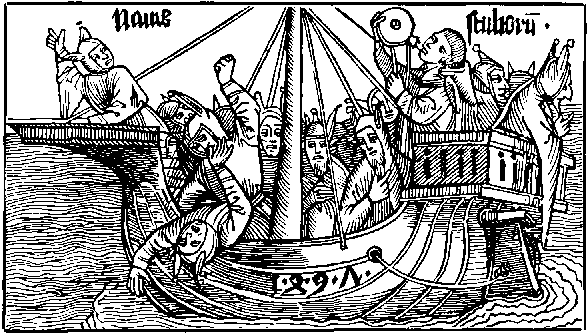
It is an immense cast, but not terribly hard to keep track of, because the characters are almost all stereotypes. Their flaws are noted with biting attention, like exaggerated caricatures, and only occasionally are they given a human softness (perhaps in keeping with the allegorical tone).  None of them is particularly an admirable character, although the bride and groom and the Spanish mother are perhaps the ideals. They have only bit parts to play - perhaps as contrasts of true love and motherhood in contrast to the rest of the dysfunctional characters. I had a little sympathy for the German doctor, who is a pious Catholic, but who nonetheless falls in love, inexplicably, with the Condessa, who is sickly and addicted to drugs. To avoid her attractions, he drugs her more, only to repent of his actions when she is finally let off the ship to live out her exile on a Spanish island. He "tormented her with his guilty love and yet had refused her -- and himself -- any human joy in it." But his suffering does give him compassion for his fellow sufferers.

The vivacious young American painter, Jenny, is apparently loosely based on Porter's younger self.  She's been in Mexico protesting inequality, she lives a Bohemian life, but misses her family (her softness), she is repulsed by the anti-Semitism of the Germans but can't bring herself to feel much sympathy for the one Jew on the ship, or to see the passengers in steerage as individuals. She can't seem to love her boyfriend or get rid of him.  But she does seem to mean well and to pursue beauty and goodness in her own flawed way. She seems to be able to overlook the meanness of others out of a kind of simpleness, for instance on her family: "She had spent years of strategic warfare trying to beat those people out of her life; then more years trying to ignore them; to forget them; to hate them; and in the end she loved them as she knew well she was meant in simple nature to do, and acknowledge it; it brought her no peace, and yet it put a certain solid ground under her feet."

The crossing is taking place in 1931, which was just as the Nazi party was beginning to gain momentum and Spain and Mexico were politically tumultuous and America was suffering a depression. An interesting time frame, but since the action takes place on the ship, history figures in only through the characters' personalities and expressions and their reactions to their fellow travelers. The wealthy Germans seem particularly distasteful for their prejudices.

Since the title comes from an allegory one might think that the book would have a message or lesson, but few of the characters are changed by their proximity to people they might otherwise never come across.  A few scenes read strongly as symbolic: for instance, when one of the peasants in steerage dies while trying to rescue a beloved bulldog. The dog lives and is pampered, while the man is drowned and given a burial at sea. A fight breaks out between the believers and the atheists in the steerage as his body is dumped into the sea. Meanwhile, the owners of the dog can't even remember the name of the man who rescued their pet and resolve that they need do nothing to show their gratitude.

If there is any, the message seems to be an observation about the capacity people have to be small and ugly to one another and unsympathetic to their fellows, especially if their own comfort is challenged.  Even if they are forced to confront their weaknesses and faults, the characters don't make amends or seem to have any motivation to be better than what they are. They seek stimulation or numbness through sex and alcohol. They either fear public opinion or flaunt it, but don't seem to seek authenticity, except maybe the Spanish dancers who don't hide their sins of thieving and prostitution because they recognize that none of the other passengers has enough courage to challenge them. The dancers hold a huge fiesta their last night on the ship, and while the other passengers scorn the idea, they nevertheless come to the party, or linger on its edges observing while the event turns bacchanalian.

After this last debauchery, the passengers are subdued, perhaps chastened, perhaps ill. Some of the potential romances are squelched as the true natures of the lovers come out in the alcohol soaked lack of inhibitions.  And as the ship nears harbor, the characters naturally withdraw from the quickly formed and somewhat forced friendships they have begun.  They become strangers again, but they are cordial as they depart the ship. Even the American lovers are reconciled, although aware that their romance may not last. The final image is of one of the ship's musicians, a young boy, looking at the harbor, whispering, "'Gruss Gott, Gruss Gott,' as if the town were a human being, a good and dear trusted friend who had come a long way to welcome him." Perhaps the vision of the homeland, the final destination, is the only consolation.

Porter was not apparently religious and lived a morally questionable life herself, according to a review of her bibliography. But supposedly she did twice flirt with Catholicism, at least according to Wikipedia. Her view of human nature seems to encompass more of the proclivity to sin than the desire for salvation, but it sounds like she spent her life in a desperate search for love that couldn't be found in other people without being able to make her way to God.  Nonetheless, she can have the doctor think, "Let science do what it might, there was a mystery in the destiny of man beyond fathoming except in the light of divine revelation; at the very bottom of life there is an unanswerable riddle, and it is just there, . . .  where man leaves off and God begins." And perhaps that is what gives him, and the author, compassion for her foolish characters.

Wednesday, September 11, 2013

Notes on the Harvard Classics

A Preface: School is underway. I'm inundated with papers to sign, notices of this event, that event, "Can I stay after school for this or that?" Yesterday I picked up two kids at 3, went back to get my friend's 2 kids because she had to get stitches, picked up 2 kids at 4:30 and dropped off her two kids, my husband picked up a kid at 5:30. Meanwhile I was heading back to the parish with 2 kids at 6. The husband returned to school with 3 kids at 6:30. I headed from parish to school at 7. Took 4 kids home at 8. Husband returned just before nine with 2 kids.

Okay, that was an unusual day: flag football, volleyball, cross country, JV football, altar server training, readathon, men's club meeting, teen Bible study.  Thank goodness our parish, the high school, and the elementary school are all on the same block about 15 minutes from our house. And homework was light last night.  Usually we only have three or four trips to school.  If we had lived on base, 30 minutes away, we would have just said no to these events. But I'm glad the kids can participate in these things - as long as nights like that don't happen often.  And I'm intentionally staying out of commitments for myself right now. No Bible study or book club for me.

Since I'm not working, I need to watch that I don't let my days slip away in a haze of reading internet news or random shopping.  How to use these hours? I have a lot of project ideas: a garden plot, finish a photo book, use up some fabric I bought in Guam for skirts for the girls, organize photos and books.

Getting to the topic:  I'm still working on unpacking boxes that came out of storage in Mississippi, where we left some things when we went to Guam, thinking our accommodations would be limited. Yesterday I unpacked my Harvard Classics set. One of the 50 is missing. Volume 2. It may yet show up, but as I was obsessing over finding it so much that I went to the computer to see if I can buy one (yes, for less than $10), I realized that if I'm going to hold on to these things, I should at least read them.  (I have way too many books for our space here but if I'm going to store books in boxes and not read them, I shouldn't hoard them, right?)

Maybe the publishers knew that most people would buy these books to make a nice decoration for their living room, but I'm sure the editor Dr. Charles Eliot hoped that most of the purchasers would read them. Let me check... Ah Wikipedia!   Eliot thought people could be liberally educated by reading just 15 minutes a day. (For how many years?) Obviously, the publication of the set was a commercial venture and over 350,000 sets were sold, which is pretty successful. The collection is subtitled "The Five Foot Shelf of Books," a moniker which seems to indicate it should occupy shelf space instead of a bedside table or the back of the toilet, where a lot of my current reads are stored (right now: Ship of Fools by Katherine Anne Porter and Thomas Merton's Seeds of Contemplation.)

I inherited my set from my grandmother who was given them by a friend.  Sadly, the day I brought them home was a hot day in July in Indiana. I had stopped to buy some sweet Hoosier wine on the way home from my grandmother's and left a couple bottles in the back of the car with my boxes of books. When I returned to the car to unload my acquisitions, the wine had expanded in the heat, popped its cork and drenched a few volumes. So several of my books have interesting wine stains.  I was worried they would emerged moldy and stuck together from storage, but other than some warping from being stuffed in a box, they seem to be in relatively fine shape. They do seem a little stiff in the spines, but perhaps that's because they haven't been read.
I don't have one five foot shelf, so the books are crammed onto two shelves

Poor Robert Burns - his volume is wine soaked.


Granted, I have skimmed through some of the volumes of poetry, and I've read some of the works in other editions in college. But maybe I need to set myself the project of reading them. There's a book by Christopher Beha, The Whole Five Feet, about a year spent reading them. He figured 60 pages a day to get through the 22,000 pages. Doable. But some of the volumes seem a little dull. (Farraday and Kelvin?)

Some other thoughts on "The Five Foot Shelf":
- from Adam Kirsch at Harvard Magazine - a commentary on how the selection of works for the collection provide insight to the thoughts of Eliot on education, on the idealism of the period, and the limitations of such a collection (first published in 1910):
In his introduction to the series, dated March 10, 1910, Eliot made it clear that the Harvard Classics were intended not as a museum display-case of the "world’s best books," but as a portable university. While the volumes are numbered in no particular order, he suggested that they could be approached as a set of six courses: "The History of Civilization," "Religion and Philosophy," "Education," "Science," "Politics," and "Criticism of Literature and the Fine Arts." But in a more profound sense, the lesson taught by the Harvard Classics is "Progress"—progress in each of these departments and in the moral quality of the human race as a whole. Eliot’s introduction expresses complete faith in the "intermittent and irregular progress from barbarism to civilization," "the upward tendency of the human race."
- A brief blog post revisting some of these ideas: http://www.dreliotsfivefeet.com/p/harvard-classics.html

- A funny clip from a 1911 New York Times about Dr. Eliot refusing to buy the set.

- An interesting critique of Christopher Beha's book The Whole Five Feet by a guy spending the year reading Shakespeare. Questions what it means to be educated if Beha contends that after the year of reading, his life hasn't changed.  Takes up Italo Calvino's "Why Read the Classics?" as an antidote:
 Calvino is showing us that reading the classics is something we do because it’s good, not because it’s good for us; we do it because we’re human. The corollary is that education isn’t schooling, not something you pay to go through, collect a piece of paper, and have done with; it is another name for the social process we call living.
 -And a blog series from someone else setting out to read and blog about the books.

More fun to be had on the internet reading about people reading than reading! So in between driving perhaps I should tuck a volume in my bag to read snippets while waiting between kid deliveries and pick ups.  Of course the easier answer would be to read them on the nook or iphone - the complete set is to be found for free around the internet: at Project Gutenberg, Bartleby, and elsewhere (a 90 day reading plan based on reading an hour a day).  But the reality is I will probably skim a couple of volumes and then move on to something else. Distractions are everywhere...
"Visions of Order" - a distant dream

...because here is our garage. And there are more books piled on
or falling off shelves elsewhere in the house. We got rid of a shelf
when we left Guam, and have no built in shelves, and don't have
room for the old melamine shelves. Shelf building - another project.


Tuesday, September 10, 2013

On running and the human spirit

Last week I was listening to NPR on radio after dropping the kids off. My dad has all sorts of conspiracy theories about NPR, but they do have interesting programming - one of the things I missed while in Guam, although they had BBC News, even better. This episode of Here and Now was about the 1972 Munich Olympics when 11 Israeli athletes were killed by Palestinian terrorists.  They were interviewing Kenny Murphy, roommate of Frank Shorter and a fellow distance runner, about the murder of the Israeli athletes.  It was a horrible moment in human history. A horrible moment for the Olympics. He says in the interview, "Until then, and I was 28, I had believed the Olympics immune somehow to the threats of the larger of the world, . . . It was an illusion, but it had been a hell of a strong illusion and it rocked me personally to have that shattered. I remember feeling what’s the use.”

The Olympics almost didn't continue. Some athletes went home. After a memorial in which, shockingly, the president of the IOC didn't mention the names of the murdered, the Israeli team went home. With a worldwide constituency, the Olympic committee perhaps was afraid of offending other countries hostile to Israel.

It must have been a terrifying and confusing time.  Mark Spitz, as a prominent Jew, was given extra security.  A Dutch 5000m runner, Jos Hermans, went back home, saying to Kenny Murphy, "If someone comes to the party and shoots people, how can you stay?" When the Olympic Committee determined that the games would go on, Bill Bowerman talked to his athletes and encouraged them to stay. "As Moore related it . . ., Olympians had laid down their arms to compete in games through the centuries. Bowerman said they knew there was more honor in outrunning a man than killing him. “One by one,” said Moore, “we came not only to see the truth in that but also to feel it. I remember Frank (Shorter) saying we have to spread the word by performance that barbarism only makes Olympians stronger. We have to say this is scared as I get and let’s go run.”"

1972 was the year America had its legendary dream team of distance runners. Bill Bowerman was the coach. Jim Ryun ran the 1500, Steve Prefontaine ran the 5000m, Jeff Galloway was in the 10000m. They didn't medal, but Frank Shorter won the gold in the marathon, the last American to win the Olympic marathon. THE event of the Games.  He was way out in front by himself.  This video makes me choke up, but maybe you have to be a runner to get teary eyed.  Moore placed fourth. 

As a runner, I wonder what I would do.  What would honor the slain athletes more, closing down the Games or striving for victory in their name?  What do you make of people who go out and do amazing feats testing human endurance, like rowing across the ocean or swimming from Cuba to Key West, to memorialize someone who died?

I have long struggled with feeling that running borders on being a selfish activity. It takes up time and involves some expense - shoes, race fees, clothes (which, seeing as I'm still wearing some of the tee shirts I got in college, I keep to a minimum).  And I'm not running to raise money for charity, even though I did donate a good part of the little bit of money I won in Guam back to the organizations that put on the events.  But even though it requires my family to make minor concessions to my hobby, I can't stop running, and I don't want to.

When I qualified for the Boston Marathon in April, I wasn't sure I would go to the race because of logistics and money. My husband kept encouraging me. When the bombing occurred, I felt more compelled to go and compete. The communal feeling of a comeback race amongst the tens of thousands of runners there next spring will be palpable.  Like Shorter said, "This is as scared as we get. Let's go run." It will be a celebration of human triumph over adversity, of dedication and devotion and perseverance, and of the capacity of the human body and spirit to struggle against limitations.  Almost like an art form or a prayer, running is a pursuit for transcendence over human weakness.

But since I still felt hesitant about committing to a race a year in an advance, my husband even asked my cousin when we were visiting this summer to tell me I should go. Her response wasn't what he expected. She said, "Absolutely not," and then argued that it was wasteful, selfish and vain to indulge in so much work and expense for physical fitness.

Her negativity almost compelled me to commit in a spirit of contrariness. Running is not just about the runner. It's about the community. It's about the human spirit, especially after the bombing attacks. Maybe that's not so evident when you wake up at 5 am to go on a long run all by yourself, and you complain and grumble in your head for 75% of the run, but when you show up at an event with hundreds of people from the neighborhood, you feel it.

On Sunday, my husband and I got up early to head to the oceanfront to cheer for one of the Navy wives in his command who was running the Ventura marathon.  I didn't sign up for this race because with our summer of "fun," I didn't keep up with training.  But I felt the itch to get back into long distance running while watching the marathoners pass by.  Despite grimaces and sweaty shirts, they looked like they were having fun, even the ones who seemed to be struggling this early on.  Runners and spectators were cheering each other forward.

I didn't write much about the marathon I ran back in April in Guam because so many other things were going on. Nor did I write about the two mile open ocean swim that my husband, 2 oldest sons, and I did just before we moved.  That's close to the equivalent of a half marathon swim - it's Ironman distance.  Both events went well. I felt strong all the way through the hours of competition - three hours and twenty three minutes for the marathon, an hour and eighteen minutes for the swim. 

Watching the marathoners on Sunday, I relived some of the moments of my race: following a Japanese couple for the first five miles when they stopped at a port-o-let, the relief of NOT having to stop myself, the fear when I figured out the splits the night before the race to make my goal - which turned out to be inconsequential because the race was marked in kilometers instead of miles, reaching the place where my kids had a cheering section with the scouts, the several miles I ran with one of the other running club members until he dropped off. I tried to encourage him to continue with me, but he was done. Then I ran alone for several miles and was overjoyed when a lady was standing by the side of the street with water just when I was really needing it - she wasn't a part of the volunteer group; she was just a generous neighbor who lived on the route. Bless her.  I had been praying the Divine Mercy chaplet when she appeared.  I also won't forget hitting 20 miles and remembering my mantra, "20 mile warm-up for a 6 mile race," and seeing the second place female runner in front of me.  She was slowing down.  I was afraid to catch her too soon in fear that I might hit the wall myself. But I passed her before the 5k left mark and still felt strong. Then I hit the last big hill with less than 2 miles to go. I was no longer feeling so strong, but I saw a guy walking in front of me. Passed him. Started passing half marathon runners. Made it to the top of the hill. And rode the wave of exhilaration all the way to the finish line, where I stayed on my feet through the shoot, through the snack line, to a curb where I could sit down and take off my shoes. Nothing felt better. Except maybe the free massage afterwards.

It's like reliving your labor story - pain, struggle, relief and joy.

After church on Sunday, we went back to the race to watch the finish.  A big party was going on all along the boardwalk.  Runners were limping around with their medals on, smiling in their sweaty clothes, drinking their recovery fluids and exchanging war stories.  We saw our friend finish and get big hugs from her kids.  I wanted to be a part of the running crowd, but I was also glad to be just a little part of the event, especially knowing how much it meant to me to have supporters cheering on the way.

Sign ups for Boston are in September, but now I know I won't be running in the 2014 Boston Marathon for a totally different reason I'll explain later.  And I want to cry from selfishness that I can't go. But the race will still be there the next year. And I'll still be running.

Wednesday, September 4, 2013

Diversions

1 . For people interested in words, here is a charmingly illustrated list of words that are untranslatable into English. Be sure to read the comments for more.

2. Here's another page sure to please people who like words: a defense of English majors. Not terribly different than the one from the Chronicle, this one is from the New Yorker by Adam Gopnik. My favorite line: "A good doctor said to me, not long ago, “You really sort of have to like assholes and ear wax to be a good general practitioner”; you have to really like, or not mind much, intricate and dull and occasionally even dumb arguments about books to study English."

3. I wish there were such a thing as a grammar major. I guess that would be in the composition department, or perhaps I should go back to school to a get a foreign language degree so I could do translations and think about grammatical forms and phraseology. I've been pleased lately that my sophomore is doing grammar, which he hasn't done for 2 or 3 years at his other schools. I get sort of excited about talking about gerunds and participles or reflexive pronouns. I have to prevent myself from doing his homework. I particularly like when he gets a tricky example.

4. That New Yorker article is a pat on the back to people who like to read. No one is likely to be offended by it. The article from the New York Times Magazine that my sister linked to is irritating and on the edge of being offensive because it's divisive.  "The Opt-Out Generation Wants Back In" by Judith Warner is yet another gauntlet thrown into the stay-at-home moms vs. working moms battle.  Why is this a battle? Because authors like Warner make it sound like an all or none choice.  She is deliberately stirring up discontent and anxiety by encouraging moms to worry about whether or not they can find employment after staying home for a few years.  Did the women interviewed think they could step right back into the workforce after 10 or more years of absence and earn the same amount?  Aside from the fact that they might have expected to start back at reduced pay, they don't give much attention to the fact that we're in a recession and many people are earning less than they used to. How many of these women would have "risen to the top" if they had stayed in their professions? There is only so much space up there. There is also only a brief mention that many of the women didn't like the jobs they left, and they get more job satisfaction from their new jobs. Additionally, how many of them are working the same number of hours?  Even if their kids are in school, their kids still have a lot of needs that limit the amount of working hours moms can reasonably carry without hiring help.

This article also bugs me because it promotes the "what about me?" attitude, which I know we all suffer from.  I hate sweeping floors, too. I hate doing laundry.  But someone has to do it. And when we do it as an act of love and service, it's easier to get past the poor me's.  When you love someone, you want to make them comfortable and happy. When you love yourself, you want to make yourself comfortable and happy and admired and well compensated.  I'm not saying all these women are selfish. But the article is definitely not written from a perspective of Christian community.  Why is it that the volunteer jobs mentioned all have to do with fundraising for elite private schools instead of soup kitchens or literacy programs or Meals on Wheels or beach clean-ups or whatever?

The article obviously got under my skin because I still struggle with the desire to do something besides just be a stay at home mom, and I'm having trouble finding that something here in California, partly because of my health condition and partly because of the schedule at the kids' schools and partly because of availability. I'm one of those unemployed English majors. In my day, English majors were legion.  So now there are no open positions for English adjuncts at the three closest branches of the community college.  And because I want to be available to volunteer at my kids' school and help them with their homework, I really don't want a full time or full attention job. My teaching and volunteer work in Guam satiated a desire to feel useful and to practice doing things I loved. I don't care that I'm not making thousands; I just want an outlet for my desire to teach that wasn't fulfilled by home schooling. So now I'm looking into other options for English majors that won't earn me millions and will allow me to continue to be present for my kids in the afternoons and to make them cookies and muffins or at least get their laundry washed during the week.

5. Finished another YA book that my 11 yr old just read: Esperanza Rising by Pam Munoz Ryan. Recommended. Kind of a cross between Caramelo and The Grapes of Wrath for the preteen. The story of a young Mexican girl whose family loses its wealth when her father dies, so she and her mother have to immigrate to California with their servants and work as farmhands. Simply told - the suffering described in The Grapes of Wrath is minimized and the value of family and friends is heightened without the drama of Caramelo.  My daughter loved it, and I'm happy she read something about a difficult period of history with a heroine who struggled against selfishness and learned to work hard for pennies to help her family survive.

6. We also both read Al Capone Does My Shirts by Gennifer Choldenko. Another unintentional California read, this time set in San Francisco. A likable story about a boy living on Alcatraz whose life is complicated by his sister's special needs.  My quibble: sometimes books that are semi-historical fiction seem a little forced when contemporary issues are appended.

7. http://www.theguardian.com/books/2013/sep/02/seamus-heaney-last-words-funeral  Seamus Heaney's last words: "Noli timere" texted to his wife.  Love it. Requiescat in pace.
Reading is one form of escape. Running for your life is another.
-Lemony Snicket