News travels slowly here. NPR only broadcasts briefly, our Wall Street Journal subscription was too expensive to forward, I can’t seem to stay awake for the news on TV. I know, it’s all on the internet, but I only catch glimpses of it.
And I did catch a glimpse of the news about Kadhafi’s capture and death. I wish I could feel more of a sense of victory but after Bin Laden’s death brought little change, it seems precipitous to hope that change for Libya is coming. Kadhafi’s successor might be a worse despot. The regime change in Egypt, too, seems to be even less tolerant of Christianity. The persecutions of Christians in the Middle East seem far away.
But after reading Persepolis, a graphic novel about a young girl experiencing the tumult of the Shah of Iran’s rise to power in 1980, these events seem closer.
After the moral soul scrubbing of reading Deep Conversion, Deep Prayer, I meant to stay away from novels for a bit while I worked on that weak will problem. I went back the A Mother’s Rule of Life, which rubbed me the wrong way when I first read it, and braced myself to make a schedule and to again rededicate myself to setting priorities, like going to bed at a decent hour instead of staying up late reading. With homeschooling, I have more time for prayer with the kids and more motivation to stick to a schedule, but I also have a greater temptation to give myself chocolate+coffee breaks and social media breaks and turning off the brain breaks. Then suddenly it’s time to run to soccer practice, and the kitchen’s a disaster, and nothing is planned for dinner.
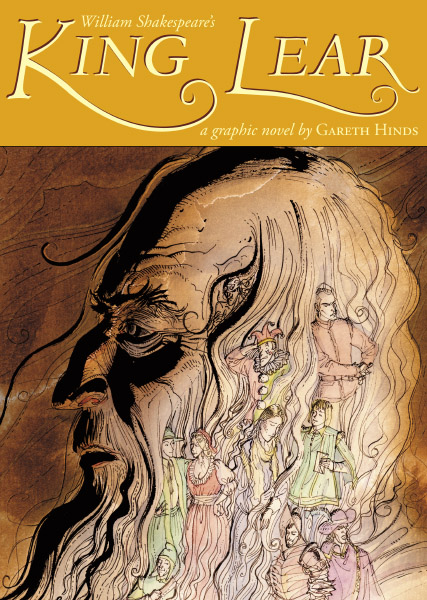
But in the name of previewing some literature for the older kids, I gave myself a novel break to read a graphic version of King Lear by Gareth Hinds and Persepolis by Marjane Satrapi. And I think I can make an argument that both of these “novels” are a kind of lectio divina.
Lear needs no excuse. Hinds retains Shakespeare’s language but places it in word bubbles above sketchy drawings of the main players. In the interest of space and illustration a couple minor characters and a few speeches were cut, but I was happy – excited even – with the book. I’ve been trying to get my older boys to read a few classics in between homework, practices, and ipods, and this was a great intro to Lear, if they can’t see it performed. The illustrations give expression to lines that might be difficult to interpret on a page of text. And it was easy to keep track of who is who. Some of the subplots between the brother-in-laws were still a little confusing to the boys, but the duplicity of Regan and Goneril was obvious. And the tragedy of Lear’s descent and the blinding of Gloucester were movingly conveyed by the illustrations. But of course the real power is Shakespeare’s wordsmithery. I had forgotten how despicable Regan and Goneril are in their grasping for Edmund, and how tragic the ending is. Shakes lets you believe that Lear and Cordelia might survive, that good will win out in the end, but then kills off the characters who could redeem the treachery.
Here you have food for meditation on the nature of parental duty, on aging and death, on loyalty and truth, on the brevity of life and what makes it worth living. And Shakespeare makes it all seem so dramatic and important – and beautiful - as if all of life were concerned with these Big Topics. Hinds's illustrations don't distract from all that.
Persepolis is quite a different creation, but it also set my head spinning. Its form is more like a traditional comic book: black and white drawings in little squares for distinct actions and conversations. But this story of a 12 year old girl living in Iran in 1979-1980 is incredibly moving. Genre-wise, it’s really a memoir, not a novel, but the form removes what could come across as melodrama in a traditional memoir.

The story reminds me a little of Reading Lolita in Tehran. An educated family in Iran is thrilled when the government is overthrown, but then overcome with disbelief at the fundamentalism of the Shah. Why don't they leave? It’s a topic that fascinates: how does such an evil regime come into being? Why do people accept the dictator’s decrees? They live in fear because their friends and relations are killed off.
But Marji retains a spunky, free-thinking attitude. She wears tight jeans under her burkha. She sasses her teachers. She questions the propaganda. Her parents are upper-class, communist-leaning, idealists who believe the regime is going to get better. But it doesn’t. Arrests, death, and exile follow
.
Both of these books raise the question of whether a graphic form traditionally used by “comic” books is effective for tragedies. I suppose you could argue whether Persepolis is by classical definition a tragedy or not, since Marji escapes the country and flourishes in France, but she loses her family and her homeland, along with whatever innocence she had when the Shah takes over.
I lay down in bed after finishing the book with my mind replaying the events in the life of Marji’s family and thinking about the tumultuous experiences of the people of the Middle East today. We have it so good; we are so blessed. But how easily it could all be lost. The news is often grim – and here we are on an island much closer to places like North Korea that could easily erupt into violence. But these stories of perseverance in the face of tragedy provide hope at the same time that they taunt “this could be you. . . . What are you doing to help?”


2 comments:
I've had Persepolis sitting here for awhile. I think it's time to read it.
Oh, also, did you leave "On Beauty" at Mom's or did you take it with you? Can't find it.
Persepolis is well worth the time - one hour or two or three? I lost track of time while reading it.
"On Beauty," on the other hand, despite the tempting title, I couldn't finish. I didn't take it, so it must still be at Mom's. I hope I didn't leave it at the lake.
Post a Comment