To be honest, I don't think I've ever read the whole of this novel before, although I thought at first I was rereading. I remember reading part of it years ago - high school, college? - and not finishing. Then I watched the movie that came out in 1999 directed by Patricia Rozema. Mistake. This movie is takes egregious liberties with the original work, and gave me a mistaken impression. I should have known the film was derivative, but in my mind I had this feeling that Mansfield Park was the "dark" Jane Austen. The characters may not be as engaging as the Bennets and the Dashwoods, and the plot a little thinner, but I'm glad I finally read it instead of thinking I knew the story from the film. It pays to read first, watch second. I kept waiting for the dark secrets suggested in the movie to come to light in the book. Of course, they never appeared.
So why do filmmakers feel it necessary to add drama and darkness to a book that is enjoyable enough without the suggestion of perversity? Would modern audiences really be bored with the story the way Austen tells it?
Surely the scriptwriters are mistaken that audiences want darkness. Judging by what I've read in response to some of the events on Downton Abbey, viewers would be happier if the scandals and surprises were toned down. The acting, dialogue, and cinematography are gripping enough without the writers needing to go to great lengths to keep the viewers in emotional turmoil. In fact, I haven't been watching because I read some spoilers and didn't want to be strung along for weeks waiting for resolutions. I'd be a bigger fan of Downton if the writers DIDN'T sensationalize the script.
Likewise, Austen's book needs very little drama to be intensely readable. Her characters and dialogue are interesting enough without excessive plotting. There's drama in reading about Fanny Price's emotional maturing. The suspense of wondering whether Edmund Bertram will have his eyes opened or whether Henry Crawford truly has turned a corner keeps you page turning. Austen adds more suspense by developing her characters enough to keep you wondering whether Fanny's judgment regarding Mary Crawford's shallowness and Henry's flirtatious nature is just. Their character flaws are masked by attractive characteristics: they're entertaining, they show compassion, they seem to do the right thing most of the time, they bring a spark of life to the party - all the things that make them easy to love, especially when countered with the sometimes dull life of the estate. It's just that every once in a while they reveal a shallowness and selfishness that will probably grow over time instead of lessen. Austen had me wondering if Fanny's goodness could make Henry into a good person, even though I knew the end of the story - would he really give up his careless flirtations if he were wed to just the right person?
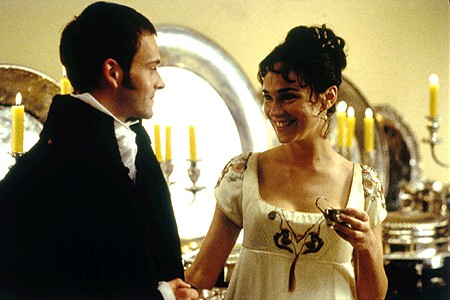
Meanwhile in the movie, the characters experience little interior change. Drama is provided by Sir Thomas' involvement in the slave trade and the suggestion that he behaved criminally to his chattel. Where Austen suggests immoral behavior on the part of Maria Bertram and Henry, the movie shows it. Fanny is more independent and energetic in the film than in the book. (Perhaps one change that I don't disagree with - Fanny in the book is extremely shy and unhealthy in the beginning. Does she not translate to the screen well as a heroine because she is too good?) And the filmmakers exaggerate all the flaws of the Bertram women to make them less likable - which highlights Fanny's attractiveness. Lady Bertram appears as a drug addict. The sisters are hateful to Fanny. Tom, the older brother, is a gambler and spendthrift. And you can see Maria and Henry plotting. It's almost too obvious what will happen. But I have to admit, the movie is easy to watch - great acting, beautiful scenery and costumes, good chemistry. It's just not Jane Austen's book.


1 comment:
The comparison of books and their movies is something I read about this week here http://www.touchstonemag.com/archives/article.php?id=26-06-014-v , in an article about why Peter Jackson fails to convey Tolkien's vision, especially as expressed in his characters. I had already been thinking about how filmmakers are artists, too, and have to create their own unique work, even when they are supposedly using another artist's story and character's for the basis. It can't help but be interpretive -- and as the author of the article I read points out, moderns rarely have the wisdom and understanding to produce anything like the great writers we are talking about.
I think it is Mansfield Park that my daughter said is her favorite Austen novel, but I have never read it. After your review I think I would like to give it a try, and I'm pretty sure I haven't seen the movie, either, so I appreciate the heads-up about that.
Post a Comment