Tuesday, November 8, 2011

Proof of the Power of Positive Thinking?


There’s a facebook post going around that shows two photos: one of soldiers from WWII, and the other of Occupy Wall Street protestors.  The caption is something about how 20 yr olds in 1944 gave everything while 20 yr olds in 2011 want everything. It stood out to me because I just read a book about a WWII soldier and the nature of survival. I don’t care much about the Occupy Wall Street movement, because I don't understand what they want, and I don't think they do either, but I wonder if the perseverance of the protesters isn’t due so much to their dedication to the cause, as to the euphoria of hanging out together.  There’s a lot you can withstand when someone else is going through it with you.

Hence, I attend book clubs.  I like hanging out.  Usually the talk at the officer spouses’ club book group centers around upcoming events, the pros and cons of different duty stations, comparing lists of who knows whom, etc.  We might talk briefly about the book, especially if there’s a movie version.  But book talk usually expires quickly. Either people don’t read the book, or they share the same opinions of it or are afraid to voice a contrarian position.

Surprisingly, the talk at the first meeting of the book club here really stayed on topic – even despite the fact that there was delicious food to yum over.  Nearly everyone read the book, which also helped.

The book indirectly talks about the importance of camaderie for survival. It was Laura Hillenbrand’s Unbroken: A World War II Story of Survival, Resilience, and Redemption, the story of World War II survivor Louis Zamperini. The Wall Street Journal had run a big review when it was came out, but the review focused on the contrast between the author’s Chronic Fatigue Syndrome and her subject’s indefatiguable spirit.  Louis Zamperini is now an active 94, which is pretty incredible, considering what he withstood as a 20something.

I don’t usually pick up historical biographies, so I don’t know how this book compares to others, but it provides great fodder for conversation.  Is that because of Hillenbrand’s writing or Zamperini’s life? He did lead an incredible life, and he survived horrendous suffering during WWII.  But I’m sure there are other lives just as miraculous – in fact Hillenbrand notes several unpublished memoirs sent to her by other soldiers which she consulted for details about the Japanese prisoner of war camps and about the Army Air Force of which Zamperini was a member, as well as other information about experiences of war. Their stories are probably just as interesting.

Part of what we found interesting in discussion about Zamperini was his change from a rebellious teen to Olympic runner to airplane bombardier to prisoner of war, then alcoholic and, finally, convert.  He went from hopelessness to glory, back to hopelessness and to, hopefully, final glory.  Growing up in depression era Southern California, he stole and fought and ran around like a hooligan. Wait, he was a hooligan. His brother finally talked him into running track, which he did first to attract girls and then because he was good.  His training for the Olympics was amazingly brief, proof of his natural talent. He qualified for the 1936 Olympics in his third 5000m race, even though he was a miler at heart.  A favorite scene for me was when the Notre Dame coach came to Zamperini to wish him good luck. Six(ty) degrees of separation?  

When Pearl Harbor was bombed he joined the air corps, and survived several missions, before the plane he was on went down while on a rescue mission.  Miraculously, he and two other men survived the crash and then lived for 47 days in the life raft, without any stores of food or water. Think Life of Pi, which I thought incredible, until reading this.  One of the men dies, the one who was new to the plane crew, but Zamp and his best friend Phil keep each other alive, even battling sharks and fire from a Japanese plane.

They finally are rescued by the Japanese and taken to a war camp. Although they initially are nursed to semi-health, their POW experience goes from bad to worse.  The pictures in the book add to the drama.  Here are all these handsome young men who died.  The few POWs who survive the torture and deprivation narrowly escape annihilation when the war ends.

So the question debated was how did they survive?  Did Louis Zamperini have special physical and mental gifts that enabled him to overcome the suffering and setbacks he experienced, or did he channel an inherent ability to survive and remain positive that everyone possesses, although many people don’t use it?

One of the wives, who has overcome a snake phobia and taken up triathlons after being a lifelong coach potato was convinced that will power was the answer. And she believes that everyone could do more for themselves just by making up their minds to do it.

It’s an interesting question.  I wanted to agree with her. And I do, sort of.  People DON’t exercise their wills – or their bodies – nearly as much as they should or can.  I definitely agree that most people give up much too easily, not on life per se, but on exercise programs, reading, name your self-improvement program. I know I’m guilty of making resolution after resolution that I don’t follow through on just because I’m lazy and selfish. (Heck, I felt like I was going to expire from endless waiting at the DMV the other day. Torture!)

But I’ve also seen that it’s possible to decide to do something and do it, even though you think you may not be able to. Running a marathon for instance, or even just running a 5K.  Running a mile for some people. A person of average health should be able to will themselves to run a mile.

There are a lot of things that sound overwhelming, but can be accomplished simply by doing and not overthinking.  Learning a language. Moving is another one. Traveling with kids.  Cooking dinner.  Fixing a toilet flusher.  Waiting in line.

The lady who had the irrational phobia of snakes wasn't even able to go outside in snake season, from the time she was little. When she found out she was coming to Guam, she had to make herself look at snakes so that she wouldn’t be afraid to go outside. She went to see a therapist, but he wanted to talk about dreams, so she made up her own program to gradually get used to looking at snakes, including watching a snake show on tv, which she wasn’t able to do before, and buying a toy snake.

I tend to be skeptic about therapists.  Could people who are depressed cure themselves by getting outside and doing some hard labor, so they stop thinking about how bad life is?  Someone mentioned that the new thing is to tell returning soldiers that they shouldn’t accept a diagnosis of PTSD as a label because then they will allow themselves to use it as a crutch or an excuse to avoid change and responsibility. Could the same be said of some people who are diagnosed with depression, or, as Laura Hillenbrand was, with chronic fatigue symptom, or other disorders that are difficult to pinpoint physically?

Even though I agree to an extent with the lady who thought people hold the power of change in their mind, I tend to think that that there are people who are just wired differently.  The guy who dies in the boat when Zamp and Phil survive may have been one of them. Maybe he let himself die because he felt guilty about eating the one chocolate bar they possessed, or because he didn’t share the connection that the other two had. Maybe his will was weak, but maybe he just didn’t have a temperament that allowed him to stay focused on living.

Of course, men of all types of personalities survived the POW camps, despite sickness, beatings and deprivation.  Did Louis have an even stronger constitution to withstand the extra beatings he receives because he was an Olympic runner, or did he simply will himself to stay alive?

Can someone train themselves to be more positive? Can someone change their temperament through will and practice? 

The example that came up was the Navy wife who never is happy where she is stationed, versus those who make the best of it, who make friends and explore. In a way this is a question of survival.  If you don’t have a choice to pick up and move across the country or across the world, you do have a choice whether to enjoy it, or to be miserable thinking that everything is better somewhere else.

I like to pride myself on my endurance and tolerance for pain.  I can run and run and run. I can drag children across the world.  I can push six kids through a tiny hole into the world without pain killers and drag them in and out of ER’s and temper tantrums.  But could I survive the privations that Louis undergoes? Could I beat back sharks and catch and kill an albatross and eat it raw?  Could I stand up under repeating beatings and punishments while suffering from dysentery and starvation?  Then overcome alcoholism and flashbacks in a single conversion moment? Is that a miracle? Was Louis Zamperini given extra gifts from God, or was he just good at using the gifts God gave him?

Sunday, November 6, 2011

Adventures with Tofu

As I showed my ID to the checker at the commissary last week, she announced, “Cases of tofu for $1.”  Behind her on a flat were about two dozen cases of tofu. 

I had passed by and was headed to the produce section before what she said registered.

Cases for $1.

I don’t have any love for tofu. Does anyone? I knew what my husband would say when he saw 12 packages of tofu in the refrigerator. But $1!?!

No one else was picking them up, so in an effort to be a good steward and help the commissary dispose of their overstock, I added a case to my cart.

It has been well worth $1 to experiment with this gelatinous soybean product.  The first package went into a traditional stir-fry: frozen mixed vegetables, soy sauce, sesame oil, chunks of tofu. Everyone complained, but they ate it, albeit reluctantly.

The second box went into a smoothie: frozen mixed fruit, milk, OJ, tofu, a couple packs of stevia.  My teenagers and their friend sucked them down. I didn’t tell them until later what was in them.  At first my 14 yr old berated me for hoodwinking them, but I tried to remind him that tofu is good for building muscles.

Another box got mixed into a batch of chili. I thought the tofu would take on the color of the tomato sauce, but it stayed whitish. So I told the kids those white chunks were like pieces of cheese.  The 5 and 7 yr olds were deceived, and the older kids kept the silence because they were hungry and the tofu was in small enough chunks not to be noticed.

Box 4 went into chocolate mousse.  I loosely followed a recipe my vegetarian friend gave me after I gave her 5 boxes of tofu.  And actually, this mousse is pretty tasty and a nice texture. And easy! Melt chocolate chips and then add melted chocolate, the tofu, a couple tablespoons of cocoa to the blender with a sweetener and blend until smooth and fluffy. Then chill a couple hours before devouring. The recipe calls for maple syrup, but I didn’t have any. I thought it would be ruining the integrity of the tofu to use corn syrup, so I used my last teaspoon of honey, a little molasses and some stevia packets. Unfortunately, the molasses taste is noticeable, but not enough to slow anyone down from eating this fluffy stuff. I can barely call it dessert. It’s nutritious!

So now I’m down to my last couple packets of tofu.  At least one will go into another smoothie tomorrow afternoon.  Suggestions for the last box?

Thursday, November 3, 2011

Stepping back in time

My son stood over my shoulder while I was typing this, and asked what I was writing. "Is that a book report?" he asked. Of a sort, I replied. 
"You're writing a book report because you want to?!" He spoke with disbelief.
Dear son, maybe someday you'll read books you want to talk about, too. 
*******
The library on base is a step back in time – not just because it shelves histories, but in the use of the card catalog, the date stamp, the way they manually check out books by signing your name on a card.
It also has a nice collection of classics in heavy duty binding left over from the 1960s – and before.  The materialistic bibliophile in me loves the heavy paper stock that is imprinted by the type, the musty smells, the indestructible covers, the black and white illustrations.  Gotta love the substance in these books too. Just finished two – one that I read in high school: Goodbye, Mr. Chips by James Hilton, and one I just saw mention of somewhere: Mrs. Mike by Benedict and Nancy Freedman.
Both of these books would send someone who deplores the reek of sentimentality running. Goodbye, Mr. Chips makes a lot of lists of classics, but I hadn’t heard of Mrs. Mike, and maybe I dreamed about reading a review of it because I can't find it now. (It is here!) But sometimes sentimental is what you’re in the mood for: a good story about good people told cheerfully. No Oprah Book Club melodrama. Just happy tales that both happen to hit on a similar theme: that suffering is not something to be avoided, but something that makes you who you are.
I won’t rehash Mr. Chips, since the story is familiar. When I initially read it, it fueled my desire to experience British boarding school – the kind of desire that I suppose is now initiated by Harry Potter books.  But I remembered little about Mr. Chips the man, and what a good sort he was, despite being a bit mundane.  He recognizes that the kind of greatness he can achieve, a minimal kind but something nonetheless, requires faithfulness in the little things: having students over for tea, eating with the faculty, doing your job as well as possible, even if not in a flashy way.
All with a good sense of humor.
Although his life is quiet, Mr. Chips is not without his tragedy: the loss of his wife and child.  Perhaps if Mrs. Chipping had lived, Mr. C might have been an even better man. But even in the brief time she shared with Mr. C and the academy, she changed him, and some of the other faculty.  Her death could have derailed him. The death of all his students in the wars could have demoralized him.  The attempt of a young headmaster to fire him could have doused his spirit. But he perseveres in being the kind of man he is, nothing more, nothing less.  And he is loved for it.  (Which is similar theme #2: people have more effect on your life than you realize even if you only meet them briefly.)
While many people apparently believed the imagined Mr. Chipping was a real person, Mrs. Mike, Katherine Mary Flannigan, actually was a real girl, even though I initially thought she was pure fiction.  I googled the book to see where I came across the reference (and didn’t find it), but I found a few testimonies about how beloved this book was by women of a certain age. Apparently, it has had a resurgence of interest with the advent of internet recommendations, and has had a reprinting.
Maybe the book isn’t first class literature, but I will add my name to its list of fans.  The story is episodic, like a Little House book for grownups, or a teenaged Caddie Woodlawn set in Canada. But the effect is that all the episodes add up to make you feel like you’ve been in northern Canada yourself. I think I could begin to understand Cree.  I had to sit in the car an extra fifteen minutes after soccer practice yesterday to finish it. And then I wanted to go back and reread the best parts. 
Initially, I thought that Mrs. Mike – Kathy - was too obvious and too chipper.  She’s a spunky Irish lass sent to her uncle in Canada to recover from pleurisy. She meets a handsome Mountie named Mike Flannigan, and falls in love with him while pretending to disdain his flirtations.  Within weeks they are married, surprisingly quickly considering she’s only sixteen. And right after their wedding they head up to the uncivilized north to Mike’s station.  It happens so fast, you almost forget to think how unlikely that should be.


But as impetuous as her decision to marry and follow Mike Flannigan is, Kathy is steadfast in her love.  If initially, she is all cheer and good humor at the beauty she sees all around, she begins to notice the ugliness: mad women sent away, dead men in the snow, Indian women called “klooches”  beaten and berated.  Her husband Mike is a realist, and where she sees injustice, he sees why the women stay around.  He intuits honesty and dishonesty in the people who come to him to arbitrate their disputes.  He doesn’t fear doing his duty, whether it be pulling a tooth, fighting a fire, or sawing off a leg.

As Kathy grows into adulthood, her innocent idealism fades away, and she becomes more interesting. The struggles she experiences and witnesses become more poignant, and Kathy becomes more dimensional.  She meets another white woman whose children keep dying.  Kathy calls her “a mother of sorrows.” But the woman remains unbroken.  

Kathy also realizes that the Native women are not all abused.  She takes in a young girl from the mission orphanage, and promises the nuns that she will keep the girl safe from a young halfbreed, Jonathan, who is in love with her.  The young man is the son of a rebellious father, and he has run-ins with the law. But as Kathy and Mike learn about his background and his character, they realize he values honor and dignity, especially after he takes the blame for a murder that a mad woman committed, rather than put her in trouble and defend himself.  Eventually, Kathy understands why her young friend, Mamanowatum, or “Oh-Be-Joyful,” is in love with the young man, and she allows them the freedom of belonging to each other.

Kathy suffers her own tragedies, and even at one point leaves Mike.  So although the book starts out with the two of them so happily married and so perfectly suited to each other, and it seems that it will simply recount their adventures, it does take a dark turn.  Sorrow drives the two of them apart, and Kathy goes back to her mother.  But she realizes she doesn’t fit in city life anymore.  The insignificance of some of the arguments she witnesses between her mother’s boarders amaze her. Their pettiness seems pale beside the disease and destruction she has experiences. She realizes she has grown to love the north, and has become a different person, one who can’t run away from her sorrows, and so she returns.

The book ends on a hopeful note, of course. Jonathan reappears at the end of the book, bringing the sorrowful news that Mamanowatum has died.  He brings their baby to Kathy and Mike to raise. The mother had named the baby Kathy, after her “almost-sister,” even though they hadn’t seen each other for 8 years.  Kathy welcomes the baby, but mourns her friend, especially since her other friend has also just died.  She contemplates how their lives have intersected, even when they weren’t in communication. “You could see that events were like the people they happened to. Oh-Be-Joyful’s life had always had that intense emotion and pathetic grasping after happiness that my mother said was characteristic of those ‘who are not long for this world.’ Perhaps on another day I would laugh at this and consider it superstition, but this day, watching Oh-Be-Joyful’s baby in Mike’s arms, I saw the pattern too. . . . Oh-Be-Joyful had cared for and loved my children, and now it was I who was to care for and lover hers. Mike was right: the pattern of a life isn’t a straight line; it crosses and recrosses, drawing in and tying together other lives, as I do when I gather in the ends of my thread to make a knot.”    

Kathy realizes that even though she has suffered much, she has also had great joy, even if just for a little while. And the remembering of those pleasures, especially of her lost children, brings more pleasure than pain.

To be honest, maybe the reason I loved this book is that it is so easy to identify with Kathy: marry young and idealistic, take off on an adventure, meet with hardship, but recognize the heavier suffering that so many others have, meet people you grow to love, lose them, feel like throwing in the towel, but finally realize that all these experiences are fitting into a pattern that is more amazing than can be predicted, even if the book is predictable like the happy ending we all hope for.

Monday, October 31, 2011

Sunday, October 30, 2011

Spooky things

Halloween is creeping up, and I’m afraid my 7 year old is going to collapse from nervous excitement before it gets here. Every day he has a different costume idea.  Every day he is jumping around in the persona of some superhero or another.  I’m about ready to ban him from trick or treating, so that the hyperactivity can simmer down without being fed candy.

If there were a reason to ban trick or treating in our family it would be this craziness both before and after the main trick or treating event. Plus, my kids have bad teeth already.  But I'm not going to ban trick or treating, because I'm feeling defensive of Halloween lately, after hearing attacks on it from some of our new home schooling acquaintances. Since we’ve resumed homeschooling, we have fallen in with some evangelical families. Just like some of the families we knew in Virginia, these families don’t do Halloween. They have Harvest fests and chili suppers (some of our friends in VA had a Reformation Party to mark Luther’s nailing of the 95 theses on October 31), but no scary costumes, no skeletons, no bloody props.  At the Christian bookstore I peeked into the other day, looking for secondhand home school stuff, I was offered a tract called “Say no to Halloween.” I didn’t take it, or I’d quote it. (A p.s: Melanie of Wine Dark Sea shared this link about the problems with celebrating Reformation Day.)

I don’t have any great love for Halloween. Theoretically, I'm opposed to all the sugar and artificial colorings, but in practice I have a hard time staying out of the goodie bags. I don’t love really gory displays of dismembered corpses and scary clowns that some neighbors set up for decorations, but I can't help driving by and recognizing in myself that perverse urge to scare the kids like my dad used to do when he would drive by old cemeteries and slow down, telling us to look out for ghosts or men with iron hooks for hands. I get tired of listening to my kids whine and beg for costumes and décor and candy.  But I like the chance to visit with the neighbors.

I’m sorry I’m not more confrontational sometimes.  I should just speak up when I'm told that Halloween is pagan, and say that we are celebrating Halloween because of All Saint’s Day (although my kids are in it for the candy).  Do I need to reply that the dates chosen for Christmas and Easter also coincided with pagan celebrations?   I was happy to see in our diocesan paper a short defense of Halloween.  I suppose the author also received one of the tracts.

It is disconcerting to be warned about the potentially detrimental effect on the soul that dressing like a mummy and pretending to be a witch can have.  Costumes and decorations have become more gory and scary. But are kids really welcoming the occult - or do they just want to impress their friends and get the most candy.?


I don’t remember anyone being against Halloween when we were growing up. On the other hand, we didn’t see as many gory or skanky costumes either.  We dressed up as things like hobos, old ladies, gypsies, and baseball players because we could put those costumes together with odds and ends that were lying around the house.  My mom didn’t have time to sew after we hit and certain age, and costumes at the store were cheapy plastic, and mostly characters from Star Wars. One year my friends and I got creative and wore garbage bags and said we were the California Raisins.  The scariest costume I ever wore was a black get-up with my hair ratted and my face powdered white.  I was Death, and my friend, dressed in a thrift shop bride dress, was The Maiden.  I guess since she came up with the idea, she got to be the pretty one.


What I wonder is if the explosion of Halloween commercialism, including the increased gore factor, is what really started the evangelical humbug about Halloween.  Or maybe their voices were out there, but there just weren’t enough of them to be heard back when I was growing up.


It would be nice if the commercialism would die back a bit.  I’m not going to buy lawn décor for Halloween, and as a matter of stubborn pride, I don’t like to buy costumes, except the occasional prop.  I'd be happy to boycott sexy costumes for preteen girls.  And 20-something guys who dress up as mass murderers are definitely creepy. 

But I like sitting out in the driveway with the neighbors, adult beverages discreetly poured into plastic cups, comparing notes on the best get-ups. I applaud the parents who dress up with their kids, although I’m not going to do it myself.  I’m happy to give an extra handful of candy to kids who show some creativity and dress as “cereal” killers and million dollar bills. 

The Halloween party poopers are right to notice that there are some really scary people and things out in the world, but trick-or-treaters don’t really qualify, do they?  Especially if they get a lesson in sharing their candy (or paying their taxes, as I like to call my share of their collection), and then get hauled off to a Mass and a cemetery the next day in honor of the feasts of All Saints and All Souls. Maybe if more Catholics, including myself, were a little better about pointing out the connection between the celebration and the solemnity that follows, those little Ban Halloween tracts wouldn’t be making the rounds.

Friday, October 28, 2011

Briefly noted

Some Halloween fun: a Chamorro ghost tale about the Taotaomo'na. The new spin in this story is that it hunts out foreigners. What we've been told and read in our Folk Legends of the Marianas Islands book is that this spirit protects the woods.  One story is that if you want to see one, you rub dog doo in your eye.  If you don't want to see one, you let the steam from rice come in your face.  They don't like perfume, and if you do something they don't like, they pinch your arm hard enough to leave a bruise. Someone else said you have to ask the taotaomo'na permission before peeing in the forest. Or at least say "Excuse me."

A video of Guam. Not sure why the reverse footage is included.  Both of these works I found on the website of the University of Guam's student newspaper, Triton's Call. But for mi familia, this is what we're looking at.


For those of you who have heard that the brown tree snake is a problem here (they have decimated the bird population, including the flightless koko bird.), here's a photo to show that the boys are doing their part to rid the island of these imported pests.. Just helping out the USDA which is paying big bucks to trap them with mice in little cages.


This is my friend the cane toad, another foreigner.  Taotaomo'na doesn't need to pinch him because his relatives are squashed all over the roads. We've been having great lessons in anatomy from the roadkill. 


Does this count as school work? I sort feel extra credit is due to the 7 year old for the artistic photography.


Below, another son hard at work at homework, beneath his father's handiwork: lofts a step above college dorm room quality.


We recently puppy-sat for this little poodle.  I have harbored prejudices against poodles, a prejudice rooted in my family's deep suspicion of small dogs.  But this little guy was awfully lovable. He hasn't replaced our labrador in my heart, but we all felt a little bereft when his owners came home and took him back. It was gratifying when we saw him on a walk the other day, and he scrambled over in excitement to see me. I was glad he didn't puddle on my shoe.


Although this is more than seven quick takes, here is another attempt at catching the sunset from across our front yard:


See Jen at www.conversiondiary.com for more.


Thursday, October 27, 2011

Not that far away

News travels slowly here.  NPR only broadcasts briefly, our Wall Street Journal subscription was too expensive to forward, I can’t seem to stay awake for the news on TV. I know, it’s all on the internet, but I only catch glimpses of it. 

And I did catch a glimpse of the news about Kadhafi’s capture and death.  I wish I could feel more of a sense of victory but after Bin Laden’s death brought little change, it seems precipitous to hope that change for Libya is coming.  Kadhafi’s successor might be a worse despot. The regime change in Egypt, too, seems to be even less tolerant of Christianity.  The persecutions of Christians in the Middle East seem far away.

But after reading Persepolis, a graphic novel about a young girl experiencing the tumult of the Shah of Iran’s rise to power in 1980, these events seem closer.

After the moral soul scrubbing of reading Deep Conversion, Deep Prayer, I meant to stay away from novels for a bit while I worked on that weak will problem.  I went back the A Mother’s Rule of Life, which rubbed me the wrong way when I first read it, and braced myself to make a schedule and to again rededicate myself to setting priorities, like going to bed at a decent hour instead of staying up late reading.  With homeschooling, I have more time for prayer with the kids and more motivation to stick to a schedule, but I also have a greater temptation to give myself chocolate+coffee breaks and social media breaks and turning off the brain breaks. Then suddenly it’s time to run to soccer practice, and the kitchen’s a disaster, and nothing is planned for dinner. 

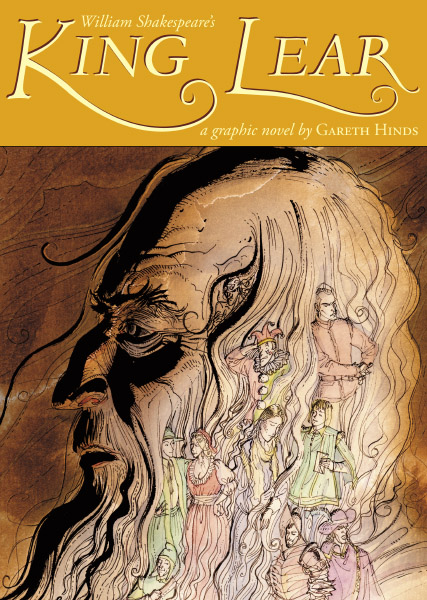
But in the name of previewing some literature for the older kids, I gave myself a novel break to read a graphic version of King Lear by Gareth Hinds and Persepolis by Marjane Satrapi. And I think I can make an argument that both of these “novels” are a kind of lectio divina. 

Lear needs no excuse. Hinds retains Shakespeare’s language but places it in word bubbles above sketchy drawings of the main players. In the interest of space and illustration a couple minor characters and a few speeches were cut, but I was happy – excited even – with the book.  I’ve been trying to get my older boys to read a few classics in between homework, practices, and ipods, and this was a great intro to Lear, if they can’t see it performed. The illustrations give expression to lines that might be difficult to interpret on a page of text.  And it was easy to keep track of who is who.  Some of the subplots between the brother-in-laws were still a little confusing to the boys, but the duplicity of Regan and Goneril was obvious.  And the tragedy of Lear’s descent and the blinding of Gloucester were movingly conveyed by the illustrations.  But of course the real power is Shakespeare’s wordsmithery.  I had forgotten how despicable Regan and Goneril are in their grasping for Edmund, and how tragic the ending is. Shakes lets you believe that Lear and Cordelia might survive, that good will win out in the end, but then kills off the characters who could redeem the treachery.

Here you have food for meditation on the nature of parental duty, on aging and death, on loyalty and truth, on the brevity of life and what makes it worth living. And Shakespeare makes it all seem so dramatic and important – and beautiful - as if all of life were concerned with these Big Topics. Hinds's illustrations don't distract from all that.

Persepolis is quite a different creation, but it also set my head spinning. Its form is more like a traditional comic book: black and white drawings in little squares for distinct actions and conversations. But this story of a 12 year old girl living in Iran in 1979-1980 is incredibly moving.  Genre-wise, it’s really a memoir, not a novel, but the form removes what could come across as melodrama in a traditional memoir.


The story reminds me a little of Reading Lolita in Tehran.  An educated family in Iran is thrilled when the government is overthrown, but then overcome with disbelief at the fundamentalism of the Shah.  Why don't they leave? It’s a topic that fascinates: how does such an evil regime come into being? Why do people accept the dictator’s decrees? They live in fear because their friends and relations are killed off.

But Marji retains a spunky, free-thinking attitude. She wears tight jeans under her burkha. She sasses her teachers. She questions the propaganda.  Her parents are upper-class, communist-leaning, idealists who believe the regime is going to get better. But it doesn’t.  Arrests, death, and exile follow
.
Both of these books raise the question of whether a graphic form traditionally used by “comic” books is effective for tragedies.  I suppose you could argue whether Persepolis is by classical definition a tragedy or not, since Marji escapes the country and flourishes in France, but she loses her family and her homeland, along with whatever innocence she had when the Shah takes over.

I lay down in bed after finishing the book with my mind replaying the events in the life of Marji’s family and thinking about the tumultuous experiences of the people of the Middle East today.   We have it so good; we are so blessed.  But how easily it could all be lost.  The news is often grim – and here we are on an island much closer to places like North Korea that could easily erupt into violence.  But these stories of perseverance in the face of tragedy provide hope at the same time that they taunt “this could be you. . . . What are you doing to help?” 
Reading is one form of escape. Running for your life is another.
-Lemony Snicket