So my opinion of this long-awaited novel from acclaimed Mississippi novelist Donna Tartt?
It was gripping, it was large in scope, it had interesting themes. But it was relatively forgettable.
Is it because of the hype that I find myself slightly disappointed? Tartt's first novel The Secret History, read on the advice of Mrs. Darwin, was glued to my hands until I finished it. The Little Friend was not as memorable to me. In fact, maybe I didn't even read it. That's how memorable. But her fans have been waiting eleven years for a new novel, and this massive tome is sure to satisfy some readers who want something worth the wait and the $35 price tag. You get a lot of pages of reading per dollar (if you actually buy the book, rather than check it out at the library.)
But even after finishing 755 pages, I found myself wishing for more. Not more pages, but more within the pages. The story line is interesting: young boy, Theo, loses his mother in a bomb blast at the NY art museum (presumably the Met). When he comes to, a dying old man encourages him to take a valuable, rare painting and his ring to his friend. Theo stays with wealthy family friends and eventually meets the old man's partner, an antiques restorer nicknamed Hobie. He returns the ring, but keeps the painting a secret. The rest of the novel follows Theo and the painting over the course of about 13 years.
Here's what I liked about the book: The writing is vivid. I can picture these places in New York, even though my acquaintance with the city is vague: a couple brief visits in college, a week's stay in Brooklyn. When Theo moves to Las Vegas to live with his father, I can picture the glare, the heat, the desolation. And Las Vegas is someplace I've never been and hope never to see, even more so after reading this book. It is a place of isolation and loneliness. The characters are interesting: Theo is smart, traumatized, suffering but persevering. His mother is beautiful, lonely, full of yearning for beauty. His father is lost, a gambler and alcoholic, anesthetizing the pain of broken dreams. Hobie is large, soulful, slow moving, but deep feeling. Pippa, the pale, red-headed girl Theo falls in love with at the museum, is frail and delicate, also a dreamer. Boris, the Russian/Polish drug addled friend who both saves and cheats Theo, is a unique blend of eastern European toughy, independent intellectual, thief, drug addict, sex-starved adolescent, and loyal friend. The Barbours, the wealthy family friends, are alienated and trapped by their social lives, but struggle to remain familial.
Despite being so vividly depicted and such interesting characters, I found myself wishing to know more about them. Since the point of view is exclusively Theo's, we don't get to learn what these characters are thinking. So they remain caricatures in a way. Maybe it's a strength of the book that Tartt makes me interested in these people. But I found myself more interested in them than in Theo, the main character. I got tired of the descriptions of drugs and drinking in the middle part of the book. The Las Vegas section is depressing and slogs along for pages. It does work to emphasize the alienation and desolation that these characters feel, but I was reading to skip ahead at one point to see if the book was worth finishing.
The attention to Theo's and Boris's drug use also takes away from the interesting relationships between Theo and Hobie and Pippa, and even Theo's relationship with the Barbours. Can Theo really risk throwing away the relationships offered by these people? I'm pretty innocent about drugs, so I found it hard to believe that Theo and Boris could take so many and drink so much vodka and still function. Poor Hobie gets taken advantage of and neglected and ignored. I found it hard to believe he could be so oblivious to Theo's obsessiveness over drugs and the painting.
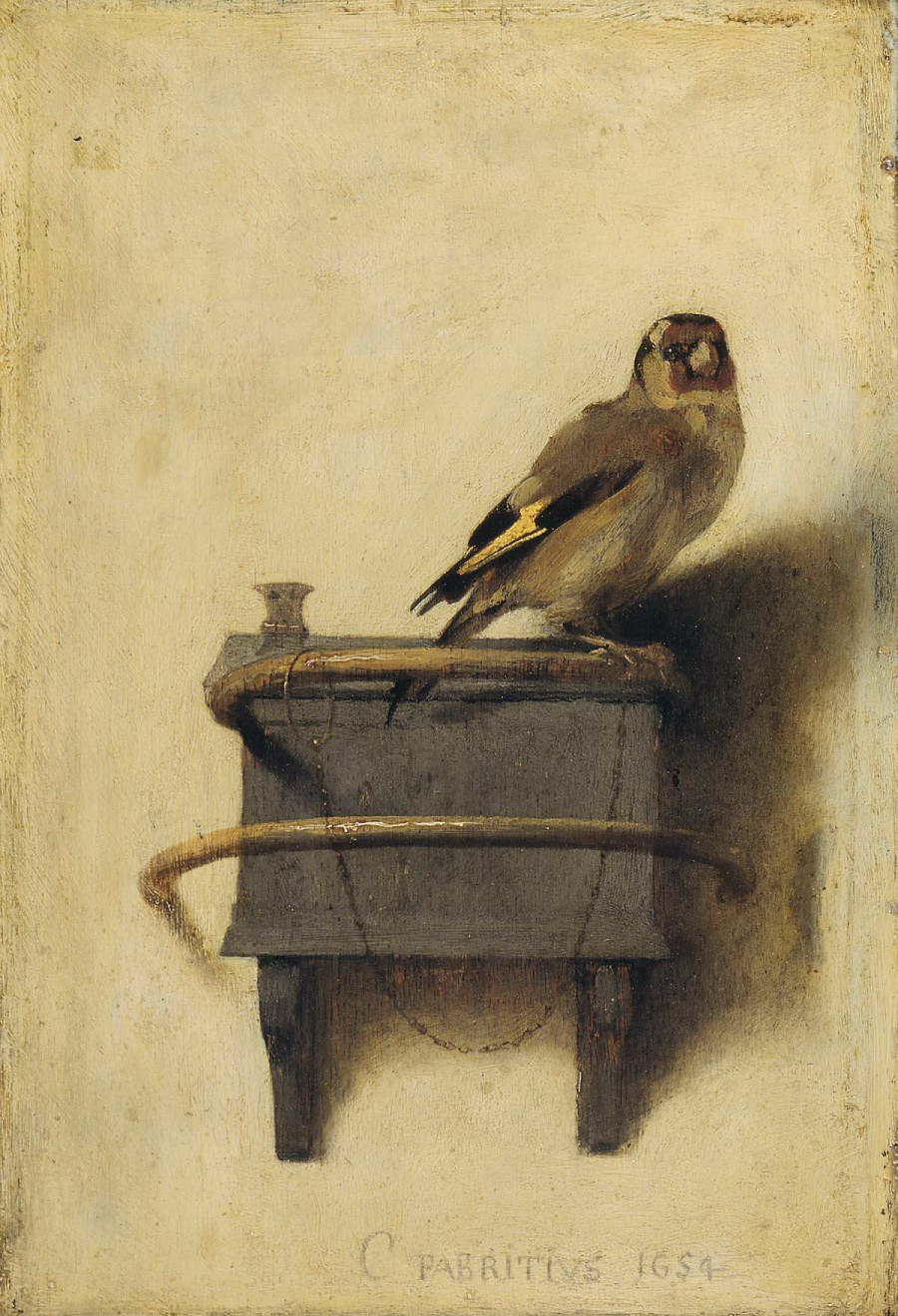
And the painting, "The Goldfinch," which is a real painting that was on display in a travelling exhibit at the Met around the time the book came out, doesn't get as much attention in the plot as I thought it might, until the end when everything kind of comes together. It is always on Theo's mind - he is afraid he is going to get caught for taking it, afraid someone is going to find it. But he rarely looks at it. His mind is obsessed about it, but it exists in the background. His mother's memory creeps forward more often. In a way, she plays a larger role than some of the other characters. Theo's memories of and love for his mother color his life much more than the painting or anything else except drugs. But he never seems to wonder what she would have thought about who he was becoming.
The book does have interesting themes: memory and loss, familial relationships and friendships, alienation and isolation, coming of age, the power of images and objects and desire, the role of fate versus coincidence. In the last chapter, some of these ideas are directly addressed, whereas the mass of the novel is propelled by action and dialogue. For instance in a photograph of the old man Welty, Hobie's partner and Pippa's caretaker who died in the museum, Theo sees that "the painting, above his head, was the still point where it all hinged: dreams and signs, past and future, luck and fate. There wasn't a single meaning. There were many meanings. It was a riddle expanding out and out and out."
There's no answer to that riddle in the main part of the book, but in the last chapter Theo reflects on his life and ties a lot of the strings together. In a way, the last chapter feels a bit tacked on. Maybe I read too quickly so that I didn't catch some of these ideas while reading - my flaw or a flaw in the writing? So in the last few pages, Theo reflects on his life and his relationships. He recalls Hobie, the antiques restorer, saying, "Where's the nobility in patching up a bunch of old tables and chairs? Corrosive to the soul, quite possibly, I've seen too many estates not to know that. Idolatry! Caring too much for objects can destroy you. Only -- if you care for a thing enough, it takes on a life of its own, doesn't it? And isn't the whole point of things -- beautiful things -- that they connect you to some larger beauty? Those first images that crack your heart wide open and you spend the rest of you life chasing, or trying to recapture, in one way or another? Because, I mean -- mending old things, preserving them, looking after them -- on some level there's no rational grounds for it ..."
Is this what Theo is supposed to have learned in his years of hiding the painting? He also learns this: "From William Blake to Lady Gaga, from Rousseau to Rumi to Tosca to Mr. Rogers, it's a curiously uniform message, accepted from high to low: when in doubt, what to do? How do we know what's right for us? Every shrink, eevery career counselor, every Disney princess knows the answer: 'Be yourself.' 'Follow your heart.'
"Only here's what I really, really want someone to explain to me. What if one happens to be possessed of a heart that can't be trusted--? what if the heart, for its own unfathomable reasons, leads one willfully and in a cloud of unspeakable radiance, away from health, domesticity, civic responsibility and strong social connections and all the blandly-held common virtues and instead straight towards a beautiful flare of ruin, self-immolation, disaster? Is Kitsey right? If your deepest self is singing and coaxing you straight toward the bonfire, is it better to turn away? Stop your ears with wax? Ignore all the perverse glory your heart is screaming at you? Set yourself on the course that will lead you dutifully towards the norm, reasonable hours and regular medical check -ups, stable relationships and steady career advancement, the New York Times and brunch on Sunday, all with the promise of being somehow a better person? Or -- like Boris -- is it better to throw yourself head first and laughing into the holy rage calling your name?
"It's not about outward appearances but inward significance. A grandeur in the world, but not of the world, a grandeur that the world doesn't understand. That first glimpse of pure otherness, in whose presence you bloom out and out and out.
"A self one does not want. A heart one cannot help."
The painting is what defines Theo: his secret grandeur. He keeps it hidden as he falls into the pit of darkness with Boris and then when he betrays Hobie, but it is his secret salvation, what makes him better than others and himself.
The small painting of a tiny, gold bird on a thin chain also symbolizes his soul: "mysterious ambiguous, inexplicable. . . . Glint of brightness on a barely-there chain. Patch of sunlight on a yellow wall. the loneliness that separates every living creature from every other living creature. Sorrow inseparable from joy."
But what he comes down to is that "life is a catastrophe. . . . For me -- and I'll keep repeating it doggedly till I die, till I fall over on my ungrateful nihilistic face and am too weak to say it: better never born, than born into this cesspool."
It is only something like the painting, that teaches Theo that people can speak to each other across time, that gives his life meaning. So he concludes the book with a direct address to the reader: "I feel I have something very serious and urgent to say to you, my non-existent reader, and I feel I should say it as urgently as if I were standing in the room with you. That life -- whatever else it is -- is short. That fate is cruel but maybe not random. That Nature (meaning Death) always wins but that doesn't mean we have to bow and grovel to it. That maybe even if we're not always so glad to be here, it's our task to immerse ourselves anyway: wade straight through it, right through the cesspool, while keeping eyes and hearts open. And in the mist of our dying, as we rise from the organic and sink back ignominiously into the organic, it is a glory and a privilege to love what Death doesn't touch. For if disaster and oblivion have followed this painting down through time -- so too has love. Insofar as it is immortal )and it is -- I have a small, bright, immutable part in that immortality. .. And I add my own love to the history of people who have loved beautiful things, and look out for them, and pulled them from the fire . . .singing out brilliantly from the wreck of time to the next generation of lovers, and the next."
Sort of a bleak image of life. And probably why I couldn't bring myself to love this book. An entertaining read, but the philosophical ideas fleshed out in the end didn't seem well developed in the text to me. Maybe I was a bad reader - blazing too quickly through the pages. But I can't think of any other passages that struck me with profundity until that last chapter, anything that I might have underlined if the book were mine. There are some creative descriptions and colorful characters, strong writing that makes the book very readable, just not much of a redemptive message to make it a particularly good book to read during Lent, although I suppose an argument could be made that it is an image of the Hell we make of life when we isolate ourselves, when we make escape and oblivion an answer to loneliness, when we don't notice all the suffering around us because we are absorbed in our own losses. Grasping what is beautiful and loving and protecting it is a better answer to the loneliness than indulging in despair, but wouldn't it be better to see the beauty in a soul?
I did a little searching around the internet for other reviews of this book, but most of what I found were articles about Donna Tartt herself and the excitement of her fans for this long-awaited book. I'd be interested to find out what others think of it, because I mistrust my own disappointment. Did I miss something? I guess I'm still waiting for the next great thing.


1 comment:
I've read The Secret History two or three times, and it's remained as fresh and vivid on re-reading as it was the first time. The Little Friend I couldn't get into -- it's on my shelf, but I've never picked it up after reading snippets over Darwin's shoulder on a plane ride. The Goldfinch I think I'll skip. One doesn't have the time for 755 pages which don't sing.
Post a Comment